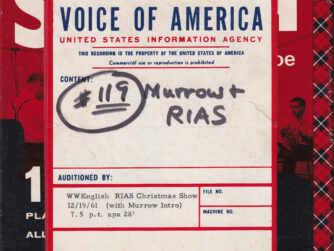


An early preserved recording documenting the program’s beginnings — and the later rise of Pat Gates as one of the Voice of America’s rare internationally recognized broadcasting personalities.
The Breakfast Show was a worldwide English-language morning program inaugurated by the Voice of America (VOA) in 1961. Produced in Washington, D.C., it combined international news reporting, cultural commentary, music, and feature segments for overseas audiences. The recording presented here is among the earliest preserved editions of the program and captures the broadcast at its institutional beginning.
The Cold War Radio Museum acquired a one-hour magnetic tape recording of the opening portion of The Breakfast Show broadcast of June 19, 1961 (approximately 1:00 a.m. to 3:30 a.m., Washington time). The seven-inch reel remains in its original Voice of America box marked “#138 FOR IGC – Mr. Plesent.” The notation suggests that the recording may have been retained for review by the General Counsel’s office of the United States Information Agency (USIA), which at the time oversaw VOA operations. Such internal recordings were commonly used for legal and policy compliance review, including copyright and statutory requirements.
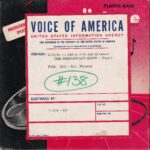
Recording One
Voice of America — The Breakfast Show — June 19, 1961 (Studio Recording)
This recording presents the opening portion of the Voice of America’s Breakfast Show broadcast of June 19, 1961. Unlike the later 1978 example that follows, this is a studio-quality archival recording preserved within VOA’s internal system.
The tape captures the program as it left the Washington, D.C. studios — before transmission, before atmospheric distortion, and before the signal traveled thousands of miles by shortwave. It allows us to hear the intended sound: clear microphone presence, newsroom pacing, controlled studio acoustics, and the structural rhythm of the program in its early institutional form.
For this archival presentation, music segments and portions of two short feature reports purchased by VOA from the U.S. privately owned National Broadcasting Company (NBC) have been removed for copyright reasons. All remaining spoken content — including both full news bulletins, continuity announcements, and promotional material — is presented as originally recorded. No additional enhancement, noise reduction, or equalization has been applied.
The purpose of preserving the audio in this form is documentary rather than aesthetic. What you hear is the sound of Voice of America as it existed at the source — a government broadcaster operating under the legal and institutional framework of the Cold War, transmitting primarily to audiences abroad under the 1948 Smith–Mundt Act restrictions of the period.
When compared with the second recording (April 1978), which survives as an off-air shortwave reception copy, this studio recording demonstrates the difference between production and reception. It reveals the clarity, tonal balance, and professional delivery that VOA intended international listeners to experience but knew that it could not achieve on shortwave.
The contrast between the two recordings illustrates an essential aspect of Cold War broadcasting: the message was crafted in the studio, but it was experienced through the unpredictable physics of shortwave transmission.
The portion of the broadcast preserved on this tape opens with host Albert Johnson introducing the program to listeners abroad, followed by a full studio newscast delivered by Edward Conley from the VOA newsroom in Washington. The bulletin presents major international developments of mid-1961 in the concise, wire-service style typical of the period. It includes the recovery of a Discoverer satellite capsule, a deadly train derailment in France, preliminary U.S.–Soviet disarmament talks, negotiations over Laos, arrests connected with bombings in the American West, developments in Singapore and Japan, reports from Tibet, and U.S. political and diplomatic news.
Among the individual items was a brief report from West Berlin quoting Willi Richter, head of the West German Trade Union Federation, who called for the right of self-determination for all Germans as a prerequisite to reunification. Richter stated that the continuing flow of refugees from East Germany to the West demonstrated that Walter Ulbricht’s regime maintained power through coercion. Broadcast in June 1961 — only weeks before the construction of the Berlin Wall — even such a short item would have carried particular resonance for listeners in East Germany and elsewhere in the Soviet Bloc.
Another item cited an assessment by the United States Information Agency that communist bloc nations had sharply intensified propaganda efforts in Latin America, Africa, and the Far East during the previous year. In Europe and the Middle East, the agency suggested, bloc activity appeared more defensive — a holding operation while attention shifted elsewhere. The inclusion of this item reflected the global framing of ideological competition characteristic of Cold War newscasts.
Audience survey results from 1977, later published by the U.S. International Communication Agency (USICA), showed that a majority of regular VOA listeners in urban Poland (57 percent) felt that VOA broadcast too little news about Poland. By contrast, 75 percent of Radio Free Europe listeners described RFE’s coverage of Polish news as “adequate.”1
At that time, the VOA Polish Service was required to translate and use news prepared by the central English-language newsroom and could not independently determine the lineup of major news items. Origination of separate Polish-language news reporting was permitted only in limited circumstances and generally required prior authorization. In practice, such authorization was seldom sought. VOA’s foreign-language services operated with limited staffing relative to the amount of airtime they were expected to fill, which made it structurally necessary to rely heavily on translation of English-language news and feature material.
The 1961 English-language newscast of The Breakfast Show contained no field reports by VOA correspondents and included no recorded voice actualities. All items were read from Washington in a formal, tightly controlled studio format. Institutional change at the Voice of America came slowly. A decade later, my future deputy chief in the Polish Service, Marek Walicki, and I observed that VOA newscasts still rarely included recorded reports from correspondents or on-the-scene audio — practices that had long been standard at Radio Free Europe.2
The 1961 Breakfast Show broadcast proceeded with additional studio-read news updates, promotional announcements, light cultural commentary, occasional attempts at humor, musical performances, and two short feature segments acquired from NBC.
It is possible that VOA management introduced The Breakfast Show as a more contemporary-sounding English-language program in anticipation of new leadership at the United States Information Agency. The distinguished CBS correspondent Edward R. Murrow was sworn in as USIA Director by President John F. Kennedy in the Oval Office on March 21, 1961. Murrow’s appointment signaled an intention to reinvigorate American public diplomacy at a critical early stage of the Kennedy administration.
Although Edward R. Murrow was a forceful critic of Senator Joseph McCarthy’s tactics in pursuing alleged — and by that time largely nonexistent — Communists within the U.S. government, he did not dismiss outright congressional investigations into programming and management deficiencies at the Voice of America.
In a CBS broadcast on February 20, 1953, Murrow referred to a VOA journalist who claimed that his scripts had been “watered down” by three employees whom he believed to be sympathetic to the Communist cause.3 Murrow himself was a resolute opponent of Communism and an outspoken critic of Stalin’s atrocities. He argued in his broadcast that if a Senate committee examined VOA scripts and found evidence of disloyalty or subversive intent, it should not be difficult to identify those responsible.4
In practice, however, the situation was more complex. Some individuals in VOA management during that period sought to avoid unnecessarily provoking U.S.–Soviet tensions — not out of disloyalty, but from a belief that a less confrontational tone might encourage gradual change within the Soviet system, which a few still regarded as reformable or historically progressive.
After assuming leadership of the United States Information Agency, Murrow moved in a different direction. He supported stronger, more direct programming critical of the Soviet Union and of the Castro regime in Cuba, reflecting his conviction that American international broadcasting should present a clear and confident defense of democratic values.5
Yet while VOA developed a more modern-sounding English-language program in The Breakfast Show — and later gained a distinctive on-air personality in Pat Gates — comparable changes did not occur in most foreign-language services during the 1960s and 1970s. Those services continued to rely heavily on translated material from the central English newsroom and had limited authority or resources to originate their own reporting.
Only during the Reagan administration did the Polish Service receive expanded airtime, funding, and staffing sufficient to produce original news reports and develop programs in a more conversational format, closer in style to The Breakfast Show.
The first recording allows us to hear The Breakfast Show as it sounded inside the Voice of America studio on June 19, 1961 — before transmission and before the distortions inherent in shortwave propagation. The second recording, made nearly two decades later, captures how such broadcasts were actually received over shortwave radio, with all the accompanying atmospheric interference and signal variability. Together, they illustrate the technological realities that shaped the way international audiences experienced American broadcasting during the Cold War.
The third recording, from 1982, makes it possible to evaluate off-air reception of the Voice of America Polish Service during the period of martial law, when radio once again became a critical medium of information.
Recording Two
Voice of America — The Breakfast Show — with Pat Gates — April 1978 (off-air shortwave reception recording)
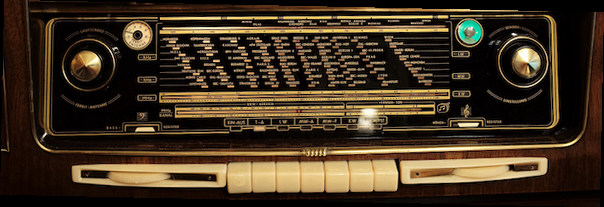
This recording captures The Breakfast Show during its mature phase under Pat Gates. It is an off-air shortwave recording of a Voice of America transmission.
The file was later shared online by a DX enthusiast in India, Sivarama Prasad Kappagantu (VU3KTB), who indicated that he did not make the original recording and does not recall its original source. The location of reception is therefore unknown. It may have been recorded anywhere within range of the VOA transmitter serving the target area at that time.
Although the online label identified the recording as “1979,” the internal news bulletin reports that the Red Brigades had announced that they had tried Aldo Moro and sentenced him to death — a development that entered international news coverage on April 15–16, 1978. This strongly suggests that the broadcast dates from mid-April 1978, most likely between April 15 and April 17. Such internal news markers are often the most reliable method for dating surviving shortwave recordings.
The sound quality reflects the realities of international shortwave broadcasting. Reception could vary dramatically depending on distance from the transmitter, atmospheric conditions, time of day, and solar activity. In some regions the signal would have been stronger and clearer; in others, more distorted or faint. What we hear here is not a studio master recording, but the way the program may have sounded to a listener abroad under specific propagation conditions.
Music segments and most of one feature report have been removed for copyright reasons. The spoken portions remain intact. The recording has otherwise not been altered, in order to preserve the authentic sound of Voice of America as transmitted and received in the late 1970s.
The second recording not only demonstrates the technical realities of shortwave reception, but also reveals how The Breakfast Show evolved over nearly two decades. By the late 1970s, under the stewardship of Pat Gates (and in collaboration with Phil Irwin), the program had become more confident in tone and more deliberately conversational. Gates’ delivery was warmer, more personal, and more assured than the early 1961 format. The program placed greater emphasis on interviews and cultural reporting rather than the lighter, sometimes awkwardly humorous NBC-acquired features heard in the earlier broadcast.
In the 1978 recording, for example, a feature segment explores the literary history of Connecticut through visits to sites associated with Harriet Beecher Stowe, author of Uncle Tom’s Cabin, as well as Mark Twain, Noah Webster, Wallace Stevens, and other writers connected to the state. The report links regional history with broader themes of American intellectual independence and cultural development — a more textured and reflective approach to presenting the United States to foreign audiences. The difference between the two recordings is not only technical; it reflects a maturation of format, pacing, and editorial focus. The 1961 broadcast captures an institution establishing its voice. The 1978 program reveals that voice embodied in a recognizable personality.
Recording Three
Voice of America Polish Service (Głos Ameryki) — Medium Wave Reception Recording, Helsinki, February 1, 1982 (1197 kHz, Munich Transmitter)
This recording captures an off-air reception of the Voice of America Polish Service (Głos Ameryki), broadcast on 1197 kHz from the Munich medium wave transmitter and recorded in Helsinki at 22:50 GMT on February 1, 1982.
The broadcast took place during the period of martial law in Poland (1981–1983), when international radio became a critical source of uncensored information. Despite poor reception conditions and the deliberate jamming of Voice of America Polish Service broadcasts by the Polish communist authorities, listenership increased dramatically during this period. Contemporary audience research indicated that the weekly audience for VOA Polish-language programs in Poland rose nearly fivefold compared to pre–martial law levels.
Medium wave transmissions from Western Europe, including Munich, supplemented shortwave broadcasts and could carry effectively at night through skywave propagation. Reception quality, however, depended on transmitter power, atmospheric conditions, distance, and local interference. This recording preserves the actual sound of international broadcasting as it was heard outside Poland — with fading, noise, and signal variations characteristic of medium wave reception.
As a reception recording rather than a studio master, the audio reflects the physical realities of Cold War radio transmission. It documents not only the content of the broadcast, but also the technical and political environment in which millions of listeners sought reliable news during a period of repression.
Pat Gates: A Rare VOA Personality
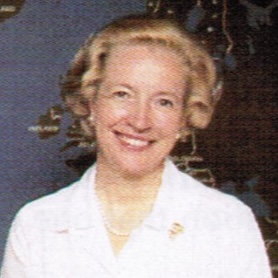
In his book Voice of America: A History, Alan L. Heil, Jr. described The Breakfast Show as a “conversational” format — a relaxed, personality-driven program within the framework of a government institution. Heil noted that the program was first hosted by Al (Albert) Johnson — the sole master of ceremonies heard in this recording — and was later succeeded by Bill Reynolds, Phil Irwin, and ultimately Pat Gates.6 Al Johnson heard Pat Gates broadcasting from Munich and subsequently invited her to join The Breakfast Show.7
It was one of the best hiring decisions made at the Voice of America. With Pat Gates, The Breakfast Show became something more than a format.
It became a voice.
Patricia Gates Lynch Ewell (1926–2011), known on the air as Pat Gates, began her broadcasting career before joining VOA. In the 1950s she worked in Washington for WETA and later for NBC, including NBC Monitor, which sent her to report from Western Europe and the Soviet Union. She also broadcast for the American Forces Network (AFN), traveling to Hungary, Poland, Turkey, Iran, and other countries.8
In the 1950s, relatively few women worked as reporters or on-air interviewers in national or international broadcasting. Most senior positions in commercial and government radio were still dominated by men, and women were often confined to narrowly defined roles. Gates entered the profession at a time when female foreign correspondents were rare.
NBC Monitor, launched in 1955, was one of the most innovative network radio programs of its era — a continuous weekend broadcast blending news, interviews, music, sports, and cultural reporting. It relied heavily on live remotes and international assignments. Working for Monitor gave Gates experience in conversational interviewing, fast-paced mixed programming, and reporting across political and cultural boundaries.
Her work for the American Forces Network placed her within a very different broadcasting system. AFN, established during World War II, was designed to serve U.S. military personnel stationed overseas by providing news from home, entertainment programming, and morale support. Although administered by the U.S. military, AFN frequently hired experienced civilian broadcasters, including military spouses, to ensure professional quality and continuity. Gates’ marriage to a U.S. Army officer likely facilitated her overseas assignments, but her hiring reflected professional qualifications at a time when AFN sought trained journalists capable of addressing American audiences abroad. AFN continues to operate today as part of the Department of Defense’s Defense Media Activity, serving U.S. forces worldwide.
These early experiences — commercial network journalism at NBC, military broadcasting through AFN, and reporting from behind the Iron Curtain — shaped Gates’ later approach at VOA. By the time she arrived at the Voice of America, she had already developed the interview-driven, personality-centered style that would define The Breakfast Show for decades.
She joined VOA in 1962 as a contract employee and became a full-time staff member in 1968.
In her oral history interview for the Association for Diplomatic Studies and Training, she described The Breakfast Show as:
It had everything on there… mostly interviews, some music. It covered American industry, theater, cultural events, science matters. It was a history of this country.9
— Patricia Gates Lynch, ADST Oral History
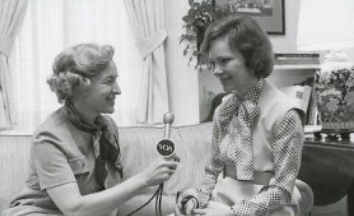
Pat Gates conducted interviews on civil rights, education, labor disputes, international conferences, and domestic political developments. She interviewed senators, Vice Presidents, Presidents, First Ladies, farmers, scientists, and teachers. She emphasized that she was never censored and that the freedom she enjoyed on the air was extraordinary. The Breakfast Show was one of the very few VOA programs whose hosts were allowed to ad lib.10
The freedom to ad lib carried a corresponding burden of responsibility. The Voice of America was a congressionally funded broadcaster charged with representing the United States to global audiences. Its credibility depended not only on accuracy, but also on restraint, professionalism, and broad public trust across partisan lines.
Gates understood this implicitly. Like most VOA journalists of her era, she did not make herself the story. She adhered to rigorous reporting standards, respected verification norms such as the two-source rule, seeking corroboration before airing sensitive claims in covering important news, and avoided provocation for its own sake in interviews with public officials. I have found no evidence of her becoming the subject of controversy because of something she said on the air, nor of having to retract major reporting errors.
Her work was respected at the White House and on Capitol Hill. That confidence mattered. In an era when VOA’s funding was debated annually, the professionalism of its broadcasters helped sustain bipartisan congressional support for the institution.
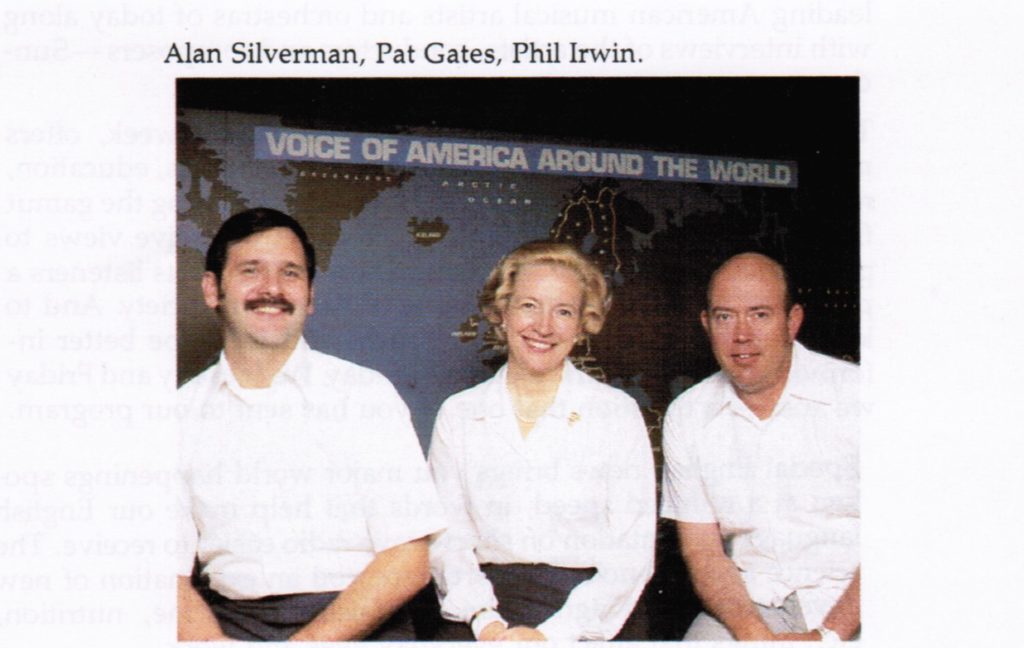
Much of the program’s structure and professional rhythm during its most successful years was shaped by Phil Irwin, who served not only as co-host but also as Chief of Morning English Broadcasts at VOA. A seasoned broadcaster with experience in Armed Forces Radio in Germany and in European commercial radio before joining the Voice of America, Irwin helped refine the balance between hard news, interviews, cultural segments, and music that made The Breakfast Show distinctive. Under the joint stewardship of Pat Gates and Phil Irwin, the program became one of VOA’s highest-rated English-language broadcasts worldwide, ranking ahead even of the Willis Conover Jazz Hour. Phil Irwin retired from VOA in 1985 after more than two decades of service and died in 2020.
Pat Gates became closely identified with her closing line, which for many listeners symbolized the program’s tone of personal connection:
Thanks for listening, and if you see someone without a smile, give him one of yours.11
She ended her final Breakfast Show in 1986 with those words before resigning following her nomination by President Ronald Reagan to serve as U.S. Ambassador to Madagascar and the Comoros (1986–1989). Earlier she had served as Press Secretary to First Lady Pat Nixon and traveled extensively with the President and First Lady, including to Vietnam during the war. After her diplomatic service, she became Director of Corporate Affairs for Radio Free Europe/Radio Liberty.
Pat Gates died in 2011. See her obituary in The Washington Post.
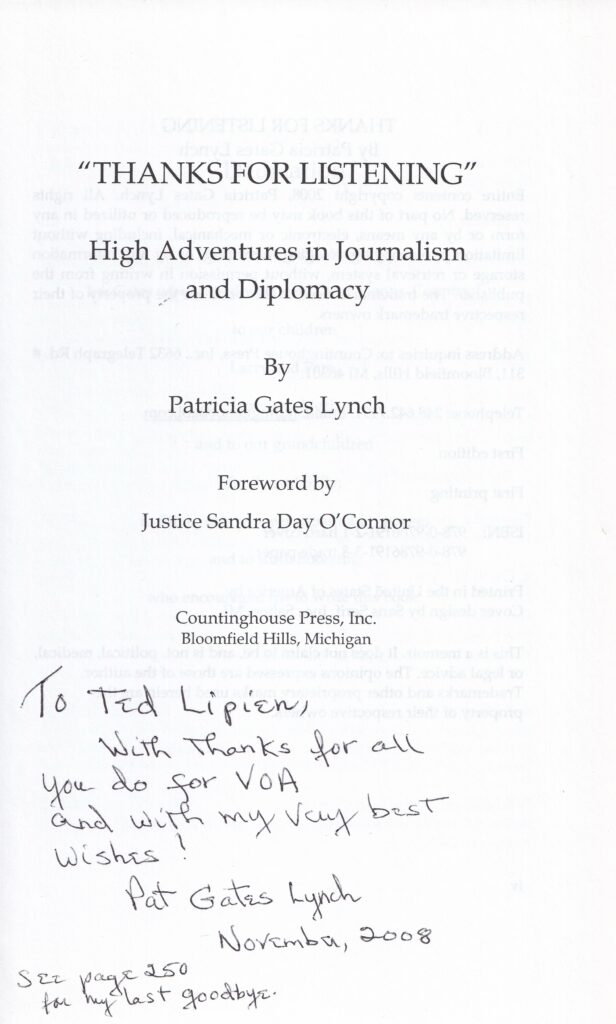
Three years before her death Pat Gates published her memoir titled “Thanks for Listening.” She opened it by recalling how her life changed as a young girl in New Canaan, Connecticut, when Hitler’s armies invaded Poland on September 1, 1939.12
Listening to radio reports about the war in Europe and the Pacific sparked her lasting interest in world affairs and in international broadcasting.
When I joined the Voice of America Polish Service in the 1970s, she was already a well-known English-language personality at VOA. From time to time I listened to The Breakfast Show through our internal studio lines. After hearing one of her interviews that was particularly relevant to issues we were covering in Polish, I went to her office — on another floor — to ask whether I might obtain a tape for translation and use in our program on the American economy.
That brief professional exchange revealed her warmth, her generosity with colleagues, and her genuine interest in Poland and in life behind the Iron Curtain. I was grateful when she later sent me her memoir with a personal dedication.
Pat Gates followed developments in Poland during the period of martial law with close attention and discussed them with me when we met. She became friends with Ambassador Romuald Spasowski and his wife and later wrote in her memoir about his dramatic defection in Washington, D.C., in December 1981. He requested political asylum and was placed under FBI protection. Spasowski had initially been an ardent communist but, like many others, became disillusioned with the system. Gates also noted that his wife was a devout Catholic.13
In her memoir, she also describes her meeting with Pope John Paul II in Madagascar in 1989, during her tenure as U.S. Ambassador, as well as her meeting with Solidarity chairman — and later President of Poland — Lech Wałęsa at the RFE/RL office in Washington, D.C., in November 1989.14 The book includes photographs from both occasions.
In the photograph with Lech Wałęsa, the unidentified translator is Piotr Mroczyk, who later became director of RFE’s Polish Service and had earlier worked under my supervision in VOA’s Polish Service.
She also wrote about her 1961 reporting trip to Poland for NBC, observing that people in Warsaw “looked busy, and churches held services, not museum tours.” At the same time, she cautioned that although Poland appeared to be the least tightly controlled country in the Soviet Bloc, “behind this façade of freedom lay many restrictions that cut into the life of the Poles.”15
Unlike some Western journalists who tended to interpret limited liberalization as evidence of systemic reform, Gates understood the distinction between surface tolerance and genuine political freedom. In her view, any meaningful restoration of independence would not come from gradual reform of the Communist Party itself, but from the resilience, patriotism, and religious faith of ordinary Poles. She later took note of the assistance provided to the Solidarity movement by the AFL-CIO under the leadership of Lane Kirkland, who also served on the bipartisan Board for International Broadcasting (BIB), the U.S. government body that oversaw Radio Free Europe/Radio Liberty. She and Malcolm S. Forbes, Jr.—known as Steve Forbes and then chairman of the Board for International Broadcasting—successfully lobbied President George H. W. Bush’s Chief of Staff, John H. Sununu, to extend Lane Kirkland’s appointment to the BIB.16
Audience Reality: Public Diplomacy vs. Information for the Oppressed
In Thanks for Listening, published with an introduction by U.S. Supreme Court Justice Sandra Day O’Connor, Pat Gates also recalled that during her earlier travels in Poland she was told that many listeners tuned to VOA, but “mostly to Radio Free Europe,” because RFE provided more detailed reporting on internal Polish affairs.17 She also wrote:
The Polish spirit seemed alive and well, jokes were told that made fun of the Soviet system, and there seemed to be little acceptance of communism.18
Carefully conducted audience surveys among Poles traveling to the West in the early 1960s showed that RFE’s Polish Service reached approximately 40 percent of the adult population weekly, compared to roughly 10 percent for VOA.19
Listenership to VOA English-language programs in Poland was minimal.
According to surveys of Iron Curtain refugees and visitors in the West conducted around 1960, Polish respondents gave 76 percent to RFE, 19 percent to the BBC, and 11 percent to VOA when asked which Western broadcaster had the most influence in their country.20
At that time, VOA foreign-language services were required to translate and use news prepared by the central English-language newsroom and could not originate independent reporting without special authorization. Most funding and staffing resources were devoted to English-language programming. Already during World War II members of Congress noted that much of VOA’s wartime broadcasting effort and spending went to English-language programs even though no English-speaking country was at war with the United States.21
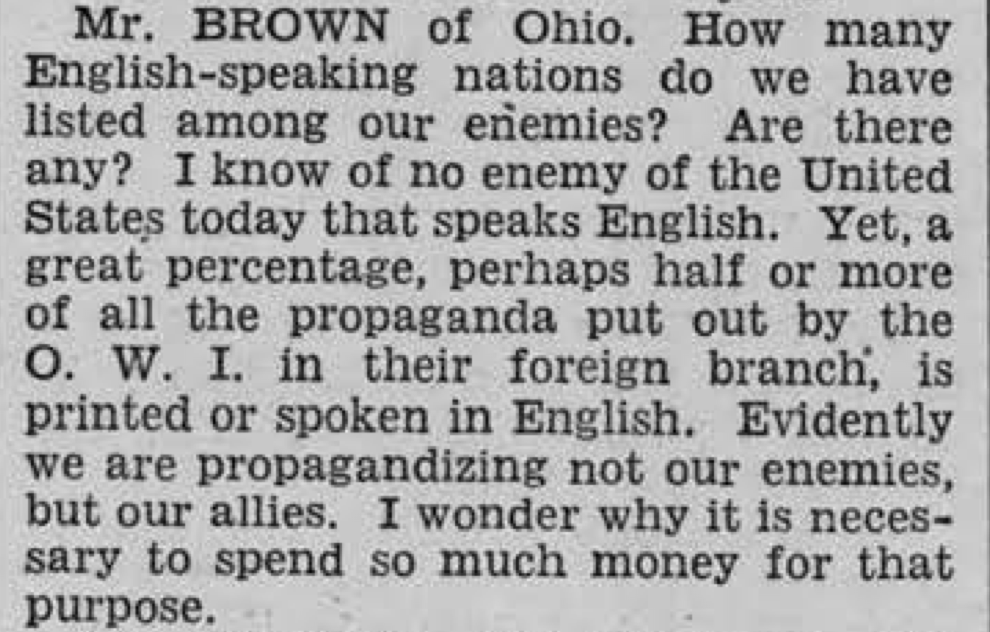
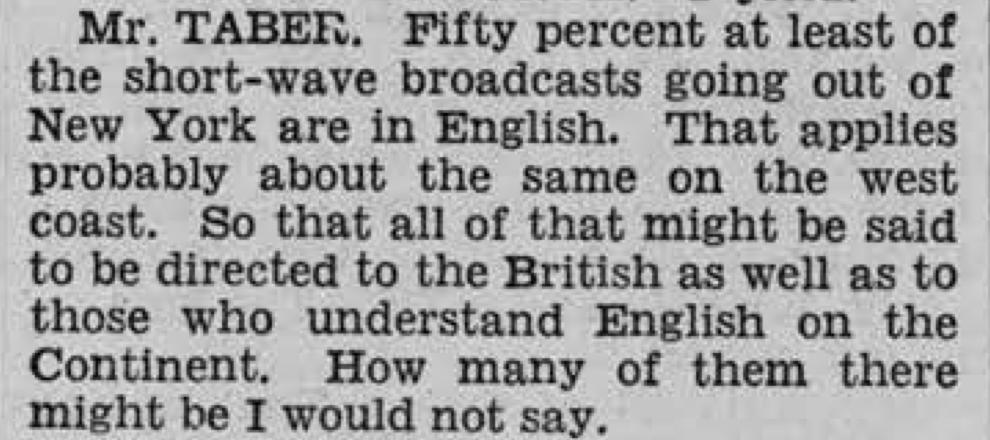
Excerpt from the Congressional Record, May 26, 1944 (p. 5022), containing remarks by Representative Harold C. Taber of New York stating that approximately 50 percent of Voice of America shortwave broadcasts transmitted from New York were in English.
Only after management reforms in the 1980s carried out by Reagan administration officials did the VOA Polish Service significantly expand its audience reach. These gains could not have been achieved by translating from English to Polish news reports and features produced by VOA’s central services. They were used from time to time, including an interview or a report presented on The Breakfast Show, but the key to the audience expansion in Poland was reporting and interviewing originated by Polish Service journalists and live programs hosted by Polish broadcasters — adopting, in their own language, a conversational style similar to that heard in English from Pat Gates. For ten years until the fall of communism in Poland at the end of the 1980s, the VOA Polish Service combined the presentation of America in the public diplomacy style of The Breakfast Show with surrogate news reporting similar to the Radio Free Europe style.
These changes illuminate a crucial distinction.
In countries without free media — where journalists were arrested, opposition suppressed, and human rights violated — listeners primarily wanted reliable information about what was happening to them. They wanted to know about arrests in their cities, strikes in their factories, protests in their universities, and political debates inside their own system.
For that, they tuned primarily to surrogate broadcasters such as Radio Free Europe and in the 1980s also to the VOA Polish Service.
The Voice of America English broadcasts were mostly about global news, U.S. news, and, to some degree, at least then, public diplomacy. It presented the United States to the world. But in repressive systems, listeners hungry for survival information about their own countries often looked elsewhere.
This distinction does not diminish Pat Gates’ achievement. It clarifies it. Her strongest audience was global and English-speaking — particularly in Africa and India — rather than in closed Eastern European societies. Not too many officials and journalists at the Voice of America who did not live under communist systems understood these distinctions, but Pat Gates did, judging from my conversations with her in the 1980s. Her role was primarily public diplomacy on behalf of the United States in the developing world.
Pat Gates and Willis Conover — and No Successors
The program’s popularity was not accidental. In her memoir, Gates recalled that The Breakfast Show consistently achieved the highest audience ratings within the Voice of America’s English-language services — even surpassing the internationally renowned Willis Conover Jazz Hour. She wrote:
New VOA directors would come and go with each change in administration, but they didn’t tamper with The Breakfast Show, their number one program in English, ahead of even the highly successful and famous Willis Conover Jazz Program. As program director Cliff Groce used to say, “The myth may be Conover, but the reality is The Breakfast Show.”22
In her 1992 oral history interview, Gates elaborated on why she believed the program resonated so strongly:
We had for many years the highest rating of any program on the VOA. I remember that used to baffle some because of the personal aspects of it. They would say, “Why is this a higher rating than our Meet the Press type things?” Well, I think it was because we really contacted [connected with] people.23
In the history of VOA, only two English-language broadcasters achieved sustained name recognition abroad: Pat Gates and Willis Conover.
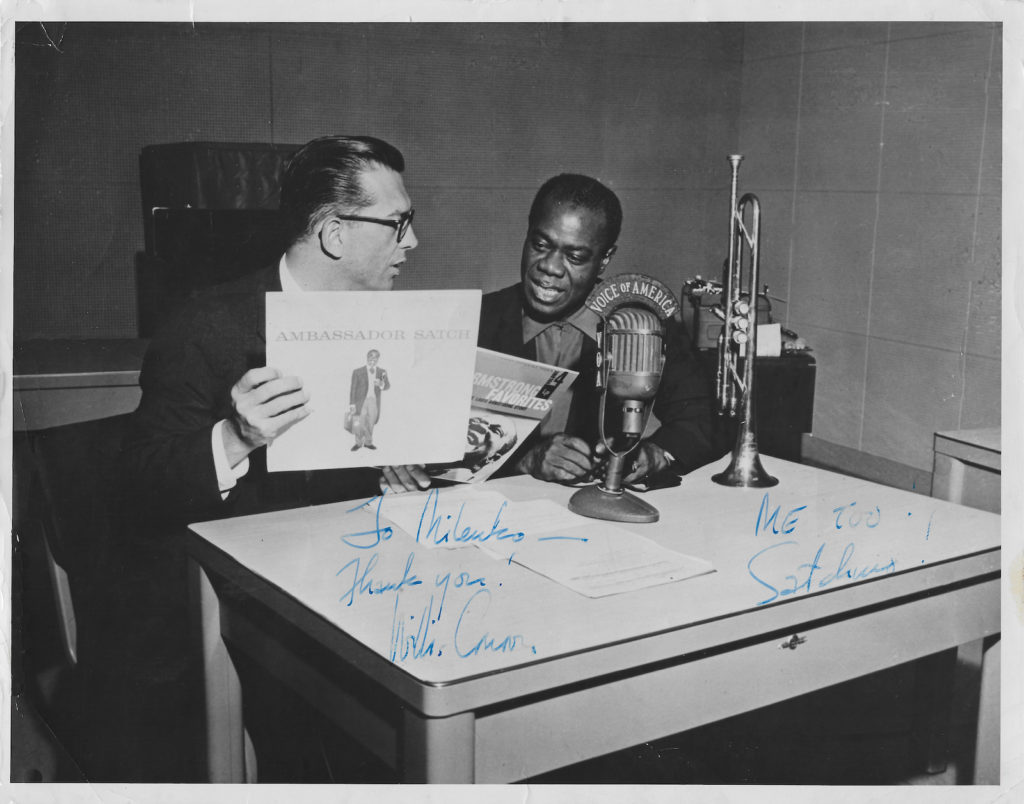
Conover’s Jazz Hour gained influence behind the Iron Curtain during the Stalinist period, when jazz was restricted in Eastern Europe. In Poland, once restrictions were lifted, its symbolic importance declined, though it remained influential longer in the Soviet Union. He was also popular in the developing world but not in Western Europe or in other countries with highly-developed free media, where demand for VOA English-language broadcasts in the second half of the 20th century was minimal and difficult to measure.
During the period of martial law in Poland, I initiated the broadcast of Willis Conover’s Jazz Hour to Poland, presented by one of our most popular Polish Service DJs, who translated Conover’s introductions into Polish. I did so largely for symbolic reasons. I understood that the program would likely attract only a relatively small, culturally elite audience, but I was mindful of Conover’s earlier popularity in Poland and of the political sensitivities surrounding his 1959 visit.
In that year, the U.S. Ambassador to Poland, Jacob D. Beam, and his political officer, Thomas Donovan, reportedly sought to use Conover’s visit to advocate within the State Department and the White House for curtailing or even eliminating Radio Free Europe’s Polish-language broadcasts in the interest of improving official U.S.–Polish relations.24 Vice President Richard Nixon rejected that proposal.25
Polish media reports, drawing on files of the Institute of National Remembrance (IPN), indicate that Conover was placed under surveillance during his visit as part of a broader intelligence and influence operation targeting the American Embassy in Warsaw.26 Conover later spoke to me about these events when we became friends at the Voice of America in the 1980s.
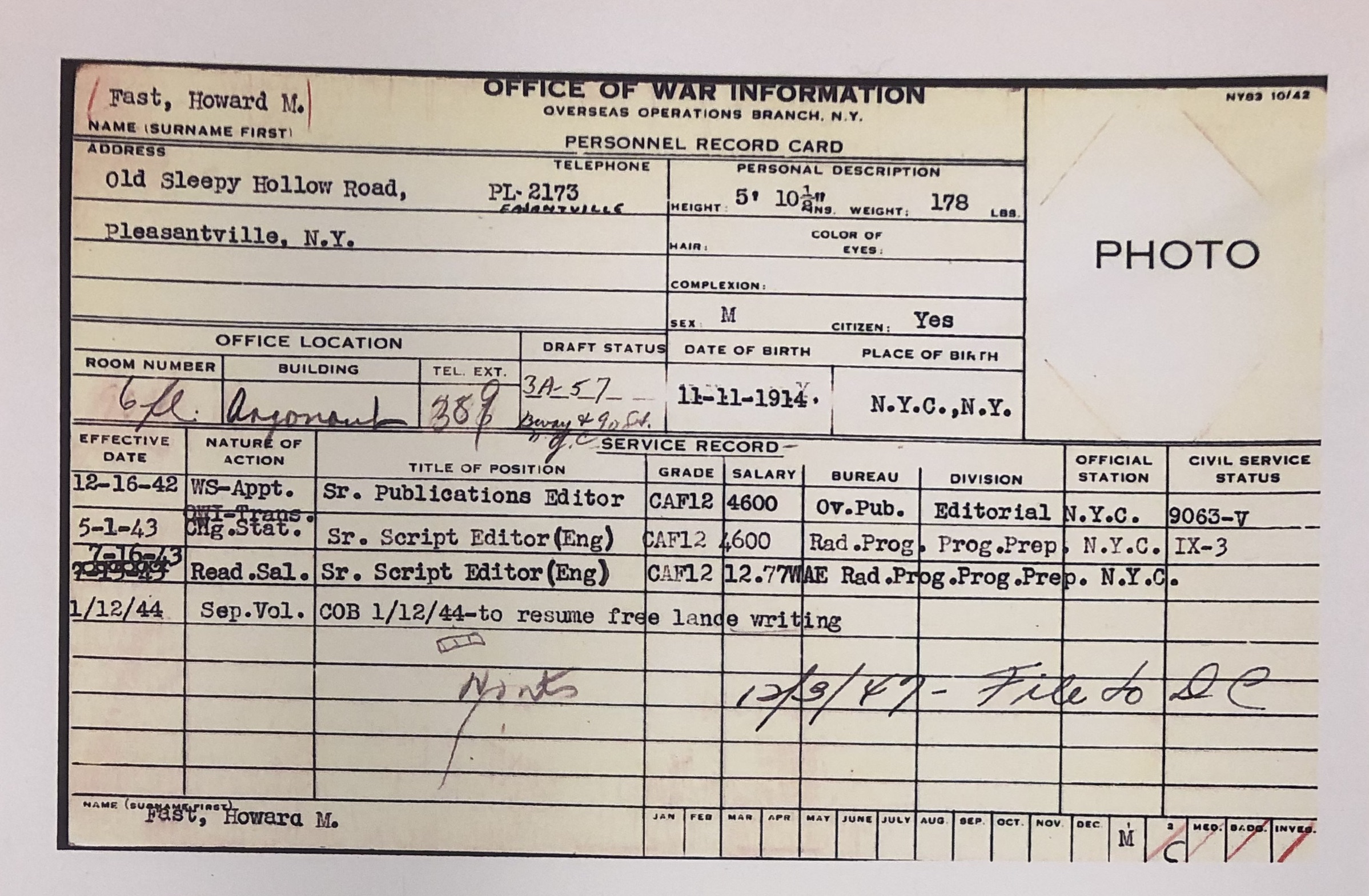
An additional historical footnote reaches back to the wartime and early postwar years. In the late 1950s, Ambassador Beam reportedly came under the influence of Mira Michałowska, who had worked for the wartime Office of War Information under her former name, Mira Złotowska, and later served as an editor on the VOA Polish Desk before returning to Poland in 1947.27 There she married a high-ranking communist diplomat. Michałowska was a friend of Howard Fast and translated some of his books into Polish.
Another memorandum with similar recommendations was submitted to President John F. Kennedy in the spring of 1961. It included similar recommendations to curtail Radio Free Europe’s autonomy, strip it of bold political commentary, and subordinate it to diplomatic and cultural exchange programs. President Kennedy rejected these proposals and, for the rest of his presidency, continued to express strong support for RFE’s mission.28
Polish government officials were far less concerned about VOA’s Polish-language broadcasts than about Radio Free Europe’s Polish Service. They had even less reason to worry about VOA’s English-language programs. In urban Poland in 1977 — where most Poles who understood English resided — only 2 percent of respondents (out of 15.3 percent total VOA listenership) reported listening to both Polish and English broadcasts, while just 0.4 percent listened to English only.29
In rural areas, listenership to VOA English would have been even lower.
Although Willis Conover and Pat Gates had millions of listeners worldwide — more than any other individual VOA broadcasters — their English-language audiences were small compared to the aggregate audiences of VOA’s foreign-language services, particularly in communist-ruled countries.
USICA’s Office of Research reported in 1980 that 56.7 percent of VOA’s 66.5 million regular weekly listeners (excluding China, for which no data were available) were located in Eastern Europe and the Soviet Union. When Western Europe is included, Europe accounted for roughly 60 percent of VOA’s total audience.
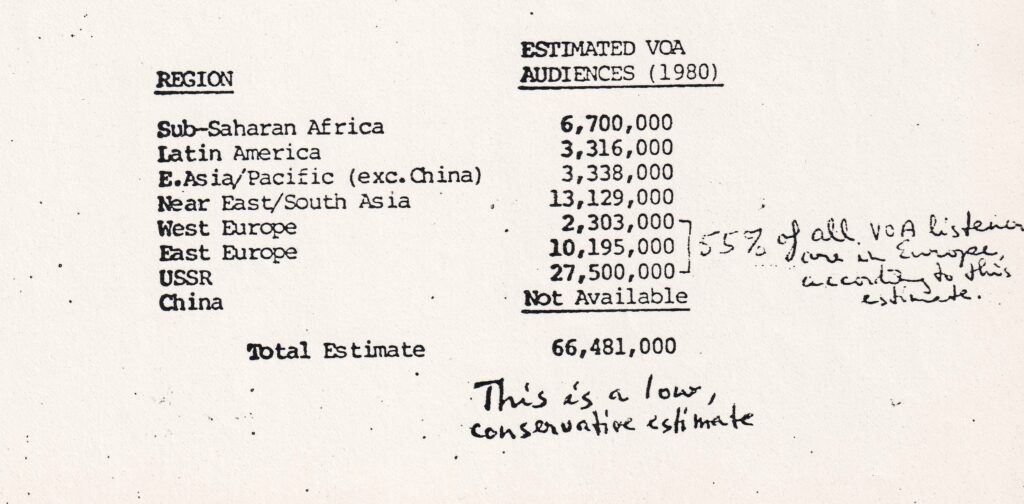
Based on this research, VOA’s European Division informed Reagan administration officials that listeners tuned in primarily to vernacular-language services. In the USSR, Eastern Europe, and Latin America, audiences listened almost exclusively to VOA broadcasts conducted in their native languages. In Arab countries, most listeners relied on the VOA Arabic Service, though some also listened to VOA English.30
English-language programs hosted by broadcasters such as Conover and Gates drew much of their audience from regions including East Asia, South Asia, and Sub-Saharan Africa, where English served as a secondary or elite lingua franca and where local-language VOA services were less extensive.
Despite their popularity abroad, Conover and Gates did not become well-known figures inside the United States since domestic distribution of VOA programs was prohibited by law. Their recognition was international in specific media markets. At that time, Voice of America officials were carefully avoiding getting VOA involved in political controversies at home. They cultivated strong bipartisan support in Congress. Individual broadcasters like Conover and Gates were also extremely careful not to become connected with domestic partisan politics in the eyes of Americans or in the perceptions of their listeners abroad.
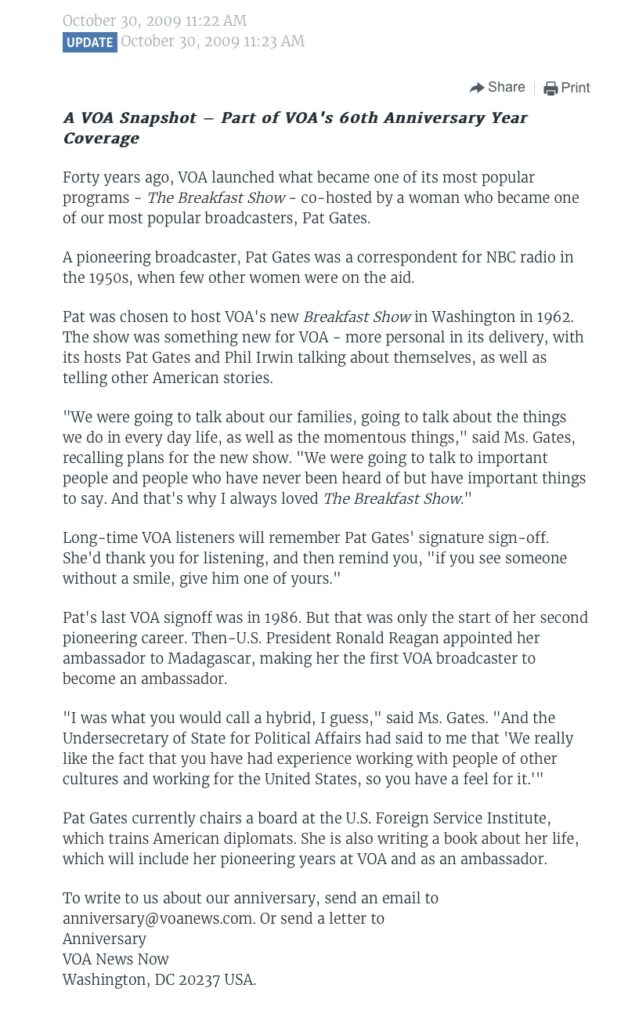
Since their departure, VOA has not found another English-language broadcasting personality of comparable stature and recognition abroad who could also help win bipartisan support from Congress and American voters. In 2002, the Voice of America remembered Pat Gates in an online article posted in connection with VOA’s 60th anniversary.31
VOA
Pat Gates Hosted VOA’s Breakfast Show – 2002–04–24
Institutional Lag and Generational Disconnect
The 1961 recording also reveals generational tone and VOA production and voicing standards.
As a teenager in Poland in the 1960s, I briefly listened to VOA Polish music programs. I was not interested in jazz and did not understand enough English to follow The Breakfast Show. What I noticed immediately was that VOA Polish music programming did not focus on rock and roll and was often hosted by voices that sounded one or two generations older than their intended audience.
I quickly switched to Radio Free Europe’s Polish Service music program Rendez Vous at 6:10, hosted by Jan Tyszkiewicz and Janusz Hewell. It was lively, contemporary, and played the latest music. It understood its audience. In contrast, the 1961 Breakfast Show music, like much of VOA Polish Service music programming of that era, was oriented toward an older generation. Teenagers in Poland who wrote letters to RFE requesting songs — mailing them to constantly changing addresses in an effort to confuse postal censors — were sometimes questioned by the communist secret police when their letters were intercepted.
Janusz Hewell later worked for the VOA Polish Service and, together with Wojciech Zórniak when I became service chief, hosted evening programs that combined news, interviews, ad-lib conversation, and music — in many ways echoing The Breakfast Show format, but in a tone better adapted to Polish listeners.

As a bureaucratic institution, VOA has often been 10, sometimes 20 years behind emerging cultural trends. It practiced formal journalism. It was less agile in sensing generational and technological change. Some VOA English broadcasters tended to talk down to their audience and underestimated their audience’s knowledge and needs for information and commentary from America.
Pat Gates was an exception. Her personal voice cut through the institutional tone.
The New Breakfast Show (1980–1981)

The guide introduced the revised format:
The Voice Of America takes pleasure in announcing the NEW Breakfast Show! A new sound, a new feel, a new immediacy, BUT WITH THE SAME OLD FRIENDS! Changing with the times, the Breakfast Show has adopted a format to enable us to bring our growing and increasingly important morning audience even closer to the latest developments…
Legal and Institutional Context
In 1961, the Voice of America operated under a distinctive legal framework established by the United States Information and Educational Exchange Act of 1948, commonly known as the Smith–Mundt Act. Under that law, VOA programming was intended exclusively for foreign audiences and was restricted from domestic dissemination within the United States. Congress imposed this restriction in the early Cold War period out of concern that government-produced international broadcasting should not become a vehicle for influencing American public opinion. During World War II, members of Congress of both parties also became aware that some officials in charge of the Voice of America and some VOA broadcasters were Soviet sympathizers who promoted Stalin’s propaganda narratives. The first chief writer and editor of VOA English news was American writer Howard Fast, a Communist Party USA journalist and activist who in 1953 received the Stalin Peace Prize.32 In his autobiography, Being Red, published in 1990, Fast wrote that he kept “anti-Soviet propaganda” out of Voice of America’s World War II broadcasts. For him, it meant censoring any negative information about Stalin and his responsibility for the Katyn massacre of thousands of Polish military officers and intellectual leaders in Soviet captivity.33
In 1943, Congress, in a bipartisan vote, almost completely eliminated funding for domestic propaganda by VOA’s wartime government agency, the Office of War Information (OWI), and came close to eliminating the Voice of America. Aware of these controversies, President Truman abolished the OWI agency by an executive order in 1945 and moved VOA into the State Department.34 In July 1947, the Truman administration announced a 40 percent reduction in Voice of America programming, eliminated several foreign-language services, and carried out deep cuts in English-language programs.35 In subsequent years, VOA and agency management responded to continuing budget pressures by further reducing or eliminating various foreign-language services while attempting to protect English-language programming and positions.
The Smith–Mundt Act of 1948 established that U.S. international broadcasting was intended for foreign audiences and was not distributed domestically as a matter of policy and practice. The restriction on domestic dissemination was later made explicit in statutory language by the 1985 Zorinsky Amendment.
Another significant provision of the 1948 U.S. Information and Educational Exchange Act (the Smith–Mundt Act) required loyalty and security investigations for employees assigned to international information activities, including those at the Voice of America. The statute provided:
No citizen or resident of the United States, whether or not now in the employ of the Government, may be employed or assigned to duties by the Government under this Act until such individual has been investigated by the Federal Bureau of Investigation and a report thereon has been made to the Secretary of State.36
The Act also restricted the hiring of non-citizens within the United States. It stated that:
such employment of aliens shall be limited to services related to the translation or narration of colloquial speech in foreign languages when suitably qualified United States citizens are not available.37
These provisions reflected the climate in which Congress sought to ensure political reliability in international broadcasting while also prioritizing the employment of U.S. citizens.
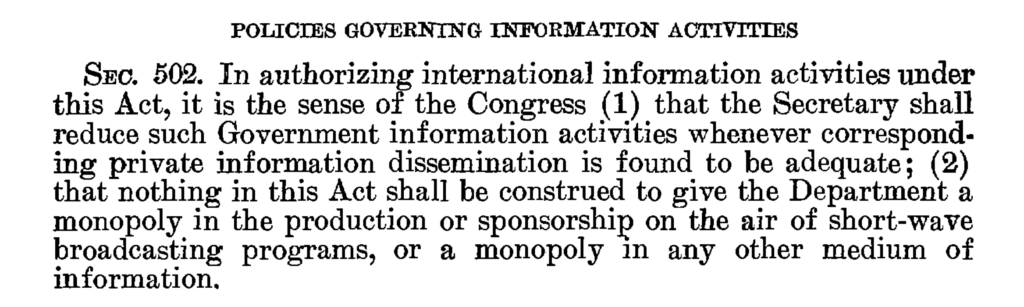
At the same time, Congress made clear that U.S. international broadcasting was not intended to displace private enterprise. Section 502 of the Smith–Mundt Act stated that government information activities should be reduced wherever adequate private dissemination already existed, and that nothing in the Act should be interpreted as granting the government a monopoly in shortwave broadcasting or in any other medium of communication.
In practice, this principle applied most clearly to English-language programming. Commercial American broadcasters could, in theory, produce English-language news and cultural programming for international audiences. By contrast, most foreign-language services could not be privately produced on a profitable basis by U.S. media companies, particularly for countries with limited advertising markets or restricted media environments.
During much of the Cold War, transmitting programs from the United States to overseas audiences — whether in English or in other languages — required costly shortwave infrastructure and government funding. Later technological developments changed that equation. Satellite distribution, and eventually the Internet, made global delivery of English-language programming relatively inexpensive and widely accessible. Today, English-language news and entertainment from the United States can be received abroad in real time from numerous private sources.
The same is not true for many foreign-language news services. Commercial production of independent, country-specific foreign-language news programming in the United States often remains economically unviable for numerous regions, especially those where free media are restricted.
Section 1005 reinforced Congress’s preference for private-sector participation by directing the Secretary of State to utilize, to the maximum extent practicable, the services and facilities of private agencies — including American press, publishing, radio, and motion picture organizations — and to encourage broad private involvement consistent with market conditions in each country.
The June 19, 1961 recording of The Breakfast Show includes two short feature segments sourced from the U.S. commercial National Broadcasting Company. During this period, the Voice of America sometimes purchased or incorporated commercially produced material for use in overseas broadcasts. In this program, the NBC material consists of light reports attempting to be partly humorous — one involving cultural commentary from Japan, and another featuring an interview with American women’s chess champion Lisa Lane. The VOA host similarly introduces elements of humor in his presentation. Listeners may judge for themselves the tone and effectiveness of these segments.
VOA’s use of commercially produced programming, while encouraged by members of Congress, also had earlier drawn congressional scrutiny and criticism of management and editorial controls by the government broadcaster. In 1948, senators sharply criticized Spanish-language programs about U.S. states that had been produced under government contract by NBC for broadcast over the Voice of America as “baloney,” “lies,” “insults,” “drivel,” “nonsense,” “falsehoods,” “downright tragedy.”38 On May 26, 1948, Senator Homer E. Capehart of Indiana read translated excerpts on the Senate floor, objecting to humorous portrayals of individual states that he regarded as inappropriate for foreign audiences. Other senators characterized the broadcasts as insulting or defamatory toward their states. The controversy underscored congressional concern that humor acceptable in domestic entertainment programming might be interpreted differently abroad, especially when presented as part of official U.S. international broadcasting. Although those programs were subject to VOA editorial approval, the episode reinforced demands for closer oversight of acquired material.
At the same time, the Voice of America enjoyed certain practical advantages in international music programming. Because VOA broadcasts were directed abroad and could not legally be transmitted to domestic audiences, the use of commercially recorded music in overseas shortwave broadcasts was generally treated differently from domestic commercial radio performance. In practice, VOA programming during this period often incorporated popular American and international music as part of its cultural diplomacy mission.
Programs produced and voiced by United States government employees are generally in the public domain. However, material acquired from commercial broadcasters or produced by contractors may remain subject to copyright, depending on the contractual arrangements in effect at the time. For the same reason that the music segments have been removed from this online presentation, only brief excerpts of the NBC material are included here in order to avoid potential copyright conflicts under current law. The full original tape, including musical content and complete NBC segments, remains preserved in the museum’s collection and may be made available for scholarly research by arrangement.
Since 2013, amendments to the Smith–Mundt framework have modified the legal treatment of domestic access to U.S. international broadcasting materials. While the original Cold War-era prohibition on domestic dissemination has been substantially relaxed, statutory safeguards remain in place to prevent the use of appropriated funds to influence public opinion in the United States. The legal environment governing archival access and online publication today therefore differs significantly from that which existed when this recording was first made.
This recording offers not only a window into the sound and structure of early 1960s Voice of America broadcasting, but also insight into the legal and institutional constraints that shaped American international radio during the Cold War.
Conclusion
The 1961 recording captures The Breakfast Show at its institutional birth.
Through Pat Gates — and in partnership with Phil Irwin — it later became one of the rare personality-driven broadcasts within a government structure: trusted not as propaganda, but as conversation.
Gates left the Voice of America at a moment when the media ecosystem that had made such English-language, U.S. government-funded radio so influential was beginning to change fundamentally. In the mid-1980s, technological shifts were expanding global access to privately produced American news and entertainment. Most visibly, CNN’s international English-language television service began broadcasting worldwide in September 1985, using satellite distribution to deliver continuous commercial news to audiences far beyond the United States. For the first time, a private American network could provide round-the-clock global television news in English on a scale previously associated only with state-supported broadcasters.
At roughly the same time, public and commercial radio distribution evolved as well. NPR expanded satellite interconnection through what became the Public Radio Satellite System, enabling reliable program feeds of American English-language programs to broadcasters and distribution networks abroad. Over the following two decades, the internet amplified these changes dramatically: hundreds of U.S. radio and television outlets — some of them in foreign languages — became accessible globally to anyone with an internet connection. In many open media markets, access to American news and culture no longer depended on a government shortwave transmitter or an interpretation by a government-hired journalist. Furthermore, English-speaking foreigners with access to the internet and social media could easily observe and read about American culture in many forms — from popular to high culture. They could read articles in the American press and other media representing all political views, and follow English-language announcements and news conferences by State Department, Pentagon, and White House spokespersons.
These developments did not eliminate the need for U.S. government-funded broadcasting in some foreign languages. In countries marked by censorship, arrests, repression, and other human-rights violations, listeners primarily sought reliable information about what was happening to them — in their own societies and in their own languages. In such environments, surrogate broadcasters like Radio Free Europe/Radio Liberty often fulfilled a different mission than VOA’s public-diplomacy model: sustained reporting on internal political, social, and economic developments that state-controlled media suppressed.
However, in today’s fragmented digital media environment, broadcasters of the caliber of Pat Gates and Willis Conover would likely find it difficult to establish a comparable role within the contemporary Voice of America. VOA officials frequently cite aggregate audience figures to demonstrate reach, yet such numbers have long been questioned by members of Congress and independent media analysts, who distinguish between nominal digital “reach” and measurable influence.
The VOA English-language YouTube channel, for example, has approximately 3.76 million subscribers — modest by global digital media standards. Its most-viewed video features a talking parrot, while many other high-traffic videos are not focused on explaining the United States to foreign audiences. This illustrates a structural challenge: digital algorithms reward entertainment, novelty, and sensational content rather than sustained, personality-driven public-affairs broadcasting and serious news reporting.
The kind of long-term trust and international recognition that Pat Gates and Willis Conover, and above all, VOA’s foreign language broadcasters built during the Cold War — through consistent voice, editorial discipline, and institutional credibility — cannot easily be replicated through social media distribution. Influence in that earlier era depended not on viral visibility, but on continuity, scarcity of alternatives, and sustained audience loyalty.
The Voice of America attempted to adapt to the new competitive environment already in the 1980s but without much success. VOA Europe, launched on October 15, 1985, combined contemporary music with short news updates and features presented by highly talented professional DJs recruited from private radio and distributed via satellite to European affiliates. It was an ambitious experiment in modernization. Yet in much of Western Europe — and later in newly emerging democracies in East-Central Europe — local stations preferred to produce their own English-language or local-language programming rather than rebroadcast an American-originated English service.
Prior to the launch of the new English-language VOA broadcasts to Western Europe, Vello Ederma, acting chief of the European Division, advised incoming Reagan administration officials that resuming broadcasting to Western Europe could help counter the waning U.S. influence in the region. He cautioned, however, that expanding English-language broadcasts in place of vernacular-language services would be perceived by “sensitive Europeans” — including the French, Germans, Spaniards, and Italians — as American “linguistic chauvinism” or even “linguistic imperialism.” Many Europeans, he noted, took considerable pride in their national languages.
Broadcasting exclusively in English to Western Europe, Ederma warned, would risk being “lost in translation.”39 By that time, VOA’s European Division no longer produced direct broadcasts to Germany, Spain, or Portugal. Instead, a small group of experienced journalists in Washington prepared short news and feature reports in the respective languages and distributed them to local radio stations for later placement through telephone or other audio links.
This affiliate model proved more effective in maintaining audience contact. In open and competitive media systems, listeners no longer depended on government shortwave transmissions for access to news about the United States. Local stations could select, edit, and integrate VOA material into their own programming, making it more compatible with domestic broadcasting formats.
As commercial media markets matured and new transmission technologies emerged, the economics of international program distribution shifted even more decisively. Satellite delivery, and later digital distribution, reduced technical barriers while increasing competition from private global media outlets. Stations increasingly demanded payment for rebroadcasting VOA English programming and, in some cases, even certain foreign-language programs in countries where domestic media were expanding and advertising markets were growing. The Voice of America could not compete with free or even partially free domestic media in East-Central Europe in English and even in local languages to achieve a significant audience impact unless it was willing to pay for rebroadcasting on domestic networks. It was the same pattern observed in Western Europe after World War II that led to the quick elimination of all of VOA’s direct broadcasts to that region. As good as she was, Pat Gates had no measurable audience in France during the Cold War. Other forms of American public diplomacy carried out by the United States Information Agency, such as cultivating contacts with local journalists and other influencers, have been used in countries with free and developed media.
From the 1990s into the early 2000s, as I worked in Europe on the distribution of VOA and RFE/RL programming, I observed this structural transformation firsthand. Shortwave listening quickly declined in importance. FM partnerships and local retransmission agreements became central but short-lasting. Station managers evaluated international broadcasters not only by editorial quality, but by format compatibility, cost, and audience demand. The conditions that had once allowed a two-hour English-language personality program to travel across continents by shortwave were disappearing.
In that changing landscape, the kind of long-form English-language radio personality program epitomized by Pat Gates became harder to sustain institutionally. Star broadcasters today would likely build their own platforms — podcasts, streaming channels, digital networks — or work for global commercial outlets such as CNN and other international media organizations. The media world no longer depends on a single shortwave frequency to carry a trusted voice across borders.
At the same time, the principal need for U.S. taxpayer-supported international broadcasting has shifted. It lies less in explaining America to English-speaking audiences in open societies, and more in providing reliable news in local languages to listeners in China, Iran, Russia, Cuba, North Korea, and a limited number of other countries where independent media remain restricted or suppressed.
The contemporary environment also poses new challenges. English-language U.S. government-supported broadcasting can become controversial in a highly polarized domestic political climate, especially when reporting on partisan disputes that are intensely debated within the United States itself. In an earlier era, under different leadership and with personalities like Pat Gates — who was notably careful not to entangle her journalism in domestic partisan controversies — the space for a broadly trusted English-language government broadcast was wider. Finding a renewed model for VOA English-language programming under present conditions may be difficult, but it is not necessarily impossible.
The 1961 tape lets us hear the beginning.
In the background hiss of the 1978 off-air recording of The Breakfast Show, we can clearly detect the age of shortwave — a signal that crossed oceans imperfectly but carried with it a sense of immediacy and human presence. Satellite and digital transmission later brought clarity, reach, and abundance. What changed was not the need for trustworthy voices, but the medium through which those voices travel — and the expectations of the audiences who choose to listen, watch, or read news.
What followed depended not only on policy and law — but on voice, and on the technology that allowed that voice to be heard.
THE BREAKFAST SHOW
Voice of America — Washington, D.C. — June 19, 1961
Complete Transcript (Cleaned Historical Edition)
(All musical performances removed for copyright reasons. Spoken content preserved in full.)
Opening
Albert Johnson:
Good morning, and welcome to The Breakfast Show. Good morning, and welcome to The Breakfast Show. This is your host, Albert Johnson, speaking to you from the Voice of America in Washington, inviting listeners in Europe and East and West Africa to be our guests for the next two and a half hours.
We’ll be here each day with reports on world news, popular music, and special features.
Now it’s time for the news. Here is Edward Conley reporting from the Voice of America newsroom.
News Bulletin — First Edition
Edward Conley:
A capsule from America’s latest Discoverer satellite was successfully recovered from its polar orbit a few hours ago after whirling in space for two days. It was the fifth Discoverer space capsule to be safely returned to Earth.
After its planned ejection from the satellite, the capsule was parachuted into the Pacific Ocean north of Hawaii and picked up shortly afterward. Inside the capsule were samples of both common and rare metals and instruments which will be studied by scientists to determine the effects of space travel on them.
Officials fear the death toll in one of the worst French train wrecks may climb even higher. Latest reports say 23 persons were killed and more than 150 were injured yesterday afternoon when the Strasbourg–Paris Express was derailed. The accident occurred near the town of Vitry-le-François in the Département de la Marne.
This morning, rescue workers were still searching for more passengers feared trapped in the wreckage. The cause of the accident has not yet been determined. Dispatches say there is no indication of sabotage. Eyewitnesses say the train was rounding a curve at a normal speed of 136 kilometers, or 85 miles per hour, when it appeared to pull apart. The locomotive and the first two cars continued along the tracks, but the next ten cars were hurled into a ravine. Three of the cars were smashed into a heap of twisted metal. The others were strewn about a slope.
Preliminary talks between the United States and the Soviet Union on the broad subject of disarmament opened today in Washington. The talks were arranged to deal with procedural matters such as the composition of the negotiating body. They are preliminary to a disarmament conference which President Kennedy expects will take place later this summer or at a United Nations General Assembly session in the autumn.
But in Moscow, the Soviet publication International Affairs said that the Soviet Union plans to talk about total disarmament, not just procedural matters. The American delegation to the talks will be headed by John J. McCloy, former United States High Commissioner in Germany. The Soviet delegation will be led by Valerian A. Zorin, Soviet ambassador to the United Nations.
In Zurich, Switzerland, the three main political leaders in Laos are meeting in an attempt to work out a settlement for the Asian kingdom. Premier Prince Boun Oum, former premier and proclaimed neutralist Prince Souvanna Phouma, and the chief of the pro-communist rebels, Prince Souphanouvong, held their first joint meeting yesterday. Three days of formal talks between the three princes are scheduled to get underway today. They say their negotiations will center on achieving national harmony and trying to agree on principles for forming a coalition government. The International Conference on Laos is scheduled to resume in Geneva at the same time.
The mystery of the bombed communication towers in the American states of Utah and Nevada last month has been solved. United States and Mexican authorities have arrested two Americans for conspiracy in connection with the bombings. Mexican authorities say the pair admitted blowing up the towers and temporarily knocking out defense circuits.
The men arrested are described as Bernard Jerome Bruce, a former real estate agent, and Dale Chris Jensen, a former machine equipment operator. Two other persons were detained for questioning. According to dispatches, Mexican authorities found a large quantity of arms and explosives aboard a schooner in which the four people sailed into Ensenada Harbor, Mexico.
Bruce, a gray-bearded man wearing a yachting uniform, said he heads a group he calls the American Republican Army, and he said the group aims at political power, though not by violent means. The bombings, he said, were just a scare to get attention, and because he claims a grievance against some privately owned companies.
The head of the West German Trade Union Federation, Willi Richter, calls for the right of self-determination for all Germans as a prerequisite to the reunification of Germany. Mr. Richter told a meeting in West Berlin yesterday that the unending stream of refugees from East Germany to the West proves that East German communist leader Walter Ulbricht keeps his regime in power only through force.
The United States Information Agency says communist bloc nations sharply stepped up their propaganda activities last year in Latin America, Africa, and the Far East. In Europe and the Middle East, the agency reported, communist propaganda activities appeared to be more of a holding operation to allow concentration in other areas.
This news is coming to you on The Breakfast Show from the Voice of America in Washington.
The government of Singapore has announced that eleven men have been arrested, charged with plotting to assassinate Prime Minister Lee Kuan Yew. No other details are available yet.
Japanese Prime Minister Hayato Ikeda has left Tokyo by air for the United States, where he will confer with President Kennedy. Premier Ikeda will also visit Canada.
A story of hardship and horror from Tibet. A Tibetan monk who has just escaped into India says the communist Chinese rulers of his country have turned from compulsion to persuasion in an effort to get Tibetans to produce more food. Mainland China is suffering from a series of poor harvests. The monk said bumper crops were harvested in Tibet during the past two years, and the Chinese confiscated almost all of them. He said that in one area the people have been driven almost insane by hunger and overwork. Recently, he said, Tibetan farmers demonstrated by lying down in the fields and roads and asking the Chinese to shoot them.
Back in the United States, death has come to former American Senator George Bender of the state of Ohio. He was 64 years old. Mr. Bender served sixteen years in the Senate and House of Representatives.
United States Ambassador Adlai Stevenson, President Kennedy’s personal envoy during his tour of ten South American countries, received a warm welcome on his arrival in Guayaquil, Ecuador. On his first stop in Guayaquil, word of his arrival spread swiftly and one thousand persons gathered at the airport to cheer him.
An exhibition of African art and culture has opened in Washington at the United States Department of Commerce called Tropical Africa: An Explosion into the Future. The exhibition is sponsored by the Twentieth Century Fund, a private organization devoted to research and public education on economic and social problems. The exhibition will also tour other American cities.
A California aircraft company has proposed jet-powered all-metal dirigibles designed to carry large payloads across the world. The Slater Aircraft Company says the fifteen-million-dollar project to design and build the first cargo dirigible would take less than two years. The company said the primary task of the proposed airship would be to handle some rocket cargoes now too big for rail or highway transportation. It is believed such an airship would be capable of moving entire buildings, radar stations, bridges, construction equipment, or any bulky cargo or pipelines where there is no access to highways.
America’s Phil Hill drove his Ferrari to victory yesterday at the Belgian Grand Prix automobile race. It was Mr. Hill’s second major racing triumph in a week. One week ago, he teamed with Belgium’s Olivier Gendebien to win at Le Mans, France. In yesterday’s race, Germany’s Wolfgang von Trips placed second.
In the Midwest city of Akron, Ohio, the small car era is creating new problems for city officials. A new footbridge was built for pedestrians only. But drivers of little sports cars, who found it just wide enough, have been using the footbridge as a roadway.
That’s the latest news. This has been Edward Conley reporting on The Breakfast Show from the Voice of America newsroom in Washington. The next report will be at five hours thirty Greenwich Mean Time.
Music
[Music removed for copyright reasons — Larry Elgart Orchestra, “Liza.”]
Albert Johnson:
The Larry Elgart Orchestra gets us off to a rollicking start on this morning’s Breakfast Show, coming to you from the Voice of America in Washington with an instrumental interpretation of “Liza.”
Music
[Music removed for copyright reasons — Larry Elgart Orchestra, “Liza.”]
Now vocalist Tommy Edwards is going to sing about the “Morning Side of the Mountain,” most appropriate early morning. It would be difficult to agree with anyone more than Mr. Edwards being on the twilight side of the hill.
Music
[Music removed for copyright reasons — Tommy Edwards, “Morning Side of the Mountain.”]
A change of style now as we hear the Mitch Miller Chorus, and they have something about a holiday for lovers.
Music
[Music removed for copyright reasons — Mitch Miller Chorus.]
Let’s take a look now at one of the foreign cultures that is foreign to Western civilization. Let’s go now to Japan, where the National Broadcasting Company correspondent, Cecil Brown, is standing by with an interesting story about Japanese ladies.
The Japanese themselves have a name for the cute, compact, and tiny Japanese girls. They call them “transistors” because they are so small. In fact, here in Tokyo, there’s a nightclub called the Long-Stemmed Statuesque Modern Japanese Beauty.
And it’s only appropriate now that the Benny Goodman Orchestra give us an instrumental selection, “Oh, Lady Be Good.”
Music
[Music removed for copyright reasons — Benny Goodman Orchestra, “Oh, Lady Be Good.”]
Report to Youth, thirty minutes of vital information dealing with the interests and aspirations of young people. This Voice of America program is to be heard each Monday at 17 hours 30. A wide range of topics is covered in Report to Youth: student panel discussions, questions and answers on current national and world problems, and the interviewing of foreign guests are just a few of the things to be heard on the Voice of America’s Report to Youth, each Monday at 17 hours 30 Greenwich Mean Time.
You’ll hear voices on Report to Youth which have that same youthful quality which was heard just now by Miss Caterina Valente as she sang for us “La Strada del Amore” on The Breakfast Show, coming to you from the Voice of America in Washington.
Music
[Music removed for copyright reasons — Caterina Valente, “La Strada del Amore.”]
At five hours thirty Greenwich Mean Time, we heard the Manny López Orchestra with an instrumental, “Summer Romance.” Now it’s time for the news.
News Bulletin — Second Edition
Edward Conley:
This is Edward Conley reporting from the Voice of America newsroom in Washington.
A capsule from America’s latest Discoverer satellite was successfully recovered from its polar orbit a few hours ago after whirling in space for two days. It was the fifth Discoverer space capsule to be safely returned to Earth.
After its planned ejection from the satellite, the capsule was parachuted into the Pacific Ocean north of Hawaii and picked up shortly afterward. Inside the capsule were samples of both common and rare metals and instruments which will be studied by scientists to determine the effects of space travel on them.
Officials fear the death toll in one of the worst French train wrecks may climb even higher. Latest reports say twenty-three persons were killed and more than one hundred fifty were injured yesterday afternoon when the Strasbourg–Paris Express was derailed. The accident occurred near the town of Vitry-le-François in the Département de la Marne. This morning, rescue workers were still searching for more passengers feared trapped in the wreckage. The cause of the accident has not yet been determined. Dispatches say there is no indication of sabotage.
In Zurich, Switzerland, the three main political leaders in Laos are meeting in an attempt to work out a settlement for the Asian kingdom. Premier Prince Boun Oum, former premier Prince Souvanna Phouma, and the chief of the pro-communist rebels, Prince Souphanouvong, held their first joint meeting yesterday. Three days of formal talks between the three princes are scheduled to get underway today. They say their negotiations will center on achieving national harmony and trying to agree on principles for forming a coalition government. The International Conference on Laos is scheduled to resume in Geneva at the same time.
Preliminary talks between the United States and the Soviet Union on the broad subject of disarmament opened today in Washington. The talks were arranged to deal with procedural matters such as the composition of the negotiating body. They are preliminary to a disarmament conference which President Kennedy expects will take place later this summer or at a United Nations General Assembly session in the autumn.
The mystery of the bombed communication towers in the American states of Utah and Nevada last month has been solved. United States and Mexican authorities have arrested two Americans for conspiracy in connection with the bombings. Mexican authorities say the pair admitted blowing up the towers and temporarily knocking out defense circuits.
The men arrested are described as Bernard Jerome Bruce, a former real estate agent, and Dale Chris Jensen, a former machine equipment operator. Two other persons were detained for questioning. According to dispatches, Mexican authorities found a large quantity of arms and explosives aboard a schooner in which the four people sailed into Ensenada Harbor, Mexico.
Bruce, a gray-bearded man wearing a yachting uniform, said he heads a group he calls the American Republican Army, and he said the group aims at political power, though not by violent means. The bombings, he said, were just a scare to get attention, and because he claims a grievance against some privately owned companies.
The government of Singapore has announced that eleven men have been arrested, charged with plotting to assassinate Prime Minister Lee Kuan Yew. No other details are available yet.
Japanese Prime Minister Hayato Ikeda has left Tokyo by air for the United States, where he will confer with President Kennedy. Prime Minister Ikeda will also visit Canada.
Back in the United States, death has come to former American Senator George Bender of Ohio. He was sixty-four years old. Mr. Bender served sixteen years in the Senate and House of Representatives.
United States Ambassador Adlai E. Stevenson, President Kennedy’s personal envoy touring ten South American countries, received a warm welcome on his arrival in Ecuador. On his first stop in Guayaquil, word of his arrival spread swiftly and one thousand persons gathered at the airport to cheer him.
That’s the latest news. This has been Edward Conley reporting on The Breakfast Show from the Voice of America newsroom in Washington. The next report will be at six hours Greenwich Mean Time.
Music and Commentary
Albert Johnson:
This is The Breakfast Show, presented daily from the Voice of America in Washington. Two and a half hours of world news, popular music, and special features. I am Albert Johnson.
The enthusiastic volunteer fireman, Mr. Arthur Fiedler, just conducted the Boston Pops Orchestra with the full sound of “Serenata.”
Music
[Music removed for copyright reasons — Boston Pops Orchestra conducted by Arthur Fiedler, “Serenata.”]
Now the Ray Conniff Singers, as they do their improvisation on “None But the Lonely Heart.”
Music
[Music removed for copyright reasons — Ray Conniff Singers, “None But the Lonely Heart.”]
I just made a personal resolution after we’ve heard the Ray Conniff Singers with their improvisation of “None But the Lonely Heart” that sometime in the very near future on The Breakfast Show we’ll hear this song as it was recorded originally.
Now, Nat King Cole, and he’s going to take us, by way of his wonderful voice, to Madrid.
Music
[Music removed for copyright reasons — Nat King Cole.]
Are you awake yet? Well, we are. There is no danger of sleeping on this morning’s Breakfast Show coming to you from the Voice of America in Washington.
There are two contemporary philosophies in the United States about American women. Well, there probably are more than two, but foremost among these is that women are very bad drivers. Now, make no mistake, I’m not going to get dragged into this, either pro or con.
The second is that women do not play chess very well. Well, I can’t get dragged into this either, because if there were only two chess players in the world, I would be the second worst, if I were the second one.
But on the subject of chess, here is Ron Cochran of the National Broadcasting Company, and he is going to be conducting an interview with Lisa Lane, who is a feminine chess champion. And you’ll hear her answering a question, why she enjoys playing chess.
Lisa Lane:
“I think so, although this only occurs during a game. I don’t have this same feeling all the time. I don’t think I would want to talk chess all the time.”
Lisa Lane, a chess champion going carefully about the business of checking a mate in person. And just imagine, when she finally does marry, her husband will probably be known as the Queen’s Pawn.
It’s just a matter of academic curiosity, but I’d like to know if the music on The Breakfast Show this morning is having the same effect upon you that it’s having upon me.
I just came back today from a long drive, having visited the home of Thomas Jefferson, the father of America’s Declaration of Independence, in Charlottesville, Virginia. His home is called Monticello. As long as we’re talking about it, if you come to the United States, please, by all means, try to make it a point to see this remarkable home. It’s a beautiful sight, and he was an incredibly interesting man — not only the father of the Declaration of Independence, but also a humanitarian, an artist, an architect, a designer, an inventor. Really remarkable.
The music you heard incidentally just a moment ago was Del Wood’s piano, and she did something which she calls “Down Yonder.” Well, she really went down there.
Music
[Music removed for copyright reasons — Del Wood, “Down Yonder.”]
Now, one of our vocal favorites on The Breakfast Show, Miss Eileen Farrell and “Old Devil Moon.”
Music
[Music removed for copyright reasons — Eileen Farrell, “Old Devil Moon.”]
Forum, a half-hour Voice of America program on the arts and sciences in the United States. Foremost authorities discuss, among other things, the natural and physical sciences, humanities, and human relations. Forum is broadcast four times each week, on Monday and Tuesday, and Thursday and Friday, and can be heard at 21 hours 30 Greenwich Mean Time.
Plan to hear Forum from the Voice of America.
THE BREAKFAST SHOW
Voice of America — April 1978 (Exact date uncertain — likely April 15–17, 1978) — Shortwave Reception Recording (Exact location uncertain)
Opening Segment
Pat Gates:
“Good morning. Let’s listen to B.J. Thomas.”
[Music removed: B.J. Thomas — popular song; performance not included for copyright reasons]
“Good morning once again. I’m Pat Gates, and you’re listening to the Voice of America Breakfast Show. We’re coming from our nation’s capital, from Washington, and every day you’ll hear feature reports and interviews here on The Breakfast Show. We’ve prepared it for you. We have complete news reports.
Everybody loves a rain song. That’s a popular song by B.J. Thomas.
Our engineer is Don Rice. And in just a few minutes on this portion of the show, we’ll be going traveling with John Furbay. And this week, he’s in the state of Connecticut.
Here now is a song by Dotsie. It’s called ‘Here in Love.’”
[Music removed: Dotsie — “Here in Love”]
“That was Dotsie singing ‘Here in Love.’ Now let’s go traveling with our friend John Furbay.”
Feature Segment
John Furbay — The Literary Trail in Connecticut
“Authors have eternally needed two things: privacy and close proximity to publishers. And Connecticut has long provided both.”
[Substantial portion of feature removed for copyright reasons]
“…by Mrs. Stowe and her sister, Catharine Beecher. The Connecticut Literary Trail continues up to modern days, and it continues to James Campbell, Gordon Wilder, and Wallace Stevens, and right up to Anya Seton and William F. Buckley. The state abounds with authors as much today as in the past. This is John Furbay on the Literary Trail in Connecticut.”
Music Segment
“And here’s Jerry Wallace singing ‘Till the End of the Rainbow.’”
[Music removed: Jerry Wallace — “Till the End of the Rainbow”]
“That was Jerry Wallace singing ‘Till the End of the Rainbow’ here on The Breakfast Show this Sunday morning in April. I hope you’re having a good time with us.
Let’s listen now to the Arena Brass. Their melody is ‘Breakfast at Tiffany’s.’”
[Music removed: Arena Brass — “Breakfast at Tiffany’s”]
Station Identification
“And this is The Breakfast Show, heard every day from the Voice of America in Washington.
It’s time now for a summary of late world news.
The news summary from the Voice of America.”
News Summary
Voice of America
“Two days of talks on Rhodesia have ended in Tanzania with reports of some sharp disagreement between the Anglo-American side and the Rhodesian Patriotic Front guerrilla alliance.
U.S. officials indicate that the Patriotic Front is demanding a dominant role in the Rhodesian governing council during transition to black majority rule, as well as the right to participate in the police force.
U.S. Secretary of State Cyrus Vance and British Foreign Secretary David Owen will continue their diplomatic efforts to convene an all-parties conference on Rhodesia. They travel to South Africa today and Salisbury on Monday.
The Italian Red Brigades guerrillas who kidnapped former Premier Aldo Moro a month ago now say they have completed their trial and have sentenced him to die. In a written message released in Rome, Milan, and Turin, the left-wing underground group said its ‘people’s court’ had found Mr. Moro guilty of political crimes as a leading member of the ruling Christian Democratic Party.”
NOTES:
- Office of Research, U.S. International Communication Agency, Research Report: “VOA and Western Radio Listening in Urban Poland: 1977,” prepared by Elaine El Assam, October 26, 1980. Cold War Radio Museum collection.
- Marek Walicki, Z Polski Ludowej do Wolnej Europy (Wrocław: Wydawnictwo Ossolineum, 2023), 163.
- Virgil H. Fulling, Chief of the Voice of America Latin-American News Service, testimony before the U.S. Senate Permanent Subcommittee on Investigations, Committee on Government Operations, chaired by Sen. Joseph R. McCarthy, February 20, 1953, in State Department Information Program—Voice of America, 83rd Cong., 1st sess. (Washington, DC: U.S. Government Printing Office, 1953). Fulling oversaw the preparation and writing of news items in English for broadcast to Latin America based on wire services and other sources. He testified that a January 21, 1953 International News Service dispatch describing a pro-Eisenhower demonstration in Guatemala City as “anti-Communist” was altered by the VOA central English newsroom, with “anti-Communist” replaced by “citizens” and “democratic.” He further stated that his objections to these edits were rejected by senior newsroom supervisors and that, following the committee’s investigation, VOA management discontinued what he characterized as the “watering down” of criticism directed at Communists. Available at https://hdl.handle.net/2027/umn.31951d02130675v?urlappend=%3Bseq=173%3Bownerid=13510798903306273-193 (accessed February 26, 2026).
- Edward R. Murrow, In Search of Light: The Broadcasts of Edward R. Murrow 1938–1961 (New York: Alfred A. Knopf, 1967), 236–37.
- A. M. Sperber, Murrow: His Life and Times (New York: Freundlich Books, 1986), 672.
- Alan L. Heil, Jr., Voice of America: A History (New York: Columbia University Press, 2003), 68.
- Patricia Gates Lynch, “Thanks for Listening”: High Adventures in Journalism and Diplomacy, foreword by Sandra Day O’Connor (Bloomfield Hills, MI: Countinghouse Press, Inc., 2008), 126.
- “Patricia Gates Lynch,” Association of American Ambassadors, archived November 19, 2010, https://web.archive.org/web/20101119120933/http://americanambassadors.org/index.cfm?fuseaction=Members.view&memberid=46 (accessed February 25, 2026).
- Patricia Gates Lynch, interview by Charles Stuart Kennedy, February 26, 1992, The Association for Diplomatic Studies and Training Foreign Affairs Oral History Project, Women Ambassadors Series (Washington, DC: ADST, 1998), Library of Congress, https://tile.loc.gov/storage-services/service/mss/mfdip/2004/2004lyn01/2004lyn01.pdf (accessed February 25, 2026).
- Lynch, ADST Oral History interview, February 26, 1992.
- Lynch, “Thanks for Listening”, 250.
- Lynch, “Thanks for Listening”, 3.
- Lynch, “Thanks for Listening,” 252–53.
- Lynch, “Thanks for Listening”, 330, 347.
- Lynch, “Thanks for Listening”, 103.
- Lynch, “Thanks for Listening”, 346.
- Lynch, “Thanks for Listening”, 104.
- Lynch, “Thanks for Listening”, 104.
- R. Eugene Parta, (Former) Director of Audience Research and Program Evaluation, Radio Free Europe/Radio Liberty, Inc., “Listening to Western Radio Stations in Poland, Hungary, Czechoslovakia, Romania, and Bulgaria: 1962-1988 — Longitudinal Listening Trend Charts.” Prepared for the Conference on Cold War broadcasting Impact co-organized by the Cold War International History Project, Woodrow Wilson International Center for Scholars, Washington, DC, and the Hoover Institution of Stanford University, Stanford, California, October 13-15, 2004.
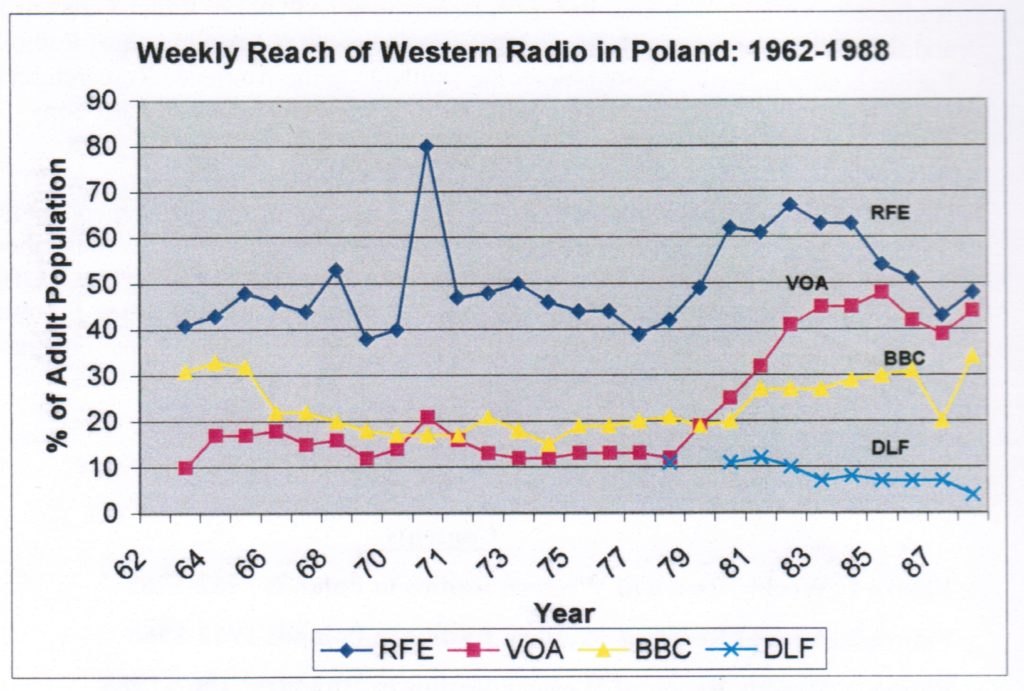
- Radio Free Europe, “The Radio Free Europe Story,” (Munich, Germany), August 1960, 13.
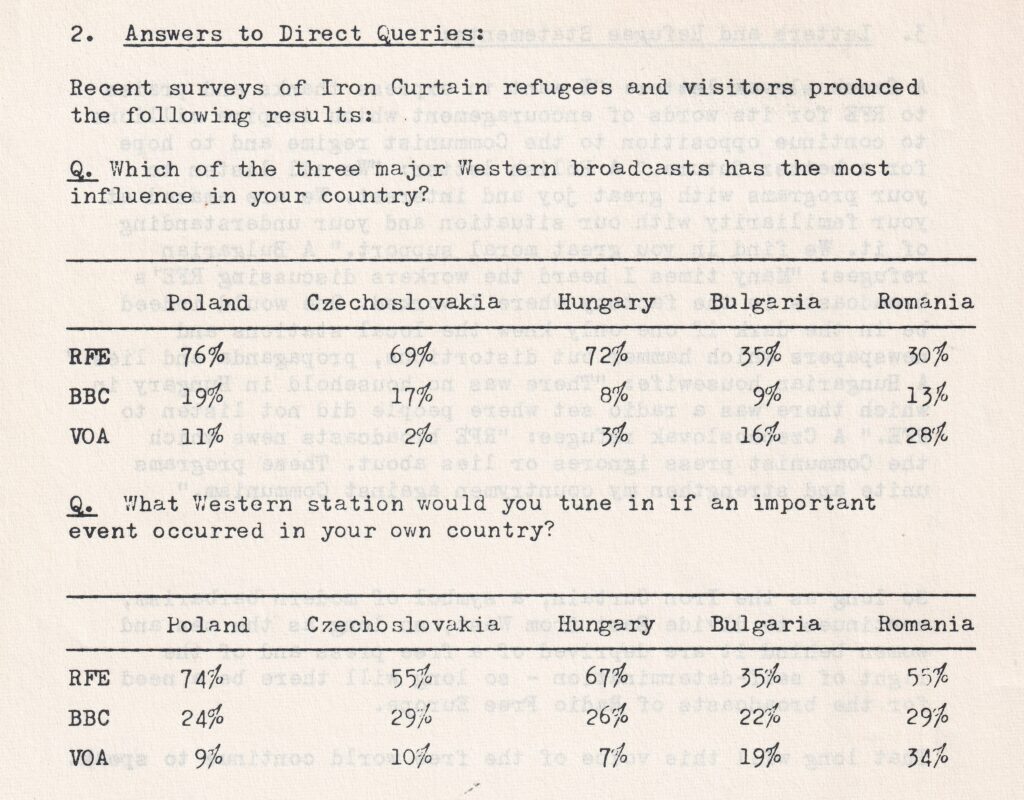
Page 13 from The Radio Free Europe Story (Munich, August 1960), summarizing survey findings on the relative influence of Western broadcasters, including Radio Free Europe, the BBC, and the Voice of America. - U.S. Congress, Congressional Record, 78th Cong., 2nd sess., vol. 90, pt. 4 (May 26, 1944), 5022, Proceedings and Debates of the 78th Congress, https://www.govinfo.gov/content/pkg/GPO-CRECB-1944-pt4/pdf/GPO-CRECB-1944-pt4-12-1.pdf (accessed February 24, 2026).
- Lynch, “Thanks for Listening”, 127.
- Lynch, ADST Oral History interview, February 26, 1992.
- “Conversation with Thomas Donovan, U.S. Embassy Warsaw,” Radio Free Europe internal memorandum, 1959, declassified document, Cold War Radio Museum collection. William E. Griffith served as chief political adviser to Radio Free Europe in Munich during the period when the organization was covertly funded by the Central Intelligence Agency.
- Arch Puddington, Broadcasting Freedom: The Cold War Triumph of Radio Free Europe and Radio Liberty (Lexington: University Press of Kentucky, 2002), 125.
- PAP and Polskie Radio 24.pl, “‘Gazeta Polska’: matka Rafała Trzaskowskiego była tajnym współpracownikiem bezpieki o pseudonimie Justyna,” September 5, 2018.
- John R. Rarick, “The ‘Untouchable Parade,’” remarks in the House of Representatives, Congressional Record, 90th Cong., 2nd sess., February 8, 1968, vol. 114, pt. 3, 2860–2862, https://www.govinfo.gov/content/pkg/GPO-CRECB-1968-pt3/pdf/GPO-CRECB-1968-pt3-2.pdf. (accessed February 25, 2026).
- “Memorandum Concerning United States Information Services Policy Toward Eastern Europe,” March 1961, 47 digital pages, Radio Free Europe, Theodore C. Sorensen Personal Papers, Subject Files, 1961–1964, TCSPP-038-004, John F. Kennedy Presidential Library and Museum, Boston; digital image and full file available online, https://www.jfklibrary.org/asset-viewer/archives/tcspp-038-004#?image_identifier=TCSPP-038-004-p0001 (accessed January 2026).
- USICA Office of Research, “VOA and Western Radio Listening in Urban Poland: 1977.”
- Vello Ederma, acting chief of the European Division, Voice of America (VOA/PE), “Program Expansions to Western Europe,” briefing book prepared for the incoming Reagan administration, July 1981. Cold War Radio Museum collection.
- “Pat Gates Hosted VOA’s Breakfast Show,” VOA News, April 24, 2002, republished October 30, 2009, https://www.voanews.com/a/a-13-a-2002-04-24-10-pat/392163.html (accessed February 25, 2026).
- Howard Fast, “On Receiving the Stalin Peace Award,” http://www.trussel.com/hf/plots/t590.htm (accessed February 25, 2026).
- Howard Fast, Being Red (Boston: Houghton Mifflin Company, 1990), 23.
- Harry S. Truman, Memoirs by Harry S. Truman: 1945 — Year of Decisions (New York: Konecky & Konecky, 1956), 95.
- U.S. Department of State, International Broadcasting Division, press release, July 29, 1947, Record Group 59, National Archives at College Park, College Park, MD.
- U.S. Congress, U.S. Information and Educational Exchange Act of 1948 (Smith–Mundt Act), Pub. L. No. 80-402, 62 Stat. 6 (January 27, 1948), https://www.govinfo.gov/content/pkg/STATUTE-62/pdf/STATUTE-62-Pg6.pdf (accessed February 25, 2026).
- U.S. Information and Educational Exchange Act of 1948, 62 Stat. 6.
- Homer E. Capehart, “Voice of America?” speech delivered in the U.S. Senate, May 26, 1948 (Washington, DC: United States Government Printing Office, 1948), “Not printed at Government expense.”
- Ederma, “Program Expansions to Western Europe,” July 1981, Cold War Radio Museum collection.