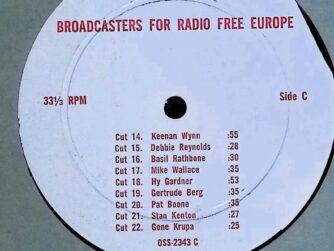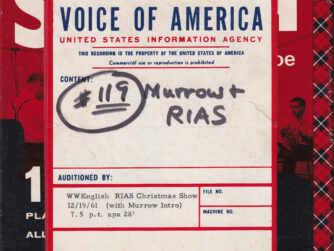

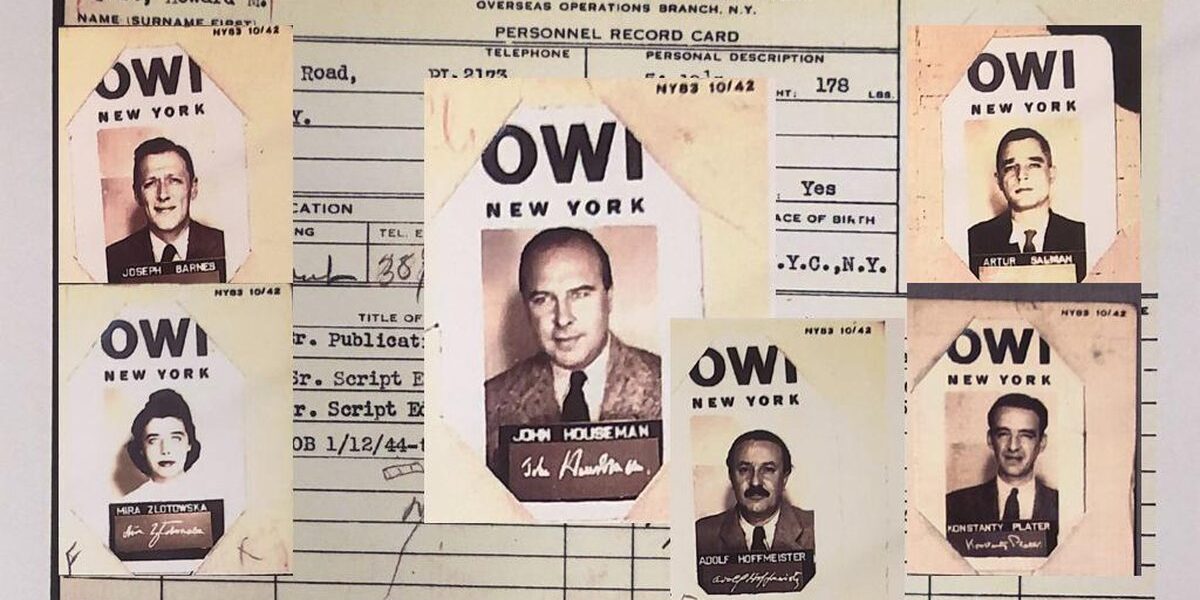
Voice of America, OWI, and the Polish Desk: A Reconsideration
The history of the wartime Voice of America (VOA) is most often presented as a story of broadcasting truthful news in defense of freedom and democracy. That description, while not entirely false, is incomplete.
In the case of the Polish-language sections of the Office of War Information (OWI) and its Voice of America broadcasts, the historical record suggests a more complex—and less examined—reality.
A large majority of those working on these Polish desks who had any prior visibility in the political or cultural life of prewar Poland were individuals with strongly left-leaning views, many of whom later supported—and in numerous cases joined—the Soviet-backed, communist-dominated government established in Poland after the war.1
Polish-American journalist Alina Żerańska, a VOA freelance writer during the Cold War, described the first Polish Service team as “poorly-qualified” producers of “mediocre” programs who, shortly after the war, returned to Poland to serve the communist regime.2
The Office of War Information’s Polish desk employees who worked on VOA broadcasts in New York and later supported the communist-dominated government in Poland—Stefan Arski (born Artur Salman), Aleksander Hertz, Olgierd Langer, Adam Tarn, and Mira Złotowska (born Zandel, later Michałowska)—were not policymakers within the U.S. government’s wartime information structure. As émigrés and minor figures in a large U.S. government bureaucracy, they did not shape the overall strategy toward Poland or make decisions on important programming policies. Yet they participated in their execution and may, at times, have been consulted by senior OWI officials on questions such as the Katyn massacre of thousands of Polish officers by the Soviet NKVD, for which Voice of America broadcasts during the war attributed responsibility to Germany.
Their later choices—taken together—form a pattern that is difficult to ignore. Several of them maintained close contacts with individuals identified by the U.S. counterintelligence service as among the most significant Soviet agents of influence in the United States on Polish affairs: Oskar Lange (NKVD codename “Friend”) and Bolesław “Bill” Gebert (NKVD codename “Ataman”).3
Lange, a Polish-born economist at the University of Chicago who became a naturalized U.S. citizen in 1943, and Gebert, a Polish immigrant and founding member of the Communist Party USA (CPUSA), were associated with efforts to shape American perceptions of Soviet intentions in Eastern Europe, including the belief that Stalin would permit free elections in postwar Poland.4
Lange, who convinced President Roosevelt that Stalin was sincere in stating his support for democratic institutions and religious freedom for the Poles, renounced his U.S. citizenship and became the communist government’s first ambassador of Poland to the United States. 5 Gebert, for his part, recommended Adam Tarn—a former journalist of the OWI Polish desk—for a position in the Polish Ministry of Foreign Affairs in Warsaw, and later served himself as ambassador of the People’s Poland to Turkey.
The Roosevelt administration would have supported the establishment of a pro-Moscow government in Poland regardless of the actions of wartime VOA Polish desk journalists, and such a system would ultimately have been imposed by force, with or without their involvement. Still, the fact that nearly all identifiable wartime journalists from the Polish desks of OWI and VOA later aligned themselves with the communist regime in Poland—as diplomats, journalists, cultural figures, and propagandists, some of them sharply anti-American—is striking.
Equally striking is how little attention this record has received. It remains absent not only from institutional narratives but also from much of the American scholarly and journalistic literature on the history of the Voice of America. The evidence for this pattern comes from several directions at once: contemporary diplomatic reporting, internal critics of OWI and VOA, later Polish scholarship, and the postwar biographies of the journalists themselves.
⸻
Wartime Censorship
The work of these OWI and VOA journalists during the war, shaped both by official policy and personal convictions, frequently aligned with Soviet wartime propaganda. This included:
• the suppression or minimization of Stalinist repression,
• the avoidance of criticism of the Soviet Union,
• and the repetition or acceptance of Soviet claims regarding the Katyn massacre.
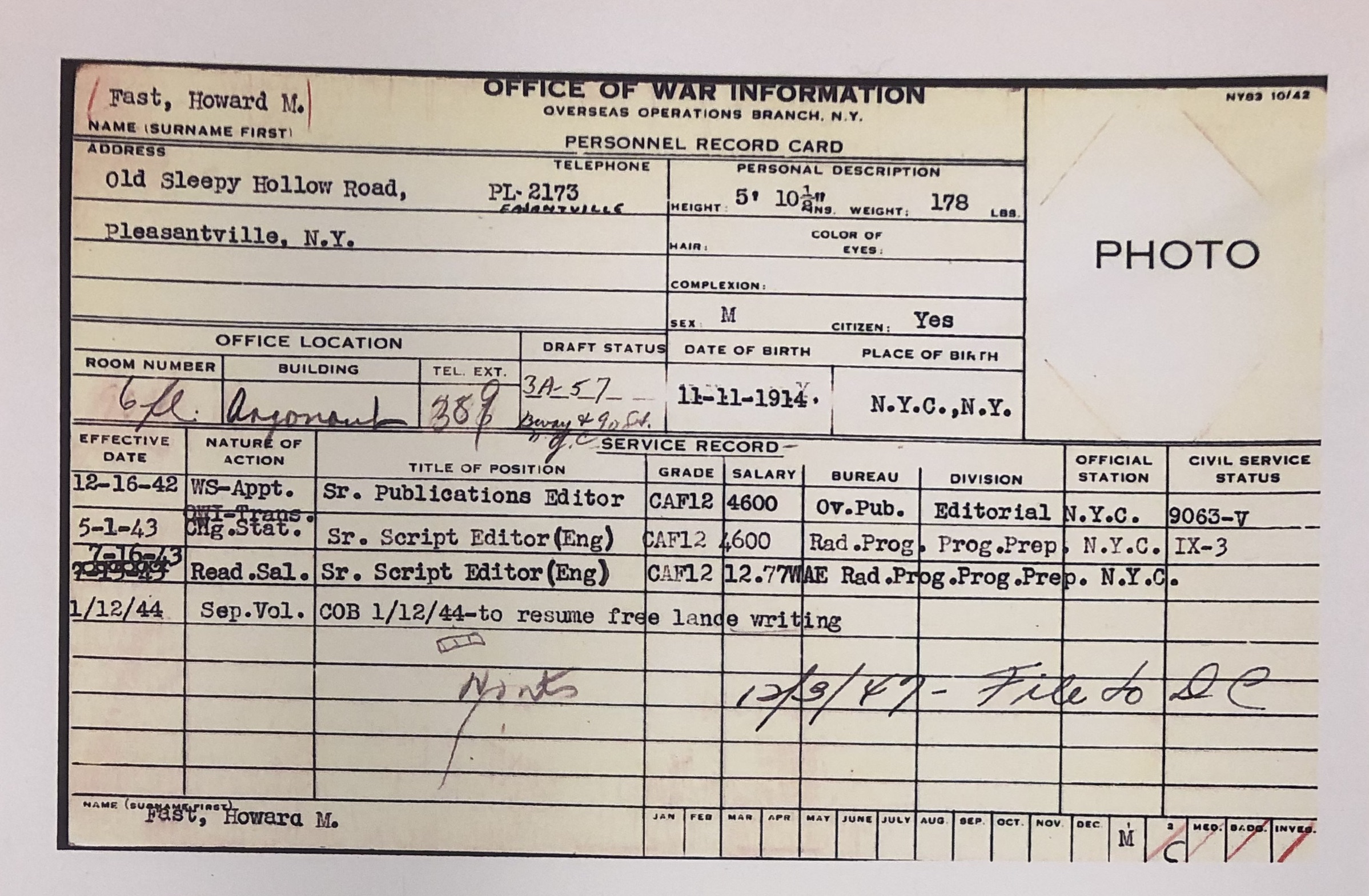
The role of individuals such as Howard Fast—later a Stalin Peace Prize laureate—illustrates this environment. Although often omitted from institutional histories of VOA, Fast himself described his approach to his work as the organization’s first World War II English-language news chief in terms that are revealing. What he rejected as “anti-Soviet or anti-Communist propaganda” included reporting on Stalin’s crimes and on the earlier Soviet alliance with Nazi Germany—topics that the Roosevelt administration did not wish to emphasize in order to preserve the wartime alliance with the Soviet Union.
As for myself, during all my tenure there [VOA], I refused to go into anti-Soviet or anti-Communist propaganda.6
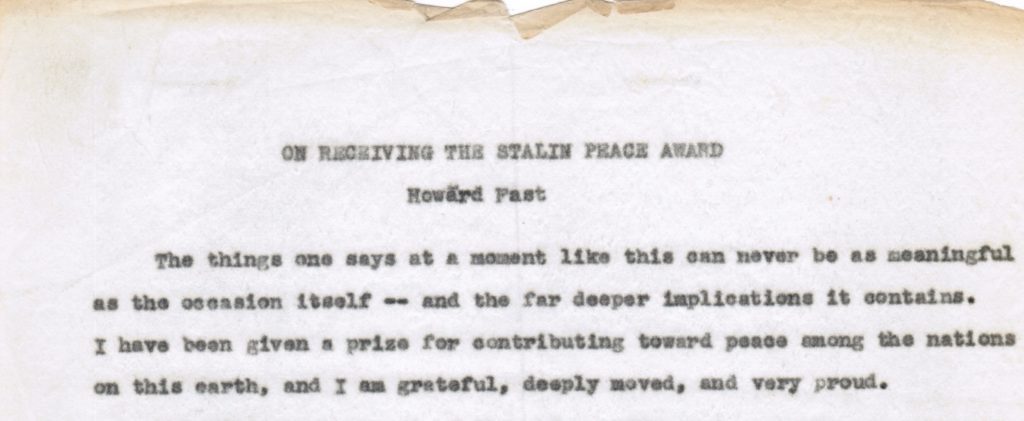
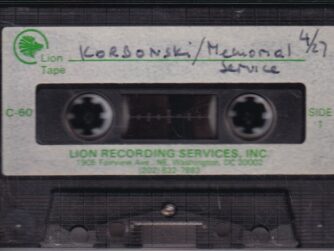
The text shown here reflects the opening portion of his remarks as preserved in the collection of the Cold War Radio Museum / Muzeum Radia Zimnej Wojny im. Stefana i Zofii Korbońskich, which also holds texts of other speeches delivered at the event. Document reproduced for historical and educational purposes (fair use).
These choices by the VOA wartime Polish desk staffers and senior VOA editors and officials were not made in isolation. They reflected a broader policy framework at the highest levels of the Franklin D. Roosevelt administration, which prioritized maintaining the alliance with the Soviet Union and sought to build a postwar international order based on cooperation with Stalin’s Russia, ignoring similarities between communism and fascism and between Hitler and Stalin.
Within this framework, the Office of War Information and the Voice of America contributed to presenting the Soviet Union as a partner in a shared democratic future. This narrative, shaped both from above and reinforced at the level of editorial personnel, influenced how events in Eastern and Central Europe—including developments in Poland—were reported or not reported.
Only one broadcaster associated with the wartime Polish-language service, Konstanty Broel-Plater, is known to have resigned in protest against pro-Soviet propaganda. His work had been restricted, and he faced pressure before leaving the organization in 1944. He was likely the only wartime broadcaster in the entire Voice of America who resigned rather than engage in pro-Soviet propaganda and disinformation. His departure stands in contrast to the decisions of his colleagues, most of whom continued their work during the war and later entered, in various capacities, the political and cultural structures of communist Poland.
Personnel and political orientation
The composition of the Polish desks at the Office of War Information and the Voice of America differed markedly from the political outlook of the societies they purported to address.
The Polish desks did not reflect the political outlook of the majority of Poles in occupied Poland, the democratic and multiparty Polish government-in-exile in London, most Polish-Americans, or most Americans generally. They were instead staffed disproportionately by individuals drawn from radical left-wing and pro-Soviet circles—people who maintained close contacts with communist organizations and Soviet agents of influence, sympathized with Soviet social and geopolitical aims, or later entered the political and cultural structures of communist-ruled Poland. They remained loyal to the government in Warsaw in later years, though it was already clear that there would be no democracy and no respect for basic human rights.
Concerns about the leadership and staffing of the U.S. wartime information apparatus were not formulated only in hindsight. They were voiced during the war itself by Allied representatives in Washington who observed the personnel and editorial direction of OWI at close range.
⸻
Polish Embassy Assessment of OWI Personnel (July 1943)
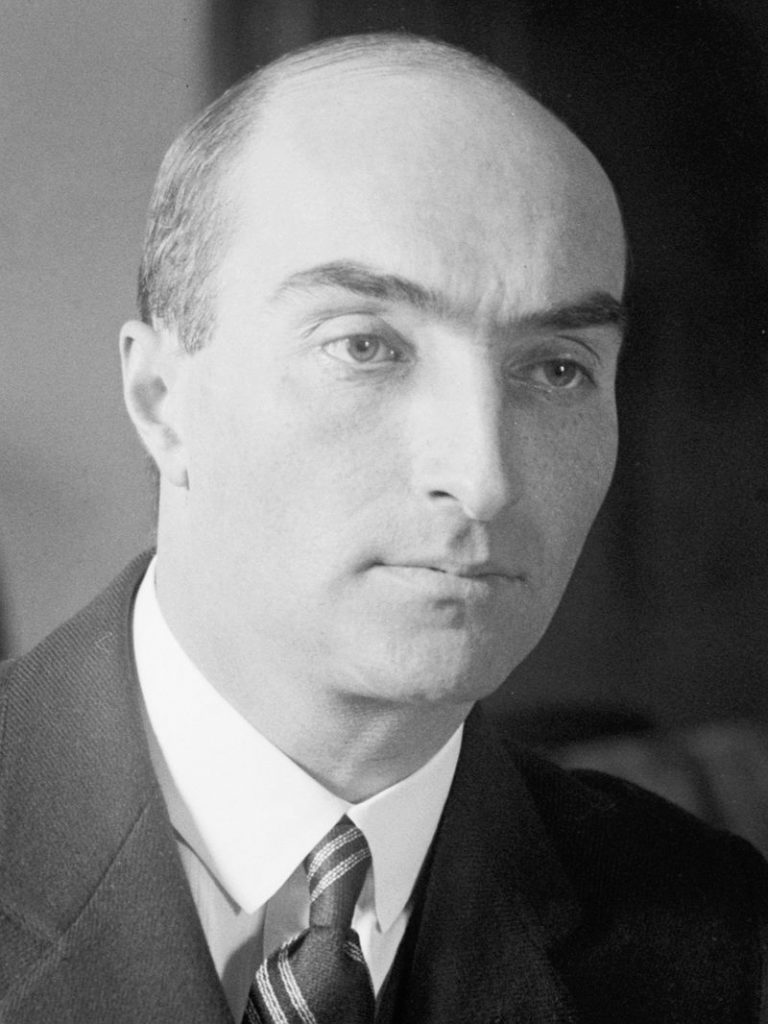
Library of Congress, National Photo Company Collection, LC-DIG-npcc-15231
https://www.loc.gov/pictures/item/2016841495/
One of the clearest contemporary assessments came from the Polish Embassy in Washington.
In July 1943, Ambassador Jan Ciechanowski, representing the Polish government-in-exile in London, reported to the Ministry of Foreign Affairs that responsibility for Polish matters within the U.S. Office of War Information had effectively passed into the hands of individuals openly sympathetic to the Soviet Union. His assessment provides a contemporaneous diplomatic view that the Polish-language section of OWI—closely connected with Voice of America broadcasts—was dominated by pro-Soviet personnel.
Polish matters have been entrusted to a group of Polish nationals who openly manifest their pro-Soviet orientation, such as T. N. Hudes, Aleksander Hertz, Artur Salman [Arski], Mira Złotowska, and Mrs. Irena Balińska—politically disoriented as a result of her long absence from Poland—subordinate to the openly Communist Joseph Barnes in the preparation of leaflets and propaganda publications intended for distribution in Poland.7
⸻
Further observations by Ambassador Ciechanowski
Ciechanowski added that similar concerns were raised by representatives of other Allied governments-in-exile:
Intervention on my part remained without result, as did analogous interventions by the ambassadors of Greece, Holland, and Yugoslavia, whose respective sections within OWI were likewise staffed by communists, deserters from the army and navy, and similar elements.8
Polish wartime Prime Minister Stanisław Mikołajczyk
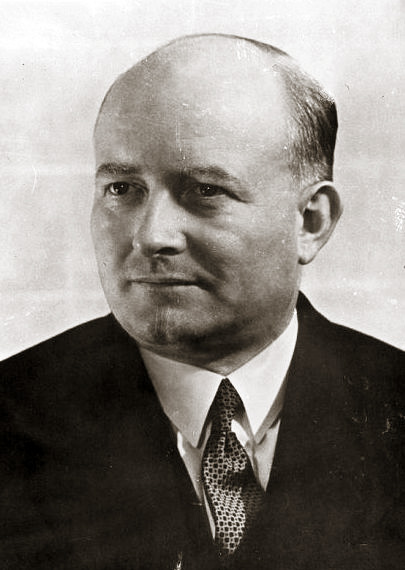
Source: “Gazeta Ludowa,” Warsaw, 1946. Public domain.
Wikimedia Commons: https://commons.wikimedia.org/wiki/File:Mikolajczyk.jpg
The prime minister of the Polish government-in-exile, the agrarian Polish People’s Party leader Stanisław Mikołajczyk, who, under pressure from the U.S. administration, joined the communist-dominated government in Poland and later had to flee to the West to save his life, was also highly critical of wartime Voice of America broadcasts in the Office of War Information.
Mikolajczyk wrote:
We finally protested to the United States State Department about the tone of OWI broadcasts to Poland. Such broadcasts, which we carefully monitored in London, might well have emanated from Moscow itself.9
Mikołajczyk repeated his concerns personally at the State Department during his visit to the United States in June 1944, when he also met with President Roosevelt. Before he met with Roosevelt, Mikołajczyk complained about the Voice of America to Under Secretary of State Edward Stettinius:
I mentioned also the tone of OWI broadcasts to Poland. They had been following the Communist line consistently, which made our own job more difficult. “It’s unwise to adopt this approach to the Polish people,” I told the Undersecretary. “If you continue to call Russia a ‘democracy,’ you may eventually regret that statement, and your people will condemn you. Your government once called Poland ‘the inspiration of the nations,’ but now the OWI calls the Communist forces just that. Please don’t think we haven’t tried to make friends with Russia for we have. Poland just does not want to become another Red satellite.”10
By the middle of the war, criticism of OWI’s handling of Polish affairs was thus being expressed not only privately but at the highest diplomatic level—by Poland’s ambassador in Washington and by the prime minister of the government-in-exile itself.
⸻
Interpretation
These observations are particularly important because they reflect not a retrospective judgment, but a contemporary diplomatic and political assessment made in Washington and London during the war. It suggests that, in the view of the Polish Embassy—and corroborated by other Allied representatives—the staffing and editorial direction of OWI’s foreign-language operations had, at least in part, moved into the hands of individuals whose political sympathies aligned with Soviet objectives.
These concerns were not limited to the Polish desks at OWI and VOA. Ciechanowski also recorded remarks made to him by the wartime ambassadors in Washington from German-occupied Greece, the Netherlands, and Yugoslavia, who expressed similar unease about communist influence within U.S. government information services.
Julius Epstein
Similar concerns were voiced from within the Office of War Information itself. Julius Epstein, a Jewish refugee from Austria and an experienced international journalist, had briefly joined the German Communist Party in his youth but later broke with it. After emigrating to the United States, he worked as a German-language editor for OWI until 1945. Epstein later stated that he believed he had been dismissed because of his internal warnings about Soviet influence within the Voice of America, particularly in relation to its handling of the Katyn massacre.
Writing in 1950, Epstein observed:
There are still too many of the old OWI employees working for the Voice, both in this country and overseas. I mean those writers, translators, and broadcasters who so wholeheartedly and enthusiastically tried for many years to create “love for Stalin,” when this was the official policy of our ill-advised wartime Government and of our military government in Germany. There is no doubt that all those employees were at that time deeply convinced of the absolute correctness of that pro-Stalinist propaganda. How can we expect them to do the exact opposite now?11
In a 1952 article, Epstein made a similar point about his earlier experience:
When I, in 1942, entered the services of what was then the ‘Coordinator of Information,’ which became after a few months the O.W.I., I was immediately struck by the fact that the German desk was almost completely seized by extreme left-wingers who indulged in a purely and exaggerated pro-Stalinist propaganda.12
Taken together, the observations of Ciechanowski, Mikołajczyk, and Epstein suggest that doubts about the political direction of OWI and VOA were present during the war and did not arise solely in the anti-communist atmosphere of the early Cold War.
⸻
Supporting evidence from Polish scholarship
Later Polish scholarship, based on biographical reconstruction and archival research, points in the same direction.
As noted by historian Krzysztof Groniowski, among Polish nationals employed by the Office of War Information up to August 1945, a number openly broke with the Polish government-in-exile and aligned themselves with the emerging Soviet-backed authorities in Poland. He lists, among others, Stefan Arski, Aleksander Hertz, Olgierd Langer (employed from 1944), Adam Tarn, and Mira Złotowska (incorrectly printed in the original text as “Złotnicka”).13
Among the identifiable and better-documented Polish-speaking staff members of OWI and VOA, nearly all those who later became publicly visible in political, diplomatic, or cultural life broke with the Polish government-in-exile and aligned themselves with the communist authorities in Warsaw selected by Stalin to establish a pro-Soviet government in Poland that would be dependent on and controlled by Moscow. This part of VOA’s early history has been largely hidden from Americans, as it is almost never mentioned by American scholars and journalists or noted in public relations materials about the Voice of America. Yet, what had been observed during the war as a matter of concern appears, in retrospect, as a consistent pattern linking wartime staffing with wartime and postwar political alignment.
Houseman and Welles
The same pattern appears in another body of evidence: internal U.S. government correspondence about the staffing of OWI and its foreign-language radio services. Concerns over the choices of personnel were not abstract. They directly affected programming decisions at the highest levels and their implementation in VOA’s English and foreign-language broadcasts.
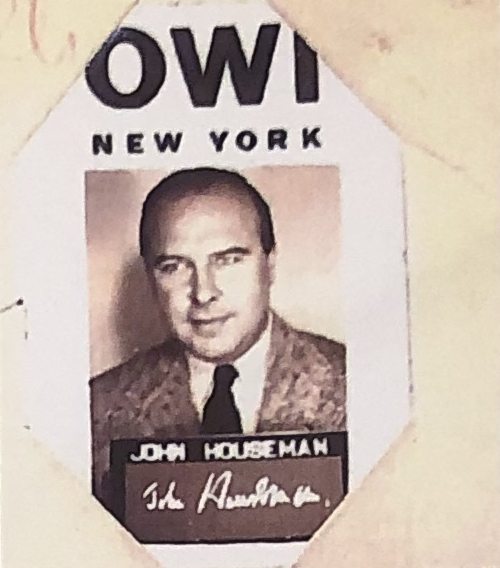
John Houseman, involved in organizing early American wartime broadcasting and later called the first director of the Voice of America, was associated with the recruitment or placement of several individuals with Communist Party affiliations or strong pro-Soviet sympathies. Houseman obtained U.S. citizenship in early 1943 through the special intervention of Robert E. Sherwood, President Roosevelt’s speechwriter and his boss at OWI. However, the State Department still refused to give him a U.S. passport to travel abroad on U.S. government business because of his suspected Soviet and communist links, thus forcing him to resign.14 The circumstances that led to Houseman’s forced resignation, as described by a secret memorandum sent to the White House on April 6, 1943, by President Roosevelt’s close friend and foreign policy advisor, Under Secretary of State Sumner Welles, have not been revealed in American scholarship or in official Voice of America history presentations.

In addition, later research—including Venona project studies of decrypted Soviet intelligence messages—identified Soviet spies and agents of influence operating within wartime American institutions, including circles connected with information work in the Office of War Information and the Voice of America.
John Houseman staffed VOA’s Polish Desk not with the most qualified writers and intellectuals available, but with pliant newcomers who would not question pro-Soviet directives. The same was true for other VOA broadcasting services. As a result, he ignored some of the greatest Polish poets and writers of the twentieth century — émigrés such as Jan Lechoń, Kazimierz Wierzyński, Józef Wittlin, and scholars like Oskar Halecki. Allied-based Polish literary and journalistic luminaries abroad, such as Melchior Wańkowicz and Marian Hemar, were overlooked, even though they could have been recruited for jobs in New York or worked as freelancers and war correspondents with Polish troops attached to the Allied armies.
The absence of these voices was not accidental; it reflected Houseman’s preference for malleable staff who would not challenge the pro-Soviet editorial line. Not all of Poland’s best journalists and writers in exile might have agreed to join VOA during the war, but these figures could have given VOA cultural authority; however, Houseman preferred “performers” who fit the pro-Soviet ideological mold.
Even if the most talented refugees had been hired, they would have faced strict limits. The White House itself — almost certainly Roosevelt, through OWI Director Elmer Davis and propaganda chief Robert Sherwood — dictated that the Katyn massacre, which triggered one of the greatest Soviet propaganda lies, be blamed on the Germans and that Stalin not be criticized. Stalin did not want the mass murder of thousands of Polish POW military officers and intellectuals, which he had ordered in 1940, to be blamed on him, and neither did President Roosevelt and VOA’s fellow-traveler journalists.
Konstanty Broel-Plater
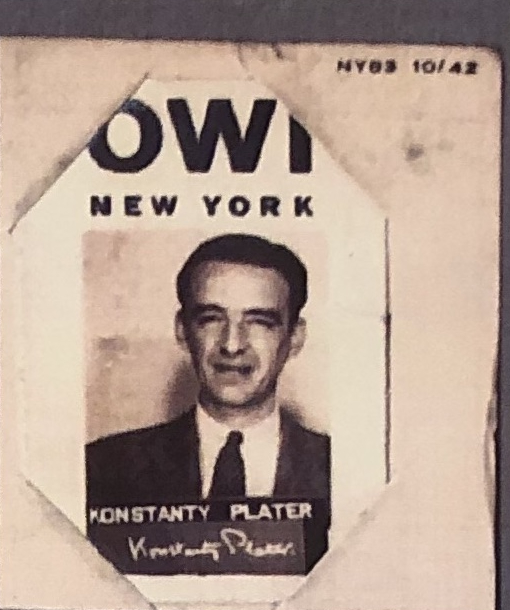
It appears that only one Voice of America journalist, Konstanty Broel-Plater, who had worked on the Voice of America Polish desk, resigned in protest against Soviet propaganda in VOA broadcasts after receiving a warning from the management and being restricted only to reading texts prepared by others.15 The combined evidence suggests that concerns about pro-Soviet influence in wartime broadcasting extended beyond programming to include recruitment, internal oversight, and the marginalization of dissent within the organization.
Adam Tarn: from OWI to the cultural establishment of People’s Poland
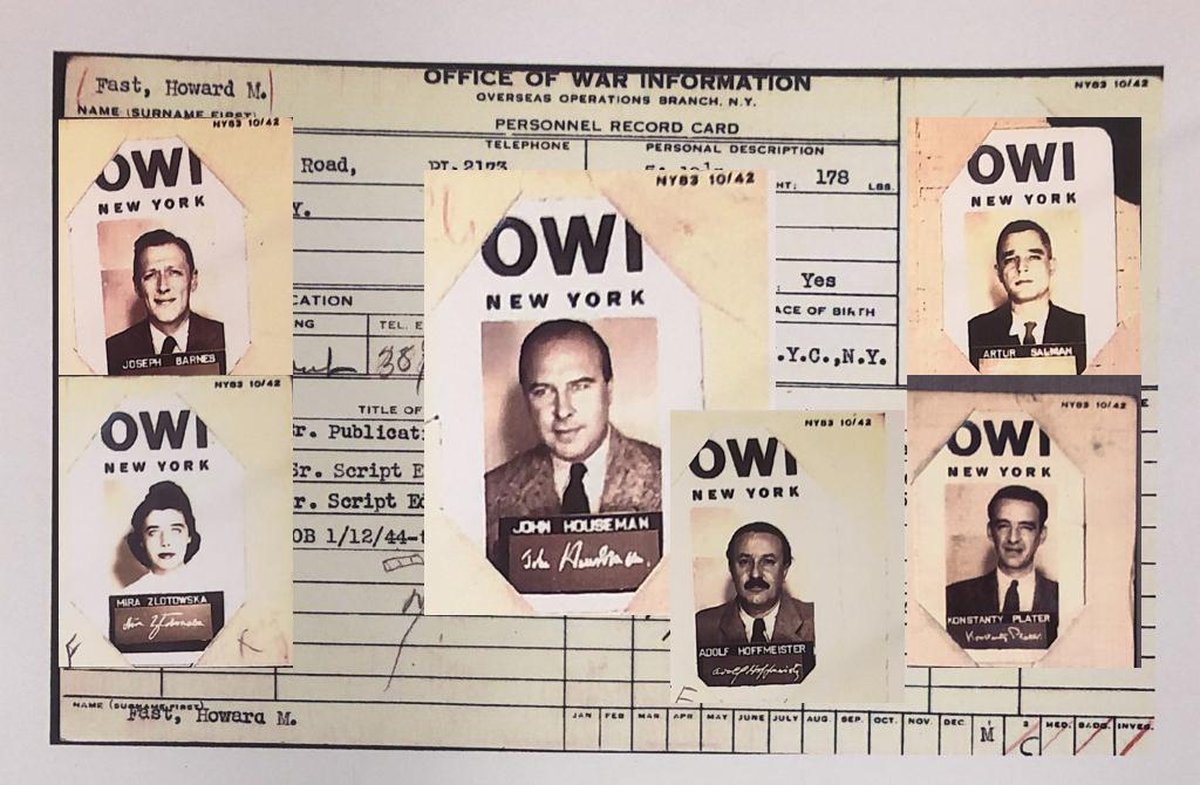
The trajectory outlined above can be seen most clearly in the case of Adam Tarn (Herman Załszupin), whose career connects wartime American information work with the cultural and political institutions of the communist state in Poland.
⸻
Prewar formation
Tarn was a highly educated intellectual, internationally oriented, and associated with left-wing political thought. He joined the Polish Socialist Party (PPS) in 1921.
He did not join the Communist Party before the war—not because of ideological distance, but because:
it was considered preferable that he remain outside formal membership and operate publicly.16
This detail from a Polish scholar, Magdalena Wasąg, is significant. It reflects a strategic relationship with communist politics, not its rejection. Tarn’s development before the war helps explain the choices he later made.
⸻
War and the United States
After the fall of France, Tarn reached the United States in 1940. He struggled initially to establish himself, attempting unsuccessfully to enter the film industry.
In 1942, he joined the Office of War Information.
There, he moved in circles that included:
- Bolesław Gebert ( leader of Polish Communists in the United States, later identified as a Soviet NKVD agent),
- Stefan Arski
- Mira Złotowska (later Michałowska)
- Aleksander Hertz,
- and other left-leaning émigré intellectuals.
⸻
Postwar transition
After leaving OWI in 1945, Tarn:
- left the United States for communist-ruled Poland in 1946,
- entered the diplomatic and cultural structures of the People’s Poland,
- shortly thereafter joined the Polish delegation to the United Nations in New York,
- and worked in the UN Secretariat.
He also joined the ruling Communist Party (PZPR), from which he was expelled during the 1968 antisemitic campaign.17 Tarn’s biography thus follows a path that was not unique but particularly well documented: from wartime employment in American information services to active participation in the institutions of communist Poland and criticism of Western societies, to the rejection of Jewish Communist Party members and cultural figures by the Warsaw regime, which forced most of them, including Tarn, into exile in the West.
His former OWI-VOA colleague, Mira Michałowska, stayed with her husband in Poland, but his diplomatic career was ended by the regime. Stefan Arski was not affected by the 1968 antisemitic purge and continued his journalistic career in Poland. In 1974, he received the Medal of the 30th Anniversary of People’s Poland (Polish: Medal 30-lecia Polski Ludowej).
Adam Tarn in American Sources
American sources from the early Cold War period, though fragmentary and often polemical, noticed essentially the same trajectory. He is not described primarily as a literary figure, but as a participant in a broader political and institutional movement—one that led from American wartime information work into the structures of the communist state in Poland.
These sources vary in tone and reliability. Some are journalistic, others investigative. Taken together, however, they outline a political biography that aligns closely with what is known from Polish sources.
⸻
Alice Widener and The Freeman (1952)
One of the most detailed contemporary American accounts of Tarn’s career appeared in The Freeman, a biweekly magazine identified with anti-communist libertarian and conservative thought. The author, Alice Widener, remains only partially identifiable today; she appears as a contributor to the magazine, but without a well-established independent biographical profile.
In the issue of November 17, 1952, in an article titled “Hiss Led the Way,” Widener described Tarn in the following terms:
Testimony given to the Senate subcommittee by Mr. Frank C. Bancroft and Mrs. Julia Older Bazer showed they are Americans employed in the UN Documents Control Division. This unit — part of which ‘pre-edits’ extremely important UN documents — was partly organized, headed and partly staffed by a Pole named Adam Tarn who performed a remarkable series of political leaps within and away from our country. During World War II, Mr. Tarn was employed by the U. S. Office of War Information. On February 10, 1947, he joined the UN Secretariat, and remained in it long enough to set up the Documents Control unit. On May 21, 1949, he left the Secretariat in order to jump over into the Communist Polish Delegation to the UN, of which he was a member for nearly two years. Adam Tarn then went to Soviet Poland, where he recently wrote a play about the UN Secretariat with a hate-America theme. Six months after Tarn went to the UN Documents control, Mr. Frank C. Bancroft became one of its editors.”18
Widener’s account is compressed, but it captures a sequence that appears repeatedly in other materials: OWI → United Nations → Polish communist diplomatic service → return to Poland.
The inclusion of this article in FBI-related documentation concerning the Hiss–Chambers case indicates that Tarn’s name circulated within American investigative frameworks of the early Cold War, even if he was not a central figure in them. Despite differences in tone and perspective, these American accounts converge on a pattern that corresponds closely to what is known from Polish sources.
⸻
California Senate Report (1959)
Tarn’s name appears again several years later in the Tenth Report of the Senate Fact-Finding Committee on Un-American Activities of the California Legislature (1959). There he is listed among individuals associated with the Office of War Information who were suspected of Communist affiliations, alongside Joseph Barnes and Julia Blazer (Bazer).19
This report belongs to the later phase of Cold War investigations and reflects the interpretive framework of that period. Yet it is notable that Tarn is grouped with figures already known from other sources—particularly Barnes and Bazer—suggesting that American investigators saw them as part of a common pro-communist and pro-Soviet spying and influence operations within OWI, VOA, and related U.S. government structures and other institutions and organizations, such as the United Nations.
⸻
James Burnham and The Web of Subversion (1954)
A further reference appears in James Burnham’s 1954 book The Web of Subversion: Underground Networks in the U.S. Government.
Burnham wrote:
Also in OWI were to be found Julia Bazer, another subsequent United Nations employee who fell back on the Fifth Amendment, and Adam Tarn, who after the war switched his citizenship to Communist-governed Poland.20
Burnham himself is a significant American figure in the intellectual history of the period. Originally associated with Marxism and later with Trotskyism, he broke with the Communist movement in the late 1930s and became one of the leading American critics of Soviet communism. A political philosopher and strategist, he later worked in advisory capacities connected with U.S. intelligence and policy planning during the early Cold War.
His work reflects both insider knowledge of left-wing movements and a strongly critical perspective on them.
⸻
Interpreting Burnham’s claim
Burnham’s statement about Tarn “switching his citizenship” should be treated with caution. It may refer to a formal legal change of nationality, but it may also be a shorthand description of a political and institutional transition—from American wartime service into the structures of the communist Polish state.
At present, this detail requires verification through primary documentation, particularly:
• Tarn’s personnel file at the National Archives in St. Louis,
• and any immigration or naturalization records.
Until such documentation is examined, the phrase is best understood as indicative rather than definitive.
⸻
Possible transmission of information
It is possible that Burnham’s information about Tarn derived from published sources such as Widener’s article. It is also plausible that it was informed by conversations within émigré intellectual circles.
Burnham maintained contact with leading figures of the Polish émigré community, including Józef Czapski and Jerzy Giedroyc, both associated with the anti-communist liberal journal Kultura in Paris. Given these connections, it is reasonable to consider that knowledge about individuals such as Tarn may have circulated through these channels.
At present, however, this remains a plausible hypothesis rather than a documented fact.
⸻
What these sources reveal
Despite their different origins, these American sources converge on a common outline:
• Adam Tarn worked for the U.S. Office of War Information during World War II;
• he moved into the United Nations Secretariat after the war;
• he then entered the diplomatic service of communist Poland;
• and he ultimately returned to Poland, where he produced literary work reflecting the socialist realism and anti-American propaganda framework of the new regime.
This sequence corresponds closely to what is known from Polish archival and scholarly sources.
American observers did not follow Tarn’s career in detail. But when they noticed him, they saw a pattern.
It was the same pattern that appears more broadly in the history of the Polish-language sections of OWI and Voice of America:
a movement from wartime American information work into the institutional and ideological structures of Soviet-aligned communist regimes in Eastern Europe.
The sources differ in tone.
They differ in method.
But in this respect, they do not contradict one another.
They point in the same direction.
Different Choices: VOA’s Supporters of Soviet Communism and the World of Kultura
The trajectory followed by many members of the Polish-language sections of the Office of War Information and the Voice of America was not the only possible path open to Polish intellectuals in the West after World War II.
A markedly different response emerged in the émigré intellectual world centered around Kultura in Paris.
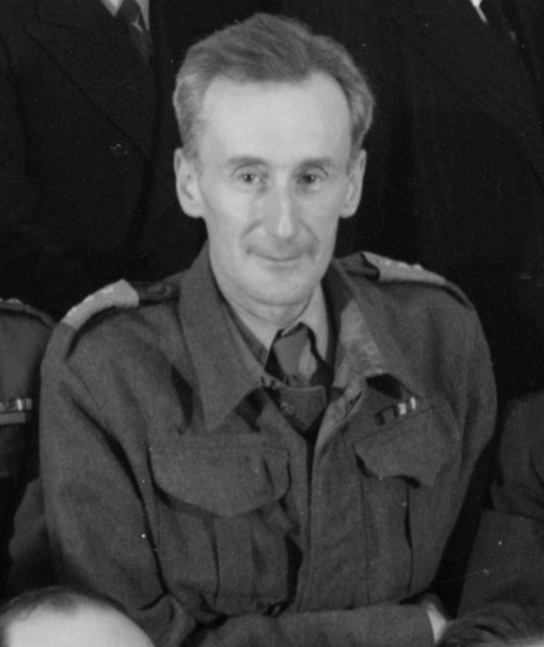
Credit: Matson Photo Service / Library of Congress, Prints and Photographs Division, digital ID matpc.21627, public domain.
Source: https://www.loc.gov/pictures/item/matpc.21627/
A large number of Polish refugees—soldiers, diplomats, writers, and scholars—chose not to return to a Poland now dominated by Soviet power. Among them emerged one of the most important intellectual centers of postwar Polish thought: the Paris-based journal Kultura, led by Jerzy Giedroyc and shaped intellectually by figures such as Józef Czapski, writer, artist, and a Polish reserve officer in Soviet captivity from 1939 to 1941, who was one of the few officers and intelligentsia leaders not executed by the Soviet NKVD in the 1940 Katyn massacre.
Their experience of the war, of Soviet policy, and of the fate of Poland led them to a fundamentally different set of conclusions from those reached by many of their contemporaries who had worked in OWI and later aligned themselves with the communist authorities in Warsaw.
⸻
Giedroyc on the Voice of America
By the late 1940s, Giedroyc had formed a distinctly critical view of the Polish-language broadcasts of the Voice of America. Writing to Zbigniew Florczak on May 9, 1949, he described the Polish section in blunt terms as staffed by “accidental Polish mediocrities.”21
This remark reflected not only a judgment of professional standards but also a deeper disappointment. Many of the individuals who had shaped wartime broadcasts were no longer in the United States. They had already moved—physically and politically—into the structures of communist Poland. Stefan Arski, for example, remained at VOA until early 1947, but soon afterward became one of the most active anti-American propagandists in Poland.
The contrast between these two groups—those who entered or served the communist state, and those who sought to expose and resist it—places the early history of the Voice of America within a broader moral and political framework.
⸻
Disappointment among listeners in Poland
In another letter, written to Czapski during his stay in Canada shortly before his trip to the United States, Giedroyc observed that although the Voice of America continued to be widely listened to in Poland, disappointment with its programming was growing. At the same time, Radio Madrid—despite weak reception—was gaining popularity.22
The criticism was not directed at the idea of American broadcasting itself, but at its tone and content—seen as overly cautious, insufficiently responsive to the realities of life under communist rule, and still marked by the legacy of wartime restraint toward the Soviet Union.
⸻
Burnham, Czapski, and American interlocutors
At this stage, the dialogue about the Voice of America increasingly involved American intellectuals and policymakers. James Burnham, a former Marxist and Trotskyist who became one of the leading American critics of Soviet communism, maintained close contact with Giedroyc and Czapski. He was among those who helped secure financial support for Kultura and who attempted to bring its concerns to the attention of U.S. officials.
Burnham and other American supporters of Kultura, concerned also with publicizing the truth about Katyn, suggested that Czapski raise the issue of VOA policy with senior officials, including the American diplomat Foy D. Kohler, then responsible for the Voice of America and later U.S. ambassador to Moscow during the Cuban Missile Crisis.23
In a letter to Burnham dated January 18, 1950, Giedroyc wrote of what he called the “astonishing irresponsibility and naiveté” of the Voice of America.24
⸻
Czapski’s memorandum on VOA
Burnham transmitted to the U.S. State Department a memorandum written by Czapski in French, reflecting both his own views and those of Giedroyc. The document is one of the most important contemporary critiques of early postwar VOA policy.
Czapski emphasized that disappointment with VOA broadcasts was increasing in Poland. He argued that the United States should more clearly state that the situation of countries behind the Iron Curtain was temporary, in order to give listeners hope that freedom could be restored.
He also recommended:
• broadcasts about the condition of American workers, to counter communist propaganda on this subject,
• programs on émigré life and Polish books published abroad,
• material on Soviet labor camps,
• and commentary on the Alger Hiss case as an example of how the American justice system functioned in practice.
This last point is particularly striking. It directly addressed claims, later echoed in the works of Tarn and Arski, that American justice was fundamentally unjust or corrupt.
⸻
The question of Katyn
One of Czapski’s central concerns was the silence of the Voice of America on the Katyn massacre. In 1950, the VOA management censored his talk about Katyn written to be broadcast to Poland.25 Czapski rejected the argument—advanced by some American officials—that discussing Katyn might provoke unrest in Poland.
He wrote that Poles understood the geopolitical situation and did not expect immediate liberation:
because no free country, and especially America, wants a new war now.”26
His conclusion was direct:
I must admit that this restraint on the question of Katyn leads me to conclude that the line of the Voice of America is cautious to the point of being useless. Faced with massive anti-American propaganda and equally massive pro-Soviet propaganda… only a fighting Voice of America, providing essential, reliable, and truthful information, can achieve its aims.27
⸻
Two contrasting worlds
At the same time that Czapski and Giedroyc were urging a more truthful and direct American voice, former VOA figures such as Stefan Arski and Adam Tarn were developing a different narrative in Poland.
They emphasized:
• the alleged poverty of American workers,
• the supposed injustice of the American legal system,
• and the moral hypocrisy of Western democracy.
These themes appear clearly both in Tarn’s play Zwykła sprawa and in his later writings, as well as in Arski’s journalistic work.
The contrast is difficult to miss.
While these authors criticized the United States for inequality and injustice, Poland itself was undergoing:
• severe economic hardship,
• shortages of basic goods,
• political repression,
• imprisonment of opponents,
• and, in some cases, executions following torture of the accused and show trials.
⸻
Unequal positions
There was also a difference in position and opportunity.
Figures such as Arski, Tarn, and Złotowska-Michałowska became part of the cultural and political elite of the communist state. They had access to:
• publishing institutions,
• travel abroad,
• and official recognition.
By contrast, many independent intellectuals:
• were denied passports,
• prevented from publishing,
• or subjected to surveillance and repression.
Those in exile, including the circle of Kultura, depended on external support for their publishing or journalistic endeavors—often arranged from secret U.S. government funds with the help of American individuals such as Burnham or figures like Arthur Bliss Lane, the first U.S. ambassador to postwar Poland.
The divergence between these two groups—former VOA personnel who aligned themselves with the communist state, and émigré intellectuals who resisted it in the West—was not only political. It reflected fundamentally different interpretations of the same experience and different ethical standards.
Both had lived through the war.
Both had known the United States.
Both spoke to Polish audiences.
But they drew different conclusions about:
• the nature of Soviet power,
• the meaning of democracy,
• and the responsibility of those who spoke in the name of truth.
That divergence is essential to understanding the early history of the Voice of America—and the choices made by those who shaped it.
“An Ordinary Case”: America on trial
Drawing on his experience in the United States, Tarn reinterpreted American institutions for a Polish audience. His most important work, Zwykła sprawa (1950), a play published and performed in communist-ruled Poland, is set in a New York courtroom.
The play was likely inspired in part by real trials of Communist Party members in the United States in the late 1940s:
- these were jury trials,
- conducted under established legal procedures,
- resulting in prison sentences, not executions.
Reports from the period describe American juries composed of ordinary citizens, including working- and middle-class individuals—one often cited example being an African-American woman serving as foreperson. The jury foreperson in the 1949 New York trial of eleven Communist Party leaders was Mrs. Thelma Dial, described as an African-American housewife and the wife of a musician. She delivered the guilty verdict on behalf of the jury.28
⸻
The transformation in the play
In Tarn’s dramatic version:
- the American jury becomes an instrument of pressure,
- economic fear replaces deliberation,
- and the outcome becomes predetermined.
The climactic speech states:
This is your democracy, your freedom—not ours…
you are falsifiers, criminals, and murderers.29
⸻
Case study: American trials and political trials in Poland
The contrast with developments in Poland at the same time is striking.
In the United States:
- defendants were tried by jury,
- sentences were limited,
- no executions followed these political trials, except for the Rosenbergs, who were convicted in a jury trial of passing American atomic secrets to the Soviets.
In Poland:
- trials were controlled by the state,
- verdicts were often predetermined,
- thousands of death sentences were imposed.
The 1948 trial of Witold Pilecki, an officer of the Polish underground Home Army who volunteered to be captured by the Germans to be sent to the Auschwitz concentration camp to send reports to the Polish government-in-exile in London and organize resistance, ended in execution by the communist regime.
At the same time:
- tens of thousands were imprisoned,
- deportations of tens of thousands to Soviet labor camps continued,
- political opposition was systematically eliminated.
In his book, The Grand Failure: The Birth and Death of Communism in the Twentieth Century, Zbigniew Brzezinski estimated that the crushing of the armed resistance to the Soviet-imposed communist regime resulted in about 45,000 deaths, about 5,000 executions of political opponents, and tens of thousands of deportations to the Soviet Gulag.30
Adam Tarn’s critique of “American freedom” in Trybuna Wolności (1952)
The same interpretive framework critical of the United States and its political system appears even more explicitly in Adam Tarn’s journalistic writing.
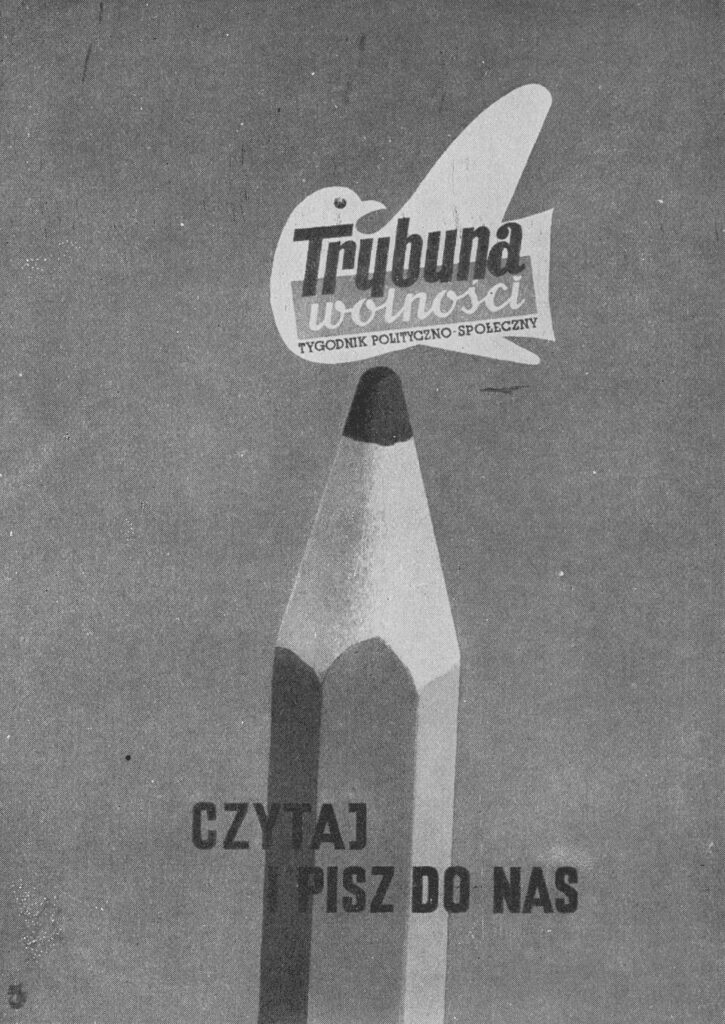
After returning to Poland, he presented himself as a witness to American realities, drawing on his wartime and postwar experience in the United States. His authority, in the eyes of readers, rested precisely on the fact that he had lived and worked in America.
In 1952, he published an article in the communist journal Trybuna Wolności, in which he sought to expose what he described as the hypocrisy of the American way of life and to reinterpret the concept of American freedom in explicitly critical and ironic terms. He asked rhetorically:
What kind of freedom is it? Simply this: the freedom to kick a competitor in the stomach, to trip him, to strike from behind. The freedom to elbow one’s way forward and take advantage of every opportunity. The freedom also to have scruples—and not to take advantage of them. The freedom to say whatever one pleases. The freedom as well to throw a man out onto the street when he says what he pleases. Everything is permitted. It is a free country.31
This passage is representative both in tone and in structure. It relies on irony, repetition, and moral inversion, presenting freedom not as a system of rights protected by law, but as a form of unrestrained competition and social indifference. Tarn’s argument was intended to lend credibility to a broader critique of the United States that the communist state in Poland demanded from writers, journalists, artists, and intellectuals. In communist-era media, critiques of the United States and reinterpretations of concepts such as “freedom” formed part of a broader propaganda narrative promoted by the regime.
Mira Złotowska: presenting Poland to American readers
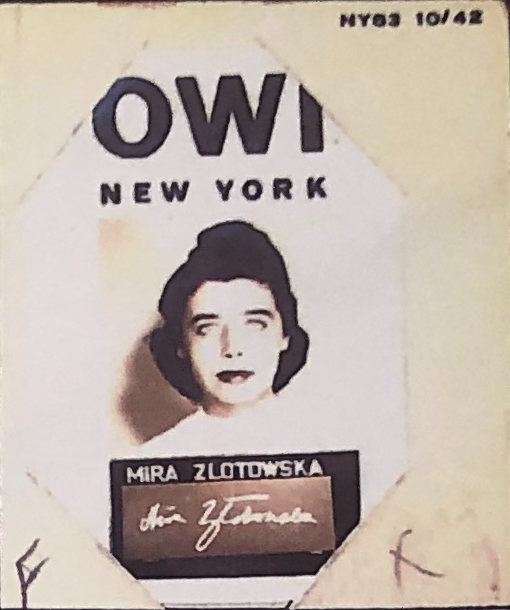
Cold War Radio Museum / Muzeum Radia Zimnej Wojny im. Stefana i Zofii Korbońskich / archival reproduction (OWI identification photograph, New York, c. 1942)
A parallel but complementary role was played by another former OWI-VOA journalist, Mira Złotowska (later Michałowska). If Tarn used his American experience to criticize the United States before Polish audiences, Złotowska used her authority as a Polish observer to reassure American readers about the new order in Poland.
In November 1946, she published in Harper’s Magazine:
“I Came Back from Poland”
The article presented Poland as:
- a country rebuilding,
- a society stabilizing,
- a state governed by respect for the rule of law.32
For American readers, this suggested democracy and continuity with Western legal norms.
⸻
Parallel narratives
Placed alongside Tarn’s work:
- Złotowska reassured Americans about democracy and the rule of law in Poland,
- Tarn questioned justice in America.
The direction differed, but the structure of the argument was strikingly similar: each used personal experience to validate a broader political narrative against the United States and in support of the communist system in Poland.
Stefan Arski: propaganda after the war
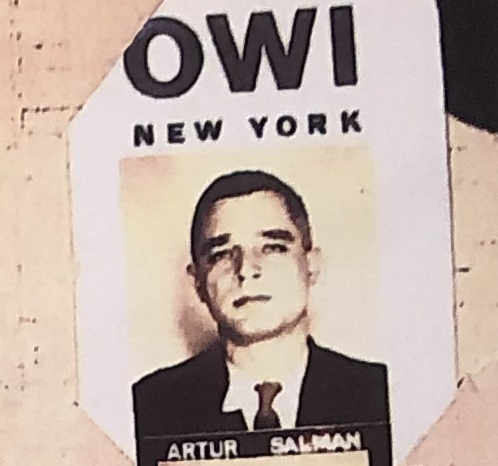
Stefan Arski followed a similar path.
- remained at VOA until 1947, when he was forced out by the Truman administration,
- then moved to Poland,
- became a leading anti-American propagandist,
- repeated and defended the Soviet false claim that the Germans, rather than the Soviet NKVD, were responsible for the Katyn massacre,
- attacked the Madden Committee investigation, the post-war Voice of America, and Radio Free Europe.
And the United States? This promised land of many miracles described to radio listeners in Voice of America programs. If one could eat words, one would die of overeating. Meanwhile, Polish immigrants in the United States are dying from hunger, just as they are dying in Canada.33
Stefan Arski published such anti-U.S. propaganda in his book issued in 1952 by the communist regime in Poland: Targowica leży nad Atlantykiem (“Transatlantic Traitors”).
Diplomatic and institutional paths
Several other individuals employed during the war to produce Voice of America broadcasts in Polish transitioned directly into state roles:
- Olgierd Langer — consular role for the Polish regime in Detroit
- Bolesław Gebert — later regime’s ambassador (including Turkey)
- Mira Michałowska — moved within the diplomatic, media, and cultural circles of the communist state
In parallel, in Czechoslovakia:
- Adolf Hoffmeister, the chief of the wartime VOA Czechoslovak broadcasting, later became ambassador to France for the communist government in Prague
These trajectories show continuity between wartime information work and postwar diplomatic structures.
Aleksander Hertz: a different path
Aleksander Hertz represents a divergence from the early support for the communist authorities in Poland.
- remained in the West,
- became associated with Kultura and opposition to the communist regime,
- contributed to émigré intellectual life.
1968: reversal
In 1968, the communist system turned against some of its earlier supporters who were Jewish.
- Adam Tarn was dismissed from his job, expelled, and forced into exile (eventually in Canada)
- other Jewish intellectuals were removed from positions
Mira Michałowska and her husband remained within the system but were pushed aside.
Conclusion: a clearer historical picture
The evidence reviewed here points to a conclusion that should no longer be avoided. The Polish-language sections of OWI and the wartime Voice of America were staffed to a striking degree by individuals whose political sympathies aligned with the Soviet wartime line and whose later careers placed them in the diplomatic, cultural, and propaganda structures of communist Poland.
This was not the whole story of VOA, but it was an important part of its early history. It helps explain why wartime broadcasts so often softened or suppressed truths about Soviet repression, including Katyn, and why postwar reform of VOA required outside pressure from Congress, the press, and anti-communist émigré critics. That history deserves to be remembered. It should not be treated as an embarrassment to be concealed, but as a warning about what happens when truthful broadcasting is subordinated to ideological fashion and geopolitical expediency. The early history of the Voice of America cannot be fully understood unless this chapter is restored to it.
NOTES:
- The Cold War Radio Museum has not found a complete list of Polish-speaking journalists employed by the Coordinator of Information (COI), the Office of War Information, and the Voice of America unit within OWI. However, among the best-known figures whose biographies and employment histories have been documented, nearly all supported the postwar communist regime in Poland.
- “Pierwsze audycje sekcji polskiej były marne. Dostały się tam wtedy jakieś mało wykwalifikowane osoby, które wnet po wojnie wróciły do kraju.” Alina Żerańska, “50 Lat Głosu Ameryki,” Nowy Dziennik: Przegląd Polski, April 30, 1992, Section 2.
- Magdalena Wasąg, “Cień Ameryki. ‘Zwykła sprawa’ Adama Tarna i ‘Dwunastu gniewnych ludzi’ Sidneya Lumeta,” Didaskalia, https://didaskalia.pl/pl/artykul/cien-ameryki. Wasąg cites Adam Tarn’s 1949 employment application, in which—according to the account of Bolesław Gebert—Tarn maintained contacts with “communists and socialists (Gebert, Lange, Araki, Hertz, Penzik)” during his work at the Office of War Information; see Adam Tarn, “Podanie o pracę,” January 7, 1949, Institute of National Remembrance (IPN), BU 01224/1526/D. On Oskar Lange (“Friend”) and Bolesław Gebert (“Ataman”) as Soviet agents of influence identified in decrypted Venona cables, see John Earl Haynes and Harvey Klehr, Venona: Decoding Soviet Espionage in America (New Haven: Yale University Press, 1999).
- John Earl Haynes and Harvey Klehr, Venona: Decoding Soviet Espionage in America (New Haven: Yale University Press, 1999), p 235.
- While distancing himself in public from Lange and presenting his trip as a purely private initiative despite considerable logistical support for it from the U.S. government, President Roosevelt continued to promote to Stanisław Mikołajczyk, the Prime Minister of the Polish government-in-exile in London, what he thought were encouraging results of Lange’s conversations with Stalin. Roosevelt also stated that Father Stanislaus Orlemanski, a radical Polish-American Catholic priest who went with Lange to see Stalin, was “pure and decent, possibly too naive, but with good intentions.” Jan Ciechanowski, Defeat in Victory (New York: Doubleday & Company, 1947), 308–10.
- Howard Fast, Being Red (Boston: Houghton Mifflin Company, 1990), 23.
- Jan Ciechanowski, Polish Ambassador in Washington, report to the Polish Ministry of Foreign Affairs in London, July 13, 1943, concerning the Office of War Information (OWI) and its handling of Polish affairs. The document is preserved in the Hoover Institution Archives (microfilm copy) and in the Archiwum Akt Nowych (Central Archives of Modern Records), Warsaw; digitized version available via Narodowe Archiwum Cyfrowe (National Digital Archives, Poland).
- Ciechanowski, Polish Ambassador in Washington, report to the Polish Ministry of Foreign Affairs in London, July 13, 1943.
- Stanisław Mikołajczyk, The Rape of Poland: Pattern of Soviet Aggression (New York: McGraw-Hill, 1948), 25.
- Mikołajczyk, The Rape of Poland: Pattern of Soviet Aggression, 58–59.
- Congressional Record: Proceedings and Debates of the 81st Congress, Second Session, Appendix. Part 17 ed. Vol. 96. August 4, 1950, to September 22, 1950, A5744–A5745.
- Julius Epstein, “The O.W.I. and the Voice of America,” a reprint from the Polish American Journal, Scranton, Pennsylvania, 1952.
- Krzysztof Groniowski, “Poland Fights (1941–1946),” Kwartalnik Historii Prasy Polskiej 29, no. 2 (1990): 67–93, https://bazhum.muzhp.pl/media/texts/kwartalnik-historii-prasy-polskiej/1990-tom-29-numer-2/kwartalnik_historii_prasy_polskiej-r1990-t29-n2-s67-93.pdf.
- Page from an April 6, 1943 memorandum by Under Secretary of State Sumner Welles to the White House (President’s Secretary’s File, Franklin D. Roosevelt Library), identifying John Houseman—chief producer of U.S. wartime radio broadcasts later known as Voice of America—as among Office of War Information personnel denied passports due to concerns about Communist affiliations and influence within foreign-language radio sections. Only one piece of information in the attachment about John Houseman sent to the White House by Under Secretary of State Sumner Welles was false. Native Son, a 1940 novel by Richard Wright, was not subversive or un-American. Wright, an African American writer who joined the Communist Party, broke with it and condemned Communism in a 1949 collection of essays, The God That Failed. Source: http://www.fdrlibrary.marist.edu/_resources/images/psf/psfb000259.pdf.
- Teofil Lachowicz, “Zapomniany dyplomata,” Przegląd Polski (New York), October 20, 2000.
- Magdalena Wasąg, “Cień Ameryki, Zwykła sprawa Adama Tarna i Dwunastu gniewnych ludzi Sidneya Lumeta,” Didaskalia. Gazeta Teatralna, 2021 nr 166, DOI: 10.34762/n17f-2m36, https://didaskalia.pl/pl/artykul/cien-ameryki.
- Wasąg, Cień Ameryki.
- Alice Widener, “Hiss Led the Way,” The Freeman 3, no. 4 (November 17, 1952): 129, https://archive.org/details/sim_freeman_1952-11-17_3_4/page/129/mode/1up. The article was also reproduced in FBI-related documentation on the Alger Hiss–Whittaker Chambers case: https://archive.org/details/AlgerHissWhittakerChambers/Hiss%2C%20Alger-Whittaker%20Chambers-xrefs-4/page/n21/mode/2up.
- Tenth Report of the Senate Fact-Finding Committee on Un-American Activities (California Legislature, 1959), 174, https://ia601600.us.archive.org/27/items/reportofsenatefa1959cali/reportofsenatefa1959cali.pdf.
- James Burnham, The Web of Subversion: Underground Networks in the U.S. Government (New York: The John Day Company, 1954).
- Jerzy Giedroyc to Zbigniew Florczak, May 9, 1949, quoted in Rafał Habielski, ed., Jerzy Giedroyc – Józef Czapski – Listy 1949–1951 (Warsaw: Więź, 2025), 211, 214 (based on the Archives of the Instytut Literacki).
- Habielski, ed., Jerzy Giedroyc – Józef Czapski – Listy 1949–1951, 341–342.
- Habielski, ed., Jerzy Giedroyc – Józef Czapski – Listy 1949–1951, 347.
- Habielski, ed., Jerzy Giedroyc – Józef Czapski – Listy 1949–1951, 376.
- Prof. J.K. Zawodny wrote in his 1962 Katyn study, Death in the Forest: “Even in the postwar years, after President Roosevelt had died, the war with Japan was over, and the U.N. Charter was already in effect—the policy of suppressing the Katyn case was continued by the State Department. The war was over for several years when Mr. Czapski, the man so actively engaged in searching for the missing men in Russia, and himself a survivor of the annihilation, came to the United States for a visit in the early spring of 1950. The Voice of America invited him to make a broadcast in the Polish language to Poland. From it, officials of the Voice of America meticulously eliminated all references to the Katyn Massacre. He was not even allowed to mention the word “Katyn. In a footnote, Prof. Zawodny cited the 1952 Congressional Record and stated that this information was verified by Mr. Czapski in his letter of December 26, 1959. J. K. Zawodny, Death in the Forest (Notre Dame: University of Notre Dame Press, 1962), 186.
- Habielski, ed., Jerzy Giedroyc – Józef Czapski – Listy 1949–1951, 427.
- Habielski, ed., Jerzy Giedroyc – Józef Czapski – Listy 1949–1951, 427.
- “COMMUNISTS: The Presence of Evil,” Time, October 24, 1949, describing “a Negro housewife… Mrs. Thelma Dial… foreman of the jury,” https://time.com/archive/6607446/communists-the-presence-of-evil/
- Wasąg, Cień Ameryki.
- Zbigniew Brzezinski, The Grand Failure: The Birth and Death of Communism in the Twentieth Century (New York: Charles Scribner’s Sons, 1989), 110.
- Adam Tarn, article in Trybuna Wolności, no. 13 (1952), 5. The original Polish text reads: “Jakaż to wolność? No, po prostu taka, że wolno konkurenta kopać w brzuch, podstawiać mu nogę, uderzać z tyłu. Wolno rozpychać się łokciami i korzystać z okazji. Wolno też mieć skrupuły i nie korzystać z okazji. Wolno mówić wszystko, co się komu podoba. Wolno też wyrzucić człowieka na bruk, gdy mówi, co mu się podoba. Wszystko wolno. To wolny kraj.”
- Mira Złotowska, „I came back from Poland”, Harper’s, November 1946, 428–429, https://harpers.org/author/mirazlotowska/.
- Targowica leży nad Atlantykiem (Warsaw: Książka i Wiedza, 1952), 102–109.