

Recovering a forgotten Voice of America / RIAS relay preserved on magnetic tape
At a glance
- Listen first: Murrow’s introduction + RIAS Christmas segments (VOA WW English relay, Dec. 1961)
- Why it matters: A rare example of Cold War broadcasting as “human voice” diplomacy across a sealed border
- Deep dive: VOA’s institutional history, Murrow’s USIA role, and primary-source documents
Jump to a section
- I. Introduction – Why This Tape Matters
- II. Murrow’s Voice: A Bridge Across the Wall
- III. The Hidden Story – VOA’s Pro-Soviet Origins
- IV. Religion, Resistance, and What Washington Missed
- V. U.S. Broadcasting Strategy After 1945 – What Changed, What Didn’t
- VI. The Berlin Voices: Clips from the Broadcast
- VII. Murrow Inside Government – The Censorship Dilemma
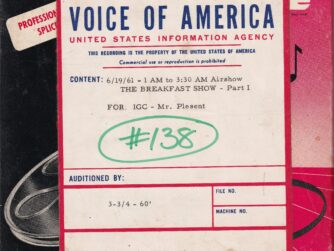
- VIII. Artifact Description – Tape, Provenance, Label Notes
- IX. Full Primary Source Transcripts
I. Introduction – Why This Tape Matters
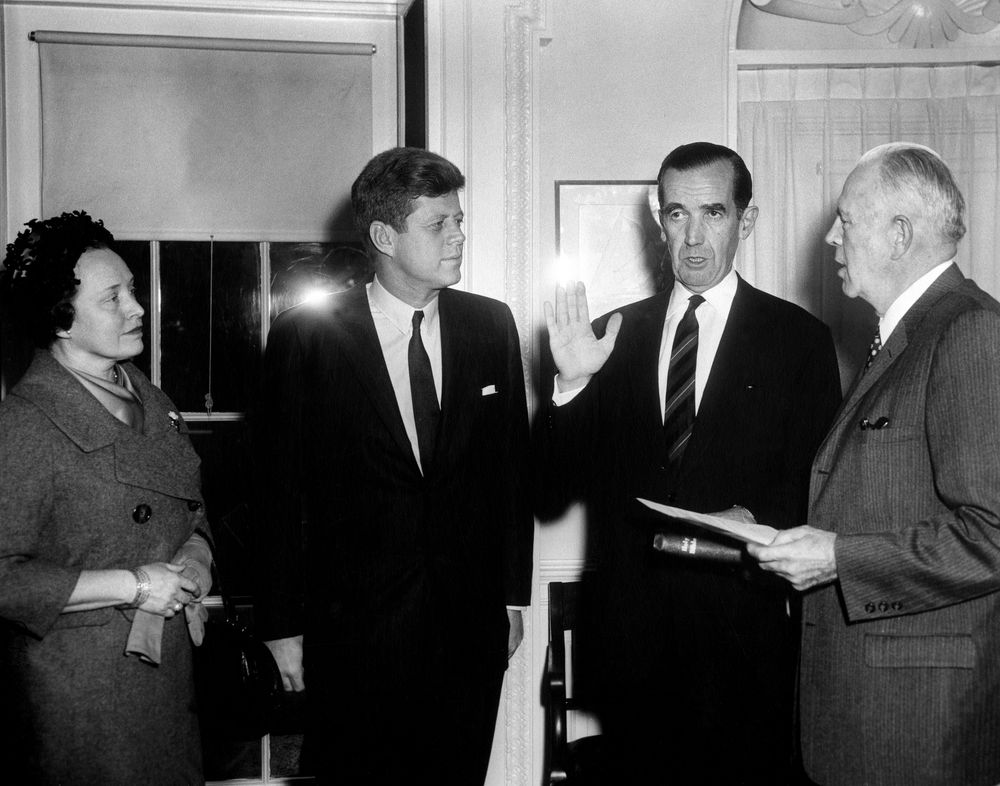
In December 1961 — just months after the Berlin Wall divided Berlin and reshaped Cold War realities — the Voice of America (VOA) presented a special World-Wide English broadcast featuring English-language renditions of Christmas material first heard on RIAS, the radio in the American sector of West Berlin. Introduced by United States Information Agency (USIA) Director Edward R. Murrow, the program reflected the Kennedy administration’s determination to strengthen U.S. outreach and counter communist propaganda and censorship with renewed clarity. Preserved today on its original reel-to-reel tape by the Cold War Radio Museum, this rare recording shows how Washington sought to reach across a sealed border not with polemics, but through voices of East German defectors, messages from families separated by the Wall, music, and a quiet affirmation of connection and the ideas of freedom.
RIAS stood for Radio in the American Sector; German: Rundfunk im amerikanischen Sektor, a radio founded by the U.S. occupational authorities in 1946 that evolved into a surrogate home service for East German listeners. RIAS remained under U.S. oversight through the U.S. High Commission and later USIA, though day-to-day production was German-run. In this Voice of America English-language broadcast about RIAS, a U.S. Senator speaks directly to East German listeners, promising that “Americans have not forgotten you,” and listeners hear family greetings that cannot longer cross the Wall. Together, these political and personal voices show why RIAS mattered in 1961 – and why this recording remains worth preserving today.
This recording is both a Christmas message and a Cold War document — evidence of how radio functioned as a form of human rights intervention when the Soviet Union and other communist-ruled nations closed physical borders. Edward Murrow’s broadcast was shaped by his instinct for decisive moral action, yet the historical picture is more complex. He believed that President Kennedy and the leaders of other Western powers could have stopped the Wall from going up. Others feared that any attempt by U.S. forces to interfere with the initial construction of the Berlin Wall could have triggered unpredictable escalation — possibly even armed confrontation between American and Soviet units. Friends who heard Murrow’s lament later suggested that his frustration, while emotionally compelling, did not fully account for the risks of counteraction in August 1961.1 We will never know whether intervention would have halted the Wall or merely produced a tragic bloodbath. What remains certain is that Murrow interpreted the moment as an example of hesitation and lack of leadership in the West.
After President Kennedy appointed him USIA director — and with the President’s explicit backing — Murrow moved quickly to strengthen U.S. efforts to counter communist propaganda not only in East Germany but throughout the Soviet Bloc and in countries facing the threat of communist expansion. In government, he did not seek to reshape the Voice of America in CBS’s image; instead, he insisted that a taxpayer-funded international broadcaster must speak with a different clarity and edge — reflecting national purpose, congressional intent, and the expectations of Americans whose dollars financed it. The 1961 Christmas program reflects that shift: a broadcast that used culture, memory, and the human voice as instruments of policy, reaching across borders where physical movement and open communication had been denied.
Rather than answer the Wall with force — a response that risked bloodshed and a wider East–West confrontation — Kennedy chose to fight with ideas and information. Under his administration, U.S.-funded radio broadcasts became a central instrument of policy: feared by the Kremlin and its satellite regimes, yet sought after by the very populations those regimes tried to seal off. Whether Kennedy or Murrow fully foresaw that weakening a totalitarian system through words would take decades, the record shows that this strategy became a defining pillar of Western policy. But it was never a substitute for hard power. The credibility and reach of this informational offensive rested on the parallel existence of NATO, U.S. military strength, and the political will to defend the West if necessary. Nowhere is this clearer than in the contrasting outcomes of the Cold War in Europe and the failure to contain communism in Southeast Asia with military force. Containment and deterrence proved effective in combination with information and public diplomacy outreach but not everywhere. It did not work in Viertnam, where the United States became militarily involved in a post-colonial nation. Later, President Reagan would expand both sides of the equation — dramatically growing U.S. defense spending but without a major military engagement abroad while also investing more in surrogate broadcasting, public diplomacy, and information warfare. The long arc of history shows that words alone could not have accomplished the peaceful collapse of Soviet rule, but when fused with deterrence and the ability to back principle with force, they proved more powerful in the end than tanks or troops. These broadcasts succeeded without triggering a violent conflict.

Archival Note — Early RIAS: “The Voice of America in Berlin” (1949)
(Photograph on file; not reproduced here)
The Cold War Radio Museum holds a 1949 photograph depicting American and German officials associated with RIAS – Radio in the American Sector (Berlin). Out of an abundance of caution regarding image-copyright status and reproduction rights, the photograph is not published online here. Scholars and credentialed researchers may request access to view the original image by contacting the Museum.
Although not displayed, the photograph is historically significant because the reverse caption refers to RIAS as “the Voice of America in Berlin” and identifies senior figures as “American and German officials of radio RIAS.” This wording reflects the institutional reality of the late 1940s: RIAS was funded and strategically supervised by the U.S. Government, including a U.S. Control Officer and an American Director, while German editors and announcers delivered most on-air content. The American-German partnership was framed as joint, but the early governance structure remained largely American.
This hybrid identity mattered. It enabled RIAS to evolve — over the 1950s — from being dominated by U.S. oversight into a true German surrogate broadcaster, speaking to East Germans in their own language, idiom, cultural references, and emotional register. By contrast, the Voice of America remained structurally and editorially American, broadcasting from America to the world, usually in English. There were many small VOA foreign language services, but with the funds and resources given to them by the management, they could do little more than translate programs prepared in English.
Context: RIAS, VOA, and Rare Moments of Institutional Cooperation
The Edward R. Murrow / VOA / RIAS tape featured in this article — a 1961 VOA World-Wide English program introducing RIAS to international audiences — is a valuable example of cross-institutional cooperation among U.S. public diplomacy actors:
- American USIA officials (Washington-based public diplomacy)
- VOA officials and English-language editors (global news)
- RIAS German broadcasters (local surrogate voice for East Germany under American management)
Such joint projects were not common. RIAS, much like its later counterparts Radio Free Europe (RFE) and Radio Liberty (RL), guarded its identity as a surrogate broadcaster and generally avoided being seen as part of U.S. government information-policy messaging, especially in English. Their legitimacy rested on sounding local — Polish voices for Poland, Czech and Slovak voices for Czechoslovakia, German voices for East Berlin — not voices speaking about them from Washington.
Therefore, the Murrow-introduced 1961 program was not meant for East German listeners; it was aimed at VOA’s English-speaking global audience, functioning largely as a public relations effort explaining RIAS to the world, rather than as a routine program of coordinated messaging.
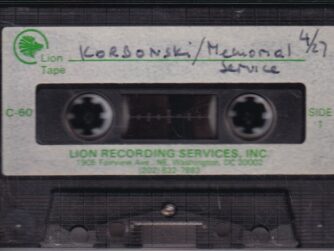
The surviving tape, labeled ‘WW English – RIAS Christmas Show – 12/19/61 (with Murrow intro),’ is held in the Cold War Radio Museum archive.
II. Murrow’s Voice: A Bridge Across the Wall
🎧 LISTEN FIRST
Edward R. Murrow introduces a RIAS Christmas broadcast from Berlin (December 1961).
Clip 1 — Murrow/VOA Introduction
Murrow’s broadcast about the Berlin Wall carries historical ironies that were largely forgotten at the time and remain insufficiently understood even today — more than sixty years later, at a moment when Russia’s propaganda and influence are again resurgent in the United States and in global affairs. Like President Kennedy, who appointed him USIA director, Murrow believed that U.S. information policy should help undermine Soviet domination in Eastern and Central Europe and counter communist advances in Cuba.
Yet less than two decades earlier, the very U.S. government radio outlet Murrow now symbolically represented — the Voice of America — had played a dramatically different role. During World War II, VOA functioned as an anti-German and anti-Japanese propaganda radio operation, but it was influenced by pro-Soviet officials within the Roosevelt administration and communist sympathizers among its journalists. At times, its early programming supported narratives that even exceeded President Roosevelt’s own willingness to appease Stalin. Roosevelt, though determined to maintain wartime unity with the Soviet Union, was sensitive to the political optics of government-funded domestic propaganda as unacceptable to most Americans and aware of the need to retain the Polish-American vote in the 1944 election — while concealing from the voters negotiations that would ultimately concede Poland’s freedom and territorial integrity to Soviet control. He deceived Polish-American leaders about his deals with Stalin at Poland’s expense to gain their support. Arthur Bliss Lane, who as the U.S. Ambassador in Warsaw from 1945 to 1947, documented the Soviet and communist takeover of the country, observed in his book I Saw Poland Betrayed Roosevelt’s manipulation of the Polish American public opinion. 2 As Ambassador Bliss Lane wrote after he had resigned from the State Department in protest against the appeasement of Stalin, President Roosevelt “had already agreed at Tehran to the sacrifice of a great area east of the Curzon Line to the Soviet Union.” Charles Rozmarek, President of the PAC, said later that had the Yalta Conference been held before the presidential elections of 1944, Mr. Roosevelt would not have been reelected, because of the votes of Americans linked by blood to those nations which had been “sold down the river.”3
General Dwight D. Eisenhower viewed some of VOA’s wartime broadcasts as a military liability. According to Eisenhower, communist-inspired excesses by early VOA broadcasters risked endangering American soldiers when VOA ridiculed tactical agreements he had reached with certain Vichy French and Italian officials to persuade them to abandon cooperation with Nazi Germany. In his memoir, Eisenhower recalled that President Roosevelt intervened to stop what he considered VOA’s “insubordination.” He also complained that as president, a VOA reporter attempted to obtain a statement from a member of Congress to attack his Middle East policy for domestic partisan purposes—a request the lawmaker reportedly refused.4
Poor personnel security, Soviet influence over elements of wartime propaganda, and the use of VOA broadcasts for domestic political purposes contributed to President Truman’s decision to abolish the Office of War Information in 1945. VOA was transferred to the State Department, and Truman administration appointees dismissed pro-Soviet staff while establishing a hiring policy that gave preference to American citizens. The Smith–Mundt Act, signed by President Truman in 1948, mandated stricter security vetting of personnel and also prohibited domestic dissemination of VOA programs — a restriction that remained in place until being loosened in 2012.
Murrow’s introduction to the RIAS program segments carries historical ironies that were largely forgotten at the time and remain insufficiently understood even today. Like President Kennedy, who appointed him USIA director, Murrow believed that U.S. information policy should help undermine Soviet domination in Eastern and Central Europe and counter communist advances in Cuba. In contrast, during World War II, the Voice of America was at times much more pro-Soviet than even President Roosevelt was willing to tolerate, despite his desire to appease Stalin. While Roosevelt was more worried about domestic political scandals over some of VOA’s pro-communist programs and broadcasters and wanted to secure the Polish-American vote in the 1944 presidential elections by deceiving Polish-American leaders about his deal with Stalin at the expense of Poland’s territory and independence, General Eisenhower was worried about VOA propaganda putting the lives of American soldiers at risk.5
Among its early critics — including members of Congress from both parties — the Voice of America became associated with Roosevelt-era information policies that, at times, echoed Soviet narratives and helped reduce public resistance to Stalin’s designs on East-Central Europe. Its reputation was later further complicated by the continued postwar presence of officials sympathetic to pro-Soviet positions within segments of the U.S. government. By 1961, however, VOA had undergone a gradual but substantial transformation, beginning under President Truman and continuing through the Eisenhower and Kennedy administrations. VOA’s impact was strongest in Eastern and Central Europe, where it attracted its largest audience. Although listeners there often desired more in-depth and locally focused coverage than VOA could provide, the service nevertheless became a powerful symbol of American solidarity and moral support. The task of reporting local news and offering commentary on domestic developments — along with the more defined mission of attempting to roll back communism and hasten national liberation — fell instead to Radio Free Europe and, later, Radio Liberty. By the early 1960s, VOA had emerged as a markedly different institution from the wartime service that once reflected Moscow’s line — becoming instead a non-military instrument of U.S. foreign policy that sought to halt the spread of communism by exposing its realities, abuses, and failures to global audiences.
↑ Back to top · ▶ Back to Murrow audio
III. The Hidden Story – VOA’s Pro-Soviet Origins
VOA During World War II: Closer to Moscow than Washington
During World War II, the Voice of America helped to advance Stalin’s postwar objectives and contributed to the Soviet consolidation of power in Poland and other nations of East-Central Europe. VOA was then managed by U.S. government officials and journalists — among them Elmer Davis, a former CBS colleague whom Murrow later knew well — who, to varying degrees, adopted or tolerated narratives aligned with Moscow. Julius Epstein — a Jewish refugee journalist from Austria, a distant relative of composer Johann Strauss II, briefly a member of the German Communist Party before breaking with it, and a highly regarded contributor to European newspapers and magazines — arrived at the Voice of America in 1942 as a German Desk editor and later became the first former OWI employee to publicly expose VOA’s suppression of Soviet responsibility for the Katyn massacre; he described what he encountered as a newcomer in 1942:
I was immediately struck by the fact that the German desk was almost completely seized by extreme left-wingers who indulged in a purely and exaggerated pro-Stalinist propaganda.6
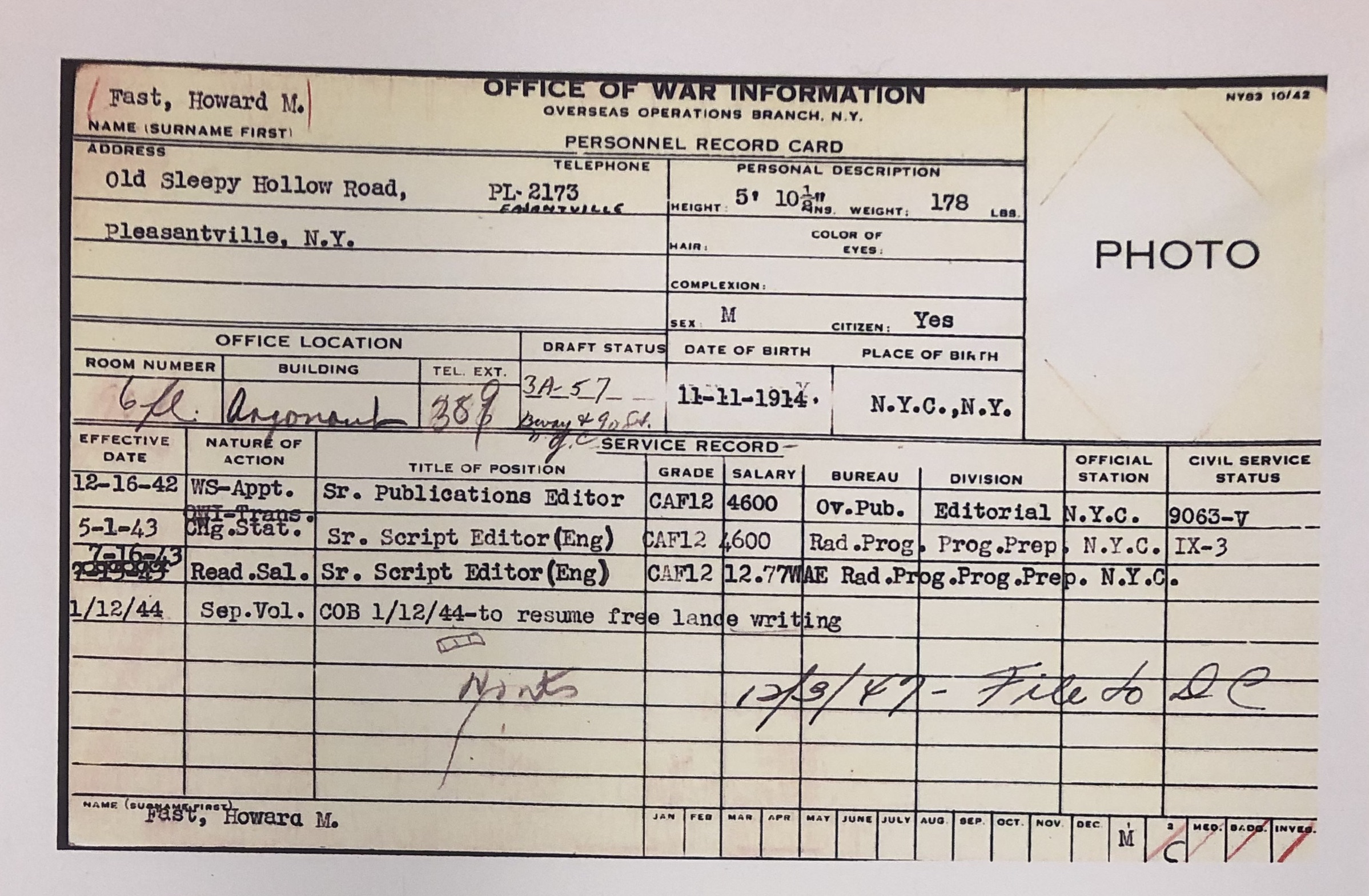
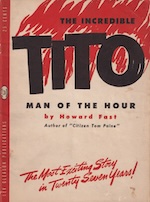
Officials in charge of OWI and VOA created an environment that enabled the hiring of Roosevelt loyalists as well as individuals sympathetic to Soviet-style communism. Howard Fast, the first chief writer and editor of VOA English news, censored reporting about Soviet atrocities and produced content that glorified Stalin and Tito.7
Arthur Krock, Washington bureau chief of The New York Times, wrote that OWI spoke with an ideology “that conforms much more closely to the Moscow than to the Washington-London line.” He added: “
Those administrators of the foreign propaganda division who are not confused, or deliberate undercutters of the State Department, are incompetent.8
Some of VOA’s Communists and Soviet sympathizers ended up working for pro-Soviet regimes after the war as anti-American propagandists and defenders of the Soviet Katyn lie (Stefan Arski, aka Artur Salman, in Poland), media advisors (Mira Złotowska, later Michałowska, in Poland) or diplomats (Adolf Hoffmeister, in Czechoslovakia).
Murrow’s message to East Germans in 1961 thus symbolized a definitive break with VOA’s pro-Soviet origins. Its uncomfortable early history — still unknown to most Americans — was understandably absent from his narrative. The RIAS Christmas broadcast preserved in this museum is, therefore, not only an audio relic; it marks a pivot point between VOA’s compromised wartime beginnings and its later role as a voice of democratic resistance.
Murrow as Broadcaster and Official: From Truth to “Persuasion”
Edward R. Murrow believed deeply in truthful reporting. He possessed a keen understanding of history, foreign policy, and foreign cultures. Yet within the Cold War framework of his time, he also accepted that U.S.-funded broadcasting would, by necessity, counter hostile propaganda — not only with facts but also with values and interpretation. In a confidential memorandum at USIA, Murrow wrote:
Decisions by the President call for an energetic campaign of persuasion — by diplomacy and propaganda — to unify Latin America against Castro, to isolate and ‘quarantine him,’ to nullify his potential for subversion, and ultimately so to weaken him in Cuba and in the rest of Latin America that his Cuban opponents (and Hemisphere pressures) can overthrow him.9
In hoping that VOA broadcasts would help bring about regime change Murrow speaks here not as a CBS journalist but as a U.S. government official — his tone, content, and omissions reflect the bureaucratic world he now inhabited. Murrow’s Press Club speech the same year reveals what he believed public diplomacy and hard-hitting U.S. government-funded journalism abroad should accomplish — and provides a lens for understanding the language in the RIAS Christmas program.
To understand why Murrow’s reassurance mattered in 1961, one must recall what the Voice of America once was — and how different it had been during World War II.
OWI, Early VOA, and the Pro-Soviet Line
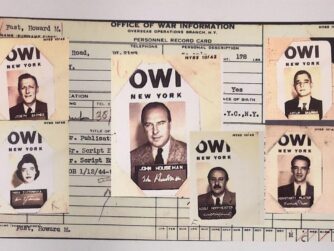
In the 1940s, during the Roosevelt administration and World War II, the Voice of America was shaped by Soviet-aligned policy and personnel within the Office of War Information (OWI). Under strongly pro-Soviet OWI officials, some VOA staff were later identified by congressional investigators as Communist Party members or sympathizers who supported the creation of communist, often anti-religious regimes in Eastern Europe. Among them was VOA’s first director, John Houseman, who — according to later congressional investigations — hired several individuals associated with the Communist Party for key VOA positions, and Howard Fast, the future recipient of the Stalin Peace Prize (1953). It was President Harry Truman who began reforming VOA and narrowing Soviet influence in the late 1940s, a process that was continued under the Eisenhower administration.
Murrow himself had nothing to do with the creation of VOA and, as USIA director, had only limited direct impact on VOA’s day-to-day programming in the 1960s. He was, however, a strong believer in truthful journalism and possessed an extraordinary talent as a reporter and communicator.
The Myth That Murrow “Helped Create” VOA
Edward R. Murrow did not “help to create VOA,” as is sometimes claimed.10 He had no involvement in the Voice of America during its early years. As Murrow’s biographer Ann M. Sperber documents in Murrow: His Life and Times, Robert E. Sherwood — President Roosevelt’s speechwriter, personal friend, and one of the two top officials in the Office of War Information (responsible for overseas VOA broadcasts) — wanted Murrow to be in charge of the international radio side of OWI, a job later divided between Joseph Barnes and John Houseman. Murrow declined the offer.11
Having been rebuffed by Murrow, Robert E. Sherwood appealed in January 1942 to President Roosevelt’s closest adviser and informal liaison to Soviet leaders, Harry Hopkins. Sherwood informed Hopkins that there existed a large audience for English-language broadcasts to Europe—a claim that was largely inaccurate outside Great Britain, though he correctly noted that the BBC already dominated that particular audience.
While emphasizing that the new government broadcasting operation would produce programs in many languages, Sherwood wrote that for the English-language broadcasts—what he called “the voice of America”—he was “most anxious to get” Edward R. Murrow.12 Murrow, however, wished to return to London to continue his CBS reporting. Aware that the government position would involve a substantial cut in salary, Sherwood suggested that a personal intervention by President Roosevelt might persuade the broadcaster to accept. Hopkins complied, sending Murrow a telegram from the White House urging him to take the post. More than a week later, Murrow replied tersely: “AFTER MUCH SOUL SEARCHING AM CONVINCED MY DUTY IS TO GO BACK TO LONDON.”13
In later decades—after serious controversies surrounding the early leadership of the Office of War Information and the wartime Voice of America—VOA would come to rely on Murrow as a symbolic anchor whose reputation could retroactively confer legitimacy on U.S. government broadcasting. This occurred despite the fact that Murrow played no operational role in VOA during World War II. The only indirect connection sometimes cited is his participation, years later, in the Radio Advisory Committee, convened at the invitation of William Benton—publisher of the Encyclopædia Britannica, former U.S. senator from Connecticut, and Assistant Secretary of State for Public Affairs from 1945 to 1947.
The committee, composed of eight prominent publishers, educators, and broadcast executives, submitted its report to the State Department in May 1947. It urged expansion of the Department’s international shortwave service—explicitly referring to it as the “Voice of America”—alongside broader cultural relations programs, warning that failure to do so could result in a “serious setback” to U.S. relations with the rest of the world.14
At the same time, the report stressed that international information efforts should, wherever possible, be conducted through private agencies, “since this is in the American tradition.”15
The committee concluded that only when private U.S. media were unable to disseminate information abroad — because of financial constraints or censorship — should the U.S. government intervene directly to ensure that the Voice of America could be heard. Murrow and other committee members therefore recommended the creation of a public corporation, authorized by Congress and funded through appropriations but operating under the supervision of an independent board of trustees rather than a government department.16 This recommendation, endorsed by Murrow, was not adopted for VOA, which remained under State Department control. It was, however, later implemented in the organizational design of Radio Free Europe and Radio Liberty.
The institutional foundations of VOA itself were laid instead by Robert E. Sherwood, head of OWI’s Overseas Branch, and his deputy Joseph Barnes, with assistance from John Houseman, later celebrated as VOA’s “first director.” Houseman was not a journalist by training but a propagandist, best known as co-producer of the famous radio drama often cited as an early example of mass-media–induced panic.17 During the war, he recruited Communist Party members and individuals sympathetic to the Soviet Union into OWI broadcasting roles, and in 1943 the Roosevelt administration declined to issue him a passport for official government travel—an extraordinary step that reflected growing concern about his political judgment and associations.
Archival correspondence shows that Houseman’s VOA employment ended after the State Department, with approval from U.S. military authorities, declined to issue him a passport. This information did not become public, and VOA leaders continued to present him as a champion of truthful journalism.18
Even decades later, Murrow’s photograph hung in VOA’s newsroom. Murrow is often quoted as saying: “To be persuasive we must be believable; to be believable we must be credible; to be credible we must be truthful.” His tenure at USIA, however, showed the complexities and constraints of applying that ideal within government. As USIA director, he ordered the cancellation of a VOA program on the presence of American nuclear weapons on Canadian soil at a moment when the Kennedy administration sought to quiet political controversy; he reversed this decision only after outside journalist Bill Stringer — the Christian Science Monitor bureau chief and moderator of the program — threatened to withdraw his participation.19 In a separate incident, after VOA director Henry Loomis and two VOA writers presented him with a program on Soviet nuclear testing that Murrow found insufficiently forceful, he instructed them to “really hit them,” and approved the broadcast only after the insertion of explosion sound effects and warnings of mass casualties.20
Murrow’s capacity to intervene in programming was strengthened by internal political networks. His principal USIA deputy, Thomas C. Sorensen, was the younger brother of Theodore C. “Ted” Sorensen, President Kennedy’s closest adviser and chief speechwriter, who helped shape the administration’s foreign-policy messaging at its highest level. In the assessment of Shawn J. Parry-Giles, a scholar of U.S. public diplomacy and the history of the United States Information Agency, Edward R. Murrow embraced what she characterizes as a “militarized propaganda program,”explicitly resisting Dwight D. Eisenhower’s efforts to recast USIA as a more ostensibly “objective” news organization.21
Rather than adopting Eisenhower’s restrained model, Parry-Giles argues that Murrow aligned himself with the more assertive information strategies developed during the Campaign of Truth under the Harry S. Truman administration — strategies explicitly designed to confront Soviet propaganda and limit communist political influence abroad.22
Claude Groce stated that during Murrow’s tenure at USIA, he received — in his words — “the only time in my entire memory of my days with the Voice of America” a written instruction on how to play the news, sent under Tom Sorensen’s authority: “accentuate the positive and eliminate the negative, don’t mess with Mr. In-between.”23 Murrow’s other deputy, Don Wilson, was, Groce recalled, a personal friend of Attorney General Robert F. Kennedy.24 Together, the two deputies symbolized what may be described as ideological and political nepotism within U.S. international broadcasting — not invented by Murrow, but inherited by him, and traceable to earlier wartime precedents.
Indeed, this pattern long predated the Kennedy administration. The first wartime head of the Voice of America, playwright Robert E. Sherwood, was also President Franklin D. Roosevelt’s speechwriter and political confidant. Sherwood issued weekly written propaganda directives guiding VOA content and, in one notorious case, explicitly instructed VOA to promote the Soviet version of the Katyn massacre and suppress contrary evidence.25
Roosevelt later assigned Sherwood to coordinate U.S.–Soviet propaganda from wartime London — illustrating that White House–directed editorial control was built into VOA’s institutional DNA from the start.26
Claude Groce’s recollections therefore cannot be read as literal transcripts of policy, but as revealing testimony about how VOA staff experienced control. He claimed Murrow may have been “sandbagged” by his politically connected deputies, yet simultaneously described Murrow approving harsh edits, overruling programs, and allowing USIA policy officials into the newsroom during the Cuban Missile Crisis, when Burnett Anderson was placed “in a censor role.”27 Groce also recounted that senior VOA editor John Albert drafted a memo comparing USIA censorship during the crisis to Goebbels’s operation; he confirmed he read this memo, though he did not retain a copy, leaving interpretation to memory.28
Yet one dimension is almost entirely absent from VOA’s later institutional memory: why Murrow and USIA believed oversight was necessary. VOA’s wartime news staff — influenced by the Popular Front atmosphere of the early 1940s — at times broadcast pro-Soviet messaging, suppressed information about Stalinist crimes, and, according to Dwight D. Eisenhower, endangered American soldiers through broadcasts he deemed reckless. The agency’s leadership in later decades never fully confronted this history. Instead, it was obscured from Americans, forgotten internally, and never systematically taught to succeeding generations of VOA journalists. This burial of institutional memory — combined with the postwar professionalization of an English-language newsroom staffed largely by journalists who had never lived under communism — meant that later VOA employees did not understand the magnitude of the threat of foreign influence, did not see the need for oversight, and came to believe that VOA’s credibility depended on operating without any policy constraint or even guidance.
In this vacuum of historical understanding, a mythic Murrow emerged — a selective memory emphasizing Murrow as a paragon of journalistic independence while omitting the Murrow who wielded information deliberately as a Cold War weapon. That myth would later shape VOA editorial decisions decades after his death and serve as a rhetorical tool for resisting even minimal oversight.
Some VOA English-language journalists invoked this later, mythologized Murrow to argue that he would have objected to countering violent extremism with explicit language — such as calling Hamas “terrorists” rather than “fighters” — because such language could harm VOA’s credibility. In their view, as a believer in freedom of the press, he would not have objected to VOA posting a graphic mourning Fidel Castro’s death or VOA praising Lenin Prize winner Angela Davis as a fighter for women’s rights.29
In contrast, Murrow’s RIAS broadcast, his National Press Club speech, and his classified USIA memoranda demonstrate his full willingness to wage information war against enemies of democracy — be they in Moscow, East Berlin, Cuba, or elsewhere.30
VOA – Castro 2016
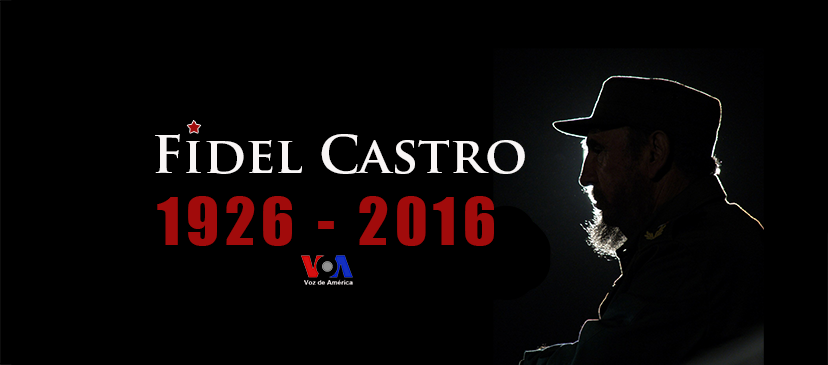
USIA – Castro 1961
Question: Returning to the Cuban situation, please assess the propaganda effects of the “tractors for prisoners” affair.
Questions and Answers at Edward R. Murrow’s Speech before the National Press Club, Washington, D.C., May 24, 1961
Murrow: … As Senator Smathers said I believe yesterday, Castro’s offer to exchange prisoners for tractors was a monumental propaganda blunder. The world-wide reaction was almost universally hostile. The obvious parallel was drawn all around the world between Castro’s offer and the one made by Hitler when he offered to trade Jews for trucks. … What he did initially, of course, was to demonstrate again to the world in dramatic fashion that the Communist machine operates without regard for those human values and human beings that are the hallmark of civilized society. And it seems to me that had American citizens remained mute and refused to act, they would, one have denied their heritage and cause much of the world to believe we value our dollars and machines above the freedom of men who are willing to risk their lives in an effort to regain freedom for their fellow countrymen.
Could Murrow Have Acted Differently During WWII?
One cannot know how Murrow would have behaved had he taken a wartime government post. But it seems unlikely that he would have echoed Soviet disinformation in the manner of OWI director Elmer Davis or certain early VOA figures — such as Wallace Carroll, the future news editor of the Washington bureau of The New York Times, who even in 1948 defended Stalin’s Katyn-massacre lie in Persuade or Perish. 31 It is unlikely that Murrow would have chosen John Houseman or Howard Fast for any positions within the Voice of America.
The unwillingness to call communist atrocity by its name was a hallmark of OWI–VOA wartime output. Truthful reporting about Katyn or the Gulag might have risked damaging the alliance with Stalin. Still, VOA’s coverup of Katyn continued after the war, when the alliance rationale no longer applied. The earlier concealment made it easier for President Roosevelt to grant concessions that placed Eastern and Central Europe under Soviet domination for decades. Whether Murrow would have participated in such a coverup can never be known.
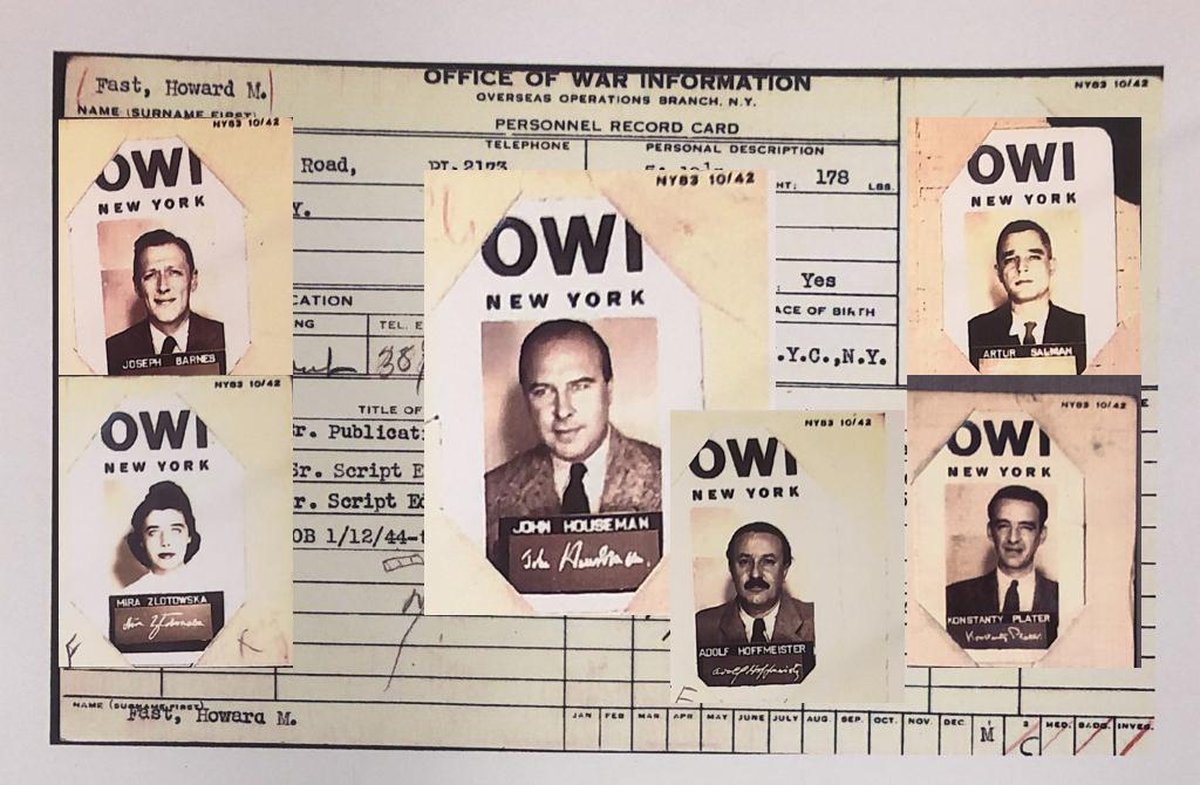
What is known is that under OWI leaders such as Owen Lattimore, Joseph Barnes, Wallace Carroll, John Houseman, Robert E. Sherwood, and Elmer Davis, VOA repeatedly misled foreign and domestic audiences about Soviet Russia and the communists in China. Professor Owen Lattimore, head of VOA broadcasts to Asia, accompanied Vice President Henry A. Wallace on his 1944 visit to Russia and later published in National Geographic a glowing description of the Kolyma gold mines — one of Stalin’s deadliest Gulag sites — claiming prisoners were “volunteer workers” for whom “extensive greenhouses growing tomatoes, cucumbers, and even melons” were built “to make sure that the hardy miners got enough vitamins!” [Exclamation in the original article.]32
Katyn, Domestic Propaganda, and Murrow’s Different Stance
Even though members of Congress — alarmed about the executive branch using government funds to propagandize to Americans — eliminated in 1943 almost all of the OWI’s domestic propaganda budget in a bipartisan vote, some of these fellow-traveler journalists continued to promote highly deceptive views of Stalin and communism in the United States using their access to U.S. radio networks, newspapers, and magazines. Edward R. Murrow was not one of them. Toward the end of the war, he became increasingly alarmed about Stalin’s intentions and secret U.S. concessions to Russia at the expense of Poland and other countries in East-Central Europe. In an exchange of letters with OWI director and former CBS colleague Elmer Davis, Murrow rejected Davis’s criticism that he was too negative in reporting on Soviet actions. Davis urged him to be patient and hope for the best. Murrow responded that saving Eastern Europe from Russian domination would require more than a single miracle.33
While Houseman and Fast viewed the Polish Government-in-Exile in London with unmasked contempt, and Elmer Davis spoke dismissively to members of Congress about the wartime Polish ambassador to Washington, Jan Ciechanowski, who repeatedly warned him and State Department diplomats about VOA’s use of Soviet propaganda, Murrow maintained contacts with Polish and other Eastern European exiles in Britain and used their information about Russia. He pointed out in his response to Senator McCarthy in 1954 that he had friends in Eastern Europe who were murdered or fled into exile.34
However, despite his contempt for McCarthy’s tactics, Murrow recognized that government bureaucracies could be mismanaged and susceptible to Communist influence. In a CBS broadcast on February 20, 1953 devoted entire to McCarthy’s investigation of the Voice of America, Murrow referred to a VOA journalist who claimed that his scripts had been “watered down” by three employees whom he believed to be sympathetic to the Communist cause. Murrow himself was a resolute opponent of Communism and an outspoken critic of Stalin’s atrocities. He argued in his broadcast that if a Senate committee examined VOA scripts and found evidence of disloyalty or subversive intent, it should not be difficult to identify those responsible.35
What Murrow Was Referring To in His February 20, 1953 Broadcast
When Edward R. Murrow spoke on CBS on February 20, 1953 about allegations that a Voice of America journalist’s scripts had been “watered down,” he was referring to testimony given that same day before the Senate Permanent Subcommittee on Investigations in a public session of the hearings on the State Department Information Program.
The witness was Virgil H. Fulling, Chief of the Voice of America’s Latin-American News Service. Hired in 1946 or 1947, Fulling’s responsibility was to prepare English-language news copy for broadcast to Latin America. His work consisted of selecting items from major wire services such as the International News Service (INS), reviewing other news sources and VOA correspondents’ reports, and drafting English-language scripts that would then be translated and broadcast to Latin American audiences.36
Fulling testified that on January 21, 1953, he had selected an INS dispatch describing a spontaneous demonstration in front of the U.S. Embassy in Guatemala City. The demonstration, according to the wire service, had been organized by “anti-Communist elements” in support of President Dwight D. Eisenhower’s inauguration. Fulling used that same terminology in his draft. At a policy meeting within the Latin American Division, its chief, Steven Baldanza, and other staff members agreed that it was appropriate to refer to the demonstrators as “anti-Communists,” since that was the wire-service language and accurately conveyed that some individuals in Latin America were explicitly opposed to Communism.
However, when the script passed through the central English newsroom in Washington for final review before broadcast, the term “anti-Communist” was crossed out and replaced in one instance with “citizens,” and elsewhere with the word “democratic.” Fulling objected to these changes. He testified that he complained first to Donald Taylor, supervisor at the central news desk; then to Harold Berman, Assistant Chief of the News Branch; and finally to Barry Zorthian, Chief of the News Branch. All declined to restore the original language. The actual editorial alteration had been made by Robert Goldman in the central newsroom under Taylor’s supervision.
Fulling described this and other instances as examples of editorial changes that, in his view, weakened or “watered down” criticism of Communism or minimized explicit references to anti-Communist sentiment. He emphasized that he had written the script using the exact wording of the wire-service dispatch and that his division had supported the original phrasing.
He was questioned by members of both parties — including Chairman Joseph R. McCarthy (R-WI), Senator Karl E. Mundt (R-SD), Senator John L. McClellan (D-AR), Senator Henry M. Jackson (D-WA), and Senator Stuart Symington (D-MO), as well as chief counsel Roy Cohn. While later testimony from central newsroom officials defended the edits as an effort to avoid suggesting that support for the United States in Latin America came only from “anti-Communists,” Fulling’s account of the sequence of editorial decisions was not directly refuted during his appearance.
Importantly, the individuals Fulling named were not junior employees but senior editors and supervisors within the VOA’s central English newsroom. The dispute was not about espionage or disloyalty, but about editorial judgment — specifically, how explicitly VOA should frame opposition to Communism in its reporting.
Fulling further testified that once the Senate investigation began, the newsroom’s editorial practices changed. According to him, quotations of outside criticism directed at Communists were no longer altered in the same manner.
Murrow, who had been one of Senator McCarthy’s most prominent critics, did not dismiss such testimony out of hand. In his February 20 broadcast, he acknowledged that if allegations of disloyalty or improper editorial interference could be substantiated, responsible individuals could and should be identified. At the same time, he cautioned against broad insinuations unsupported by evidence. His reference to a VOA journalist who claimed that scripts had been weakened or altered appears to have been a compressed summary of Fulling’s testimony that day.
Fulling himself does not appear to have been a disgruntled employee seeking publicity. The hearing record portrays him as a professional news editor defending what he believed to be accurate wire-service language and objecting to editorial revisions he thought obscured ideological realities in Latin America.
In practice, the situation was complex. The hearings did not produce evidence of any pro-Communist conspiracy. Still, Fulling’s criticism of editorial practices by the VOA central English news desk were shared by other VOA journalists in several foreign-language divisions. Some individuals in VOA senior management during that period sought to avoid unnecessarily provoking U.S.–Soviet tensions — not out of disloyalty, but from a belief that a less confrontational tone might encourage gradual change within the Soviet system, which a few still regarded as reformable or historically progressive.
Murrow Presents Himself as Anti-Communist, Condemns McCarthy
From See It Now: “Edward R. Murrow – Response to Senator Joseph McCarthy,” CBS Television, April 13, 1954.
I require no lectures from the junior Senator from Wisconsin as to the dangers or terrors of Communism. Having watched the aggressive forces at work in Western Europe, having had friends in Eastern Europe butchered and driven into exile, having broadcast from London in 1943 that the Russians were responsible for the Katyn massacre, having told the story of the Russian refusal to allow allied aircraft to land on Russian fields after dropping supplies to those who rose in Warsaw — and then were betrayed by the Russians — and having been denounced by the Russian radio for these reports, I cannot feel that I require instruction from the Senator on the evils of Communism.37
More on Katyn Massacre Propaganda by OWI and VOA
Soviet propaganda organs such as TASS routinely attacked such Western coverage as “anti-Soviet” and hostile to socialist achievements, though direct Soviet press statements naming Murrow by name are not readily documented in the archival record. In contrast to Murrow’s assertions about his reporting on Soviet-Polish issues, the Office of War Information — and therefore the wartime Voice of America — aligned their broadcasts with the Soviet narrative on Katyn, actively disseminating Moscow’s version of events and suppressing competing evidence to the contrary.38
Sometime in April 1943, OWI director Elmer Davis wrote a special radio commentary in which he blamed the Katyn massacre on the Nazis. It was broadcast abroad by VOA and domestically on American radio networks. At the time, even the State Department advised the OWI to avoid reporting on the Katyn story altogether “if at all possible” because the evidence was inconclusive.39
Davis later claimed before Congress that he was convinced the Germans were responsible for the murders.40 He, however, almost certainly had access to information that strongly pointed to the Soviet responsibility for the crime. As a journalist, he could have easily asked questions of the right sources, including State Department officials, Ambassador Jan Ciechanowski representing the Polish Government-in-Exile, and some American reporters who covered the Soviet Union from Washington, New York, or Chicago. “Mr. Davis, therefore, bears the responsibility for accepting the Soviet propaganda version of the Katyn massacre without full investigation,” the bipartisan Select Committee of the U.S. House of Representatives, which investigated the Katyn Massacre, concluded in its final report in 1952.
The governments-in-exile of German-occupied countries, some like Poland with considerable armed forces which were part of the anti-Nazi alliance, would be later betrayed by Roosevelt’s concessions to Stalin, made without their knowledge or approval. Still, FDR remained a hero for Murrow. He kept a bust of Franklin D. Roosevelt, a gift from Murrow’s reporter colleagues, in his USIA office.41 He had less admiration for John F. Kennedy, whom in private conversations he referred to as “that boy.”42 Initially, JFK wanted to recruit Frank Stanton, Murrow’s boss at CBS, for the USIA job, but Stanton recommended Murrow instead.43
From Wartime Propaganda to Moral Counter-Weight
While Murrow was broadcasting truthful news for CBS from London, VOA’s wartime output was being shaped by Davis, Sherwood, and other pro-Soviet officials in the Office of War Information. Voice of America programmers echoed Soviet propaganda lines, following the pattern set in the 1930s by The New York Times correspondent Walter Duranty. Duranty’s friend and fellow traveler, American journalist Joseph F. Barnes, held a senior role guiding VOA programming as John Houseman’s superior. Duranty’s misleading reporting helped shield Stalin and the Soviet Union from criticism, and VOA did something similar during the war.44 Its broadcasters repeated the Kremlin’s lie about the Katyn massacre, while Murrow is widely reported to have told his audience that the Soviets were responsible. He also reportedly covered Stalin’s betrayal of the 1944 Warsaw Uprising truthfully, at the same time as VOA, in line with Soviet preferences, largely marginalized non-communist Poles and their underground Home Army fighting the Germans.
In defending himself from false accusations by Senator Joseph McCarthy (R-Wisconsin), Edward R. Murrow pointed out in a CBS’ See It Now television program broadcast on April 13, 1954, that he had gotten the Katyn story right when it was first reported by the Germans and correctly blamed the Soviets for the massacre of thousands of Polish POW military officers and intellectual leaders. The Cold War Radio Museum continues to search for Murrow’s recordings and scripts of wartime reports about Katyn and the Warsaw Uprising since they have not been made public in books or online.45 In Soviet and fellow-traveler propaganda, these anti-Nazi Poles were branded “fascists” and “reactionaries.” Former OWI and VOA Polish Desk editor Stefan Arski used such language in his anti-American propaganda following his return to Poland from the United States in 1947 and joining the Polish United Workers’ (communist) Party.46 In an anti-U.S. propaganda book published by the Warsaw regime in 1952, Arski attacked the Voice of America, his former U.S. government employer, and Polish anti-communist refugees, some of whom had replaced him and other Soviet sympathizers in VOA broadcasting jobs in the late 1940s and the early 1950s. He is particularly known for his vehement and consistent denials of Soviet responsibility for the Katyn massacre.
Against this backdrop, the 1961 RIAS Christmas broadcast takes on added meaning: it was not merely radio — it was a deliberate moral counter-weight to an earlier era of betrayal, coverup and silence in wartime VOA broadcasts.
↑ Back to top · ▶ Back to Murrow audio
IV. Religion, Resistance, and What Washington Missed
Listening to the VOA–RIAS program now, one also notices what was still not said. Even though the broadcast is centered on Christmas and on human rights violations in East Germany and other countries behind the Iron Curtain, there is almost no explicit mention of religious persecution and discrimination against Christians and other believers under communism. This absence does not necessarily imply intentional suppression; rather, it reflects USIA’s narrative priorities in 1961 and certain lack of understanding among USIA officials of the extent of persecution of religion by communist regimes (although not nearly as strong as when Stalin and Stalinist regimes ruled in the late 1940s and early 1950s) and the importance of religious faith and churches in sustaining resistance to communist rule.
Former American communist activist Bertram D. Wolfe, who renounced Soviet totalitarianism and during the Truman and Eisenhower administrations worked in the State Department producing Voice of America programs about the Soviet Katyn massacre, recalled that some American-born VOA journalists in the 1940s and early 1950s failed to grasp the nature of religious persecution and other human rights violations under communism:
“When I went to work for the Voice of America in the period from 1950 to 1954, religious leaders and believers were being framed, tortured, and sent to concentration camps in all the countries under Communist rule in Eastern Europe. After trying to get my script writers to write effective radio broadcasts to defend the religious freedom of the churchmen and devout believers who were being thus persecuted, I found that I had to write the scripts myself to get the requisite feeling into them. I did not believe what the persecuted believed, but I did believe in their right to freedom to harbor and practice their beliefs without interference.”47
USIA officials who, in 1961, may have drafted Murrow’s narration for the VOA–RIAS broadcast most likely did not fully appreciate that some of the strongest opposition to communism and Soviet domination came from deeply religious industrial workers and peasants, particularly in Poland. Murrow’s own May 1961 address at the National Press Club also contains no explicit reference to discrimination against religious believers or their central role in resisting communist oppression. His remarks focused instead on the global information struggle — Soviet and Cuban influence in the Western Hemisphere, new pressures in Southeast Asia, and the political awakening of Africa.
By contrast, many post-World War II VOA broadcasters who were refugees from communism believed that greater U.S. public diplomacy attention and resources should have been directed toward East-Central Europe and the Soviet Union, where audiences were both large and especially receptive to religious and moral arguments. In contrast to VOA, Radio Free Europe and Radio Liberty devoted considerable airtime to religious programming and to exposing communist repression of religious institutions and individuals — an area largely neglected by VOA until the Reagan administration. Radio Free Europe also had more regular listeners behind the Iron Curtain than VOA.
Archival Note — Radio Free Europe, Munich (ca. December 1962)
In the Cold War Radio Museum collection, a Christmas-season photograph from Radio Free Europe’s Munich headquarters shows several children of RFE exile-journalist families gathered at a studio microphone bearing the RFE logo, singing seasonal hymns. The original caption reads: “RFE transmitters, broadcasting across the Iron Curtain, help to keep the Christmas spirit alive in communist lands.” (Cold War Radio Museum, private archive. Photograph reverse caption dated December 1960.) For copyright reasons, only a textual description is provided here. Researchers wishing to consult the photograph should contact the Cold War Radio Museum.
A Flawed Policy Blueprint for RFE: Internal White House Criticism of VOA and Radio Free Europe (1961)
In early 1961, President Kennedy authorized a confidential internal review of U.S. information policy toward Eastern Europe. The resulting memorandum —“Memorandum Concerning United States Information Services Policy Toward Eastern Europe” — was circulated privately within the White House and among senior officials, including the United States Information Agency. White House aide Theodore C. Sorensen forwarded the memorandum to Robert C. Sorensen for comment and informed him that Thomas (“Tom”) Sorensen, then serving in a senior policy role at USIA under Edward Murrow, had been asked to prepare a parallel analysis for the President.48
The authorship of the analytical sections is not explicitly identified, a common feature of internal White House policy papers of the period. While Theodore Sorensen’s role was that of a conduit and presidential adviser, the memorandum appears to reflect the views of USIA officials skeptical of both surrogate broadcasting and confrontational political messaging toward the Soviet Bloc.
The critique of the Voice of America was blunt. The memorandum asserted that “the American propaganda machine compares very modestly with that of the Soviet Union” and that its “costs are out of all proportion to the unimpressive results achieved,” contributing, in the author’s view, to “the recent decline of American prestige in the world.”
VOA’s broadcasts were described as “stiff, stuffy and completely detached from the life of the countries to which they are broadcast,” and Eastern European listeners were said to complain that VOA programs were “dull and monotonous,” the product of “a bureaucratic approach and a lack of journalistic touch.”49
The memorandum also criticized VOA’s personnel policies, noting that naturalized Americans and political exiles—people “with an expert knowledge of their countries or at least a natural understanding of their countrymen’s reactions and ways of thinking” — were “by virtue of their birth excluded from editorial and advisory posts” and used primarily as translators.50 Ironically, this criticism echoed concerns later raised by VOA’s own foreign-language services, whose broadcasters were refugees from communism and possessed precisely the lived experience that many VOA English-language editors lacked.
The assessment of Radio Free Europe was even more severe. The memorandum declared that RFE “has fallen very far short of the noble ideals it was supposed to propagate” and claimed that it had “a poor reputation in Europe generally, and has no moral authority behind the Iron Curtain,” despite being widely heard because of its powerful transmitters.51 Its programming was characterized as “purely negative,” consisting of “constant bickering and monotonous attacks on the inefficiency and shortcomings of the Communist regimes,” which the author argued could not lead to constructive political change.52
From the perspective of Radio Free Europe’s documented performance—especially in Poland under the leadership of Jan Nowak-Jeziorański, where RFE urged restraint to avoid Soviet military intervention and earned deep public trust — these claims appear exaggerated or demonstrably false. Listeners in Poland and elsewhere understood RFE’s connection to the United States, valued its pluralism, and respected its independence. The memorandum’s recommendations — to curtail RFE’s autonomy, strip it of bold political commentary, and subordinate it to diplomatic and cultural exchange programs — reflected a vision favored by some U.S. diplomats who viewed surrogate broadcasting as an obstacle to engagement with communist regimes.
Despite internal criticism of Radio Free Europe within parts of the Kennedy administration, President Kennedy’s own actions demonstrate that he ultimately rejected proposals to curtail RFE’s mission and did not adopt the memorandum’s central recommendations. His continued public support for the Radio Free Europe Fund and his refusal to weaken RFE’s mission suggest that, while he welcomed internal debate, he did not accept the premise that surrogate broadcasting was counterproductive. A White House memorandum of February 6, 1962, prepared by National Security Adviser McGeorge Bundy, acknowledges the President’s reservations about the Radio Free Europe Fund, yet emphasizes that Kennedy had again agreed to meet with its leadership and that his attitude would “make a great deal of difference” to the program’s success.53 The following day, Kennedy wrote personally to Charles H. Kellstadt, Chairman of the Radio Free Europe Fund, praising RFE for providing “a window on reality” to people living behind the Iron Curtain and affirming that its work was “the least we can do for them.”54
These documents confirm that while John F. Kennedy understood the political sensitivities surrounding Radio Free Europe’s public fund-raising role, he did not hesitate to support its core mission. On the contrary, Kennedy deliberately chose Edward R. Murrow to implement his policy of engaging the Soviet Union and international communism through an intensified war of ideas. Murrow’s own actions as USIA director — together with his public speeches and classified memoranda —demonstrate that he was not merely compliant with this approach but one of its most energetic advocates. Far from opposing the use of U.S. international broadcasting as an instrument of foreign policy and ideological competition, Murrow actively promoted harder-hitting content when he believed existing programming failed to confront Soviet propaganda forcefully enough. The documentary record thus contradicts later claims that Murrow, in his government role, favored a restrained or purely non-ideological conception of international broadcasting.
As historian Arch Puddington — a former deputy director and head of the New York Bureau of Radio Free Europe/Radio Liberty — later observed, President Kennedy “had vowed to escalate the struggle against communism,” while Robert F. Kennedy was “an enthusiastic supporter of RFE.” The administration, Puddington wrote, “announced its intention to engage the Soviet Union in an aggressive war of ideas all over the globe.”55
Puddington’s empirical findings also directly contradict the Sorensen memorandum’s portrayal of RFE as ineffective and distrusted. He noted that “RFE clearly stood as the most popular foreign broadcast service in the Eastern bloc,” citing a 1959–60 survey conducted by European research institutes showing RFE with “far more regular listeners than either the BBC or the VOA.” By contrast, “the VOA had suffered a notable decline in listenership since the Hungarian Revolution,” which he attributed to management restrictions on political broadcasting and a programming emphasis on “world news, American culture, and jazz music.”56
When Regime Narratives Travel Upward: Disinformation, Diplomacy, and Policy Blind Spots
A further dimension of the 1961 policy debate merits attention, not because it was decisive, but because it illustrates a recurring structural vulnerability in U.S. foreign policy making: the ability of authoritarian regime narratives to migrate — often indirectly — into American internal analysis.
Several of the internal memorandum’s most severe criticisms of Radio Free Europe’s Polish Service closely resembled arguments advanced earlier by officials of the Polish communist regime and repeated in U.S. Embassy Warsaw reporting during the late 1950s. These claims portrayed RFE as politically irresponsible, dominated by émigrés detached from realities inside Poland, exaggerating repression, and obstructing prospects for gradual reform through diplomatic engagement. Such themes featured prominently in the reporting and advocacy of Ambassador Jacob D. Beam and his political officer Thomas Donovan, who urged that RFE’s Polish broadcasts be curtailed or eliminated in the interest of improving official U.S.–Polish relations.
That these embassy-originated criticisms were contested within the U.S. government at the time is documented in a declassified 1959 Central Intelligence Agency assessment responding directly to Ambassador Beam’s critique of Radio Free Europe. In that memorandum, CIA official Cord Meyer acknowledged isolated weaknesses in some RFE Polish broadcasts but rejected the Embassy Warsaw’s overall negative assessment as overstated and strategically misguided. The CIA analysis emphasized that RFE remained a “responsible and reliable source of news and commentary,” that allegations of systematic exaggeration were unsupported, and that embassy complaints closely tracked Polish regime sensitivities rather than listener realities. The document further warned that suppressing or fundamentally restructuring RFE’s Polish Service in response to such complaints would risk depriving the United States of one of its most effective channels to the Polish population.
What is striking is not that such criticisms originated in Warsaw, where the communist authorities had a clear interest in neutralizing RFE, but that similar formulations later appeared in an internal White House policy review forwarded in early 1961 to Theodore C. Sorensen. By the time these arguments reached senior policymakers, they no longer appeared as regime talking points but as ostensibly pragmatic assessments aligned with diplomatic caution and bureaucratic preference.
A declassified 1958 Radio Free Europe internal memorandum documenting a conversation between Donovan and RFE’s chief political adviser, William E. Griffith, captured the circulation of these arguments at the time.57 The document records embassy claims that RFE distorted political conditions in Poland and obstructed diplomatic objectives — assertions RFE leadership regarded as both factually incorrect and politically naïve.
The communist authorities in Warsaw had a clear interest in neutralizing RFE, but that similar formulations later appeared in a White House policy review intended to guide the new Kennedy administration. Radio Free Europe’s response rested on empirical evidence rather than theory. Its Polish Service consistently avoided incitement, discouraged premature confrontation, and emphasized national continuity, cultural identity, and factual reporting. Under Jan Nowak-Jeziorański’s leadership, RFE urged restraint during moments of crisis precisely to avoid provoking Soviet military intervention. Audience research, listener correspondence, and independent surveys contradicted claims that RFE lacked credibility or moral authority in Poland.
Senior U.S. officials ultimately accepted this judgment. Ambassador Beam’s campaign against RFE failed, as did later efforts to subordinate surrogate broadcasting to official diplomacy. Vice President Richard Nixon, after witnessing the extraordinary public response to his 1959 visit to Warsaw—made possible in part by Radio Free Europe’s reporting — reportedly reminded Beam that an American ambassador’s duty was not only to deal with a communist government but also to maintain a relationship with the people living under it.58
Seen in this light, the Sorensen memorandum illustrates less a failure of judgment than a persistent institutional tension. U.S. diplomats and public diplomacy officials often hoped that moderation, cultural exchange, and engagement might soften authoritarian systems from within. Surrogate broadcasters, informed by refugee experience and audience feedback, tended to regard such hopes as unrealistic so long as those regimes remained fundamentally illegitimate and dependent on Moscow. Where these perspectives collided, foreign disinformation could find an opening — not through deception alone, but through alignment with preexisting assumptions of high-level U.S. government officials and advisors, a dynamic that has reappeared in different forms in later eras, including contemporary Russian influence efforts aimed at shaping Washington’s responses to Moscow’s war against Ukraine.
These documents allow readers to trace this process directly. They show how arguments originating with a communist regime entered embassy discourse, migrated into internal U.S. policy debates, and were ultimately tested against empirical evidence and political judgment. They also help explain why President Kennedy, despite welcoming critical analysis, declined to accept recommendations that would have weakened Radio Free Europe’s independence or silenced one of the most effective voices reaching Poland behind the Iron Curtain.
Jazz, Diplomacy, and Influence: The Beam Critique, Radio Free Europe, and a Polish Intelligence Operation
The declassified CIA memorandum rejecting Ambassador Jacob D. Beam’s critique of Radio Free Europe offers more than a bureaucratic disagreement over broadcasting policy. Read in context, it illuminates a broader and more troubling pattern: the vulnerability of U.S. diplomatic and information officials to foreign influence operations that aligned neatly with their own institutional preferences and assumptions.
By the late 1950s, Ambassador Beam and some officials within the State Department and the United States Information Agency had become convinced that what would most effectively undermine communism in Poland, the Soviet Union, and other Eastern Bloc countries was not surrogate political broadcasting but cultural engagement—above all, the Voice of America’s jazz programs hosted by Willis Conover. Beam argued as early as 1957 that “a good case can be made that R.F.E. should be dispensed with in favor of a modified Voice of America,” a view echoed in varying forms by diplomats who regarded Radio Free Europe as an obstacle to engagement with communist governments.
This assessment rested on a serious misreading of social and political realities. While Conover’s Jazz Hour held undeniable symbolic value, its actual reach in Poland during the 1950s was limited. The program was listened to primarily by a relatively small circle of English-speaking young intellectuals and artists. It enjoyed far greater resonance in the Soviet Union, where American jazz had been banned for longer and where English-language cultural broadcasts carried a different weight. In Poland, by contrast, the communist authorities had largely lifted restrictions on American music by the mid-1950s. Jazz and other Western music were already being played on Polish state radio by the end of the decade.
Yet Conover’s 1959 visit to Poland — enthusiastically embraced by jazz musicians and fans — appears to have been leveraged as political proof that cultural diplomacy alone could succeed where surrogate broadcasting was supposedly unnecessary. Declassified records and later Polish archival findings suggest that this visit was closely monitored by the Polish communist intelligence service and secret police, which sought not merely to observe Conover but to exploit the occasion to influence U.S. diplomats in Warsaw. The broader objective, as reconstructed from multiple sources, appears to have been to encourage Washington to censor or shut down Radio Free Europe’s Polish Service.
Polish media reports, drawing on files held by the Institute of National Remembrance, indicate that the surveillance of Conover was part of a wider influence and intelligence operation targeting the American Embassy in Warsaw in the late 1950s.59 These efforts coincided with diplomatic pressure from Ambassador Beam and others who hoped that eliminating RFE would facilitate cultural exchanges and détente with the Polish communist regime.
One reported — but not fully documented — figure in this milieu was Mira Michałowska (formerly Mira Złotowska), a former wartime Office of War Information and Voice of America Polish Desk editor who later returned to Poland, married a high-ranking diplomat, and reportedly enjoyed access to senior U.S. officials in Warsaw. While direct evidence of her role remains incomplete, contemporary records and later accounts suggest that she may have served — wittingly or unwittingly — as an informal channel through which Polish regime perspectives reached American diplomats. If so, this would represent a striking continuity with earlier wartime patterns in which individuals associated with U.S. international broadcasting became conduits for foreign influence.
The CIA memorandum rejecting Beam’s critique is therefore significant not only for defending Radio Free Europe but for implicitly recognizing the strategic danger of such influence. Intelligence officials acknowledged that RFE programming could be imperfect, but they rejected the notion that surrogate broadcasting lacked credibility or popular trust. They understood that cultural diplomacy and music, while valuable, could not substitute for sustained political reporting and commentary aimed at mass audiences.
Indeed, the historical record demonstrates that it was not jazz that ultimately undermined communist rule in Poland. The industrial workers and farmers who formed the backbone of the Solidarity movement did not, for the most part, speak English or follow American jazz. They were influenced by Western radio’s political reporting — especially Radio Free Europe’s Polish Service — which provided uncensored news, pluralistic debate, and moral clarity during moments of crisis.
Willis Conover remains an enduring symbol of American cultural influence and deserves his place in Cold War history. But elevating his programs into a substitute for political broadcasting reflects a persistent tendency among some public diplomacy practitioners and scholars to romanticize culture while downplaying the central mission of international broadcasting. Voice of America was fortunate to have Conover at a critical moment, but it never again developed a comparable musical figure with mass appeal. By contrast, Radio Free Europe’s Polish Service produced popular and influential music programming alongside hard political reporting, integrating culture into a broader strategy rather than treating it as a replacement.
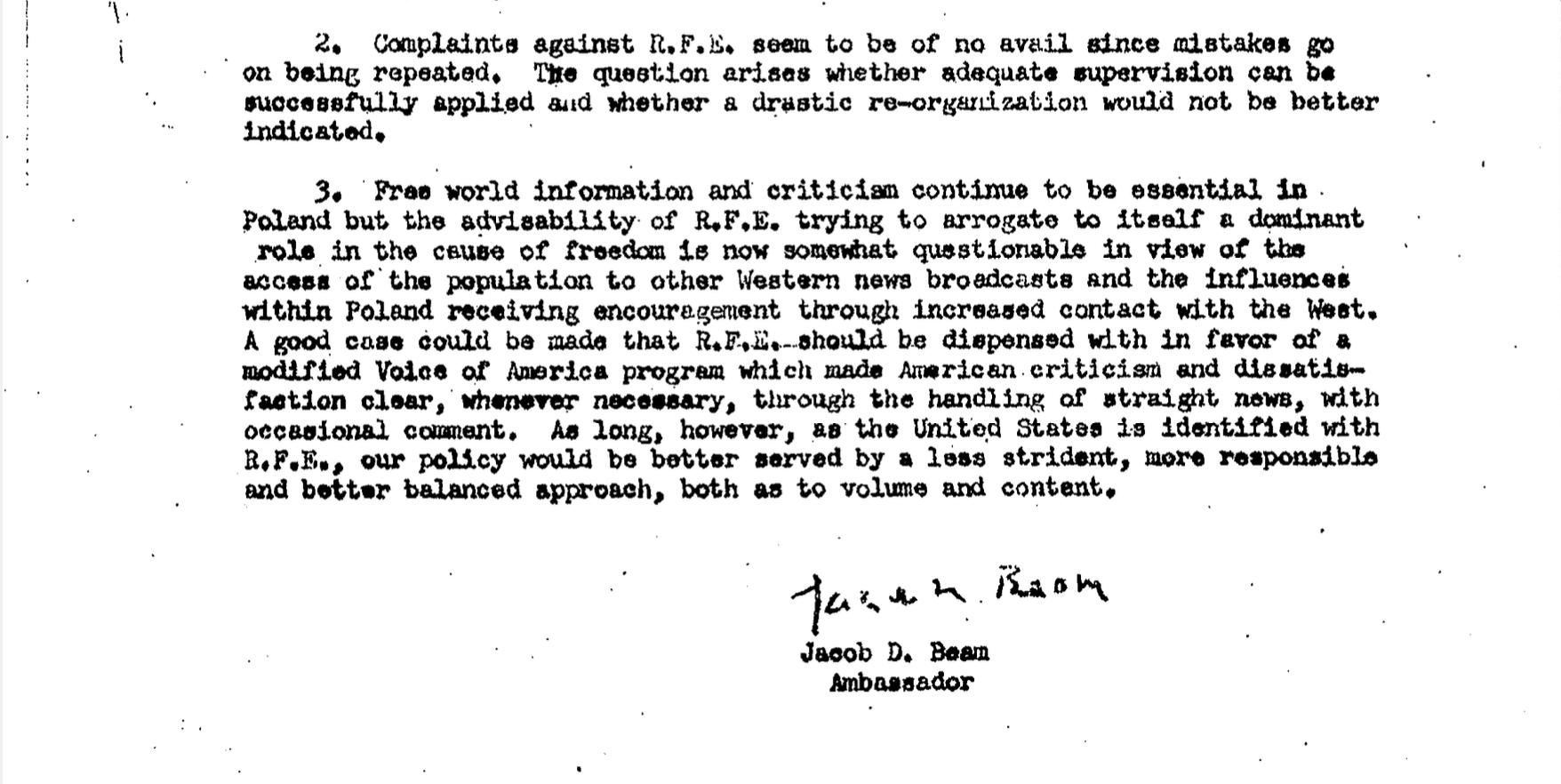
Seen in this light, the Beam critique and the Polish intelligence operation surrounding Conover’s visit offer a cautionary tale. Foreign disinformation and influence do not always succeed through outright deception. They are often most effective when they reinforce existing preferences within target institutions — here, the diplomatic desire for engagement, cultural exchange, and the reduction of politically confrontational broadcasting. The CIA’s rejection of Beam’s arguments stands as an early recognition of this danger, one with implications that resonate well beyond the Cold War.
↑ Back to top · ▶ Back to Murrow audio
V. U.S. Broadcasting Strategy After 1945 – What Changed, What Didn’t
Redirection of resources to counter rather than support Soviet propaganda initially began under the Truman administration, which took the first steps to reduce the influence of pro-Moscow radicals within VOA. However, the momentum to transform VOA gradually slowed during the Eisenhower years. President Kennedy strongly supported U.S. government international broadcasting but — facing Cuba, Berlin, and decolonization — focused much of his attention on Latin America and Africa. Later, under Presidents Nixon and Ford, the White House — acting largely through Henry Kissinger — chose not to expand U.S. government broadcasting to the Soviet Bloc, not because of sympathy for communism, but to preserve détente and avoid jeopardizing negotiations on Vietnam and nuclear arms. It was during this period that USIA, at the White House’s direction, ordered a ban on the Russian Service’s interviewing of Aleksandr Solzhenitsyn.60 In contrast, the VOA–RIAS Christmas broadcast and Murrow’s National Press Club speech present a much earlier moment — one of stronger institutional confidence and a clearer commitment to countering Soviet propaganda directly.
To this day, Cuba remains a communist dictatorship. The eventual fall of communism in East-Central Europe began in Poland under the strong moral influence of the Catholic Church. Mark G. Pomar, a former director of Russian-language programming at Radio Liberty and at the Voice of America, observed that prior to Ronald Reagan’s presidency, “if one were to search through publications or government documents about VOA during the Cold War, one would be hard-pressed to find any explicit references to religious programming.”61 Still, even though religion is largely absent from the VOA–RIAS narration – apart from Christmas music – the USIA – VOA – RIAS program clearly brought a measure of hope to listeners behind the Iron Curtain, especially if VOA foreign-language services reused segments in their own languages. This regional comparison shows why messages of hope — whether religious or secular — carried geopolitical weight.
Murrow, Regime Change in Cuba, and the Tone of VOA Broadcasting to the Soviet Union
As director of the United States Information Agency, Edward R. Murrow was an explicit supporter of regime change in Cuba and intervened repeatedly to make Voice of America coverage of Cuba more forceful and confrontational. At the same time, he occasionally voiced objections to specific Kennedy administration policies — most notably restrictions on travel by Americans to the island — demonstrating that his support for administration objectives did not preclude disagreement over tactics.62
Contrary to the later image promoted by some former USIA and VOA officials, editors, and reporters, Murrow did not believe that the Voice of America should function as an autonomous or detached journalistic institution. He regarded VOA as an authoritative voice of the United States government, one that was expected to support the policies of the President and his administration. As Murrow told a Miami Herald reporter, he did not object to being described as a “propagandist” so long as “the propaganda is based on the truth.”63
President Kennedy appointed Edward R. Murrow a member of the National Security Council, yet he did not inform him in advance about the Bay of Pigs operation. Murrow learned of the planned CIA action in Cuba from his deputy, Donald M. Wilson, who in turn had been alerted by Polish-born New York Times foreign correspondent Tad Szulc, later credited with breaking the story of the invasion.64 Despite being sidelined at such a critical moment, Murrow did not resign from USIA. On the contrary, he publicly reaffirmed his full support for President Kennedy’s Cuba policy and for an intensified American information offensive.
Speaking to journalists at the National Press Club on May 24, 1961, Murrow declared unequivocally that the United States was no longer content to remain on the defensive in the ideological struggle with communism:
We are taking the offense in this war of ideas. We shall be more alert in exposing Communist techniques and tactics. Distortion and duplicity about this land will not go unanswered.65
Murrow left no ambiguity about how USIA and the Voice of America should describe Fidel Castro’s regime. Rejecting euphemism and moral relativism, he stated that American international broadcasters must make clear to their audiences:
We shall ask them [USIA and VOA audiences] to recognize the nature of his totalitarian dictatorship, his betrayal of the ideals of the revolution that brought him to power, his suppression of basic human liberties, his treason to the ideals of civilization, and his atrocities, his calculated reliance on the Sino-Soviet bloc and the danger that this threatens to free institutions in the Western Hemisphere.66
In light of these explicit statements, it is difficult to reconcile Murrow’s own record with later claims — advanced by some former USIA and VOA officials—that he would have tolerated the glorification of revolutionary violence, the uncontextualized dissemination of anti-American imagery or the use of U.S.-funded media to run one-sided electoral campaign commercials against a sitting American president. Under Murrow’s leadership, it would have been unthinkable for USIA or VOA to praise figures such as Che Guevara, distribute material showing the burning of American flags without critical context, or function as platforms for domestic political campaigning while invoking journalistic independence as a shield against oversight during the last two decades.
Murrow understood that journalists employed by the U.S. government and funded by American taxpayers did not occupy the same role as private reporters in the domestic press. Their mission, as he defined it, was to tell the truth — but to do so in the service of democratic values, American foreign policy, and a clear moral understanding of the totalitarian adversaries the United States confronted.
Murrow was notably more hawkish in his expectations of VOA programming directed to and about Cuba than in broadcasts aimed directly at the Soviet Union. With respect to VOA’s Russian-language output, he accepted the argument — advanced by Foreign Service officers within USIA — that the Soviet audience required a different approach. He supported an increased emphasis on cultural programming and believed that VOA’s Soviet Division needed both a strategic reset and new leadership.67
This shift became visible after Murrow’s tenure. A short item in the conservative weekly Human Events reported on February 1, 1964, that Alexander Barmine — a former Soviet general and outspoken anti-communist — had been removed from his position as head of VOA’s Russian desk. According to the column, Barmine had fallen into disfavor with USIA superiors for inserting what they viewed as “provocative” programs into broadcasts beamed to the Soviet Union. The same report noted that Murrow’s successor as USIA director, Carl Rowan, planned to expand “non-controversial radiocasts to Russia.”68
Foreign Service Officer Hans H. Tuch, who served in multiple senior roles at both USIA and VOA, later confirmed Murrow’s personal involvement in Barmine’s removal. In a 1989 oral history interview, Tuch stated that Murrow had supported transferring Barmine from his VOA Russian Service post to a largely marginal position at USIA headquarters. According to Tuch, Murrow wanted “an American with experience in the Soviet Union, an American officer who spoke Russian with recent experience,” to head the VOA Soviet Division.69
Mark Pomar, former assistant director of the Russian Service at Radio Free Europe/Radio Liberty and former director of the USSR Division at the Voice of America, wrote in his Cold War Radio book that when he joined VOA, “Barmine was long gone, but stories about him still circulated. He had been feared by many of the old timers but also deeply admired for the way he stood up to American management and supported an independently minded Russian Service.”70
Taken together, these episodes further undermine the later portrayal of Murrow as a defender of a restrained or purely non-ideological Voice of America. His record as USIA director shows a pragmatic and strategic actor — willing to intensify information warfare where he deemed it effective, cautious where he believed it was not, but consistently committed to the view that U.S. international broadcasting was an instrument of national policy rather than an independent journalistic enterprise.
One Small Inaccuracy
Murrow, or those who drafted his narration for the VOA Christmas broadcast about RIAS, included one somewhat misleading statement: that for most listeners in the Soviet-occupied zone of Germany, RIAS broadcasts “constituted their only link with the free world.” In reality, many East Germans could listen to radio stations broadcasting from the Federal Republic of Germany, and in some areas of the GDR they could even receive West German television. Still, RIAS broadcasts were a powerful symbol of American commitment to the freedom of West Berlin and to the eventual restoration of democracy in the Eastern Bloc.
This clarification does not diminish Murrow’s narrative power but helps situate his rhetoric in reality. Some VOA journalists, USIA officials, and officials of USIA’s successor agencies often exaggerated the size of their audience and the impact of their programs, especially English-language broadcasts, which had a limited audience and limited effectiveness in countering Soviet propaganda. The largest audiences for VOA were for foreign language broadcasts to Easter and Central Europe. USIA and VOA leadership tended to highlight English-language broadcasts, partly to justify maintaining a large American-staffed newsroom. Murrow placed a number of his former CBS colleagues in USIA and VOA jobs.
Ich bin ein Berliner
While Murrow’s 1961 RIAS Christmas introduction offered hope and human connection across the Wall, another moment of symbolic communication came more than two years later. On June 26, 1963, President John F. Kennedy delivered his now-famous Ich bin ein Berliner speech in West Berlin, declaring solidarity with the people of the divided city nearly two years after the Wall’s construction.
The speech — aimed as much at the Soviet Union as at West Berliners — affirmed that “all free men, wherever they may live, are citizens of Berlin,” and concluded with Kennedy’s emphatic “Ich bin ein Berliner” (I am a Berliner).”  Kennedy’s words gave a morale boost to West Germans living under the shadow of the Wall and became one of the most iconic moments of Cold War public diplomacy. 
Kennedy’s speech was developed over weeks of preparation. His chief speechwriter and presidential adviser, Ted Sorensen, played a significant role in drafting the address, though Sorensen himself later wrote that the famous line may ultimately have originated with Kennedy or emerged in rehearsal. Kennedy also practiced the German phrase with Robert H. Lochner, an interpreter and former RIAS official who helped Kennedy with pronunciation and phonetic cues.71
Edward R. Murrow did not have a direct role in drafting or delivering the Ich bin ein Berliner speech, and there is no evidence that he was physically present for it. Nonetheless, this moment—like the RIAS broadcast in 1961 — underscores the importance of symbolic speechmaking and messaging in U.S. efforts to counter communist domination and affirm democratic identity during the Cold War. His reported remark that even a child could have stopped it (“a little girl with a lollypop“) expressed moral outrage, but it also invites sober historical reflection.72 It is unclear whether anything short of massive East German civilian resistance — which did not materialize — could have altered the course of events, as eventually occurred in Poland during the Solidarity movement, supported morally by Pope John Paul II and, decisively, by President Ronald Reagan. Even then, neither Solidarity nor Reagan advocated violent resistance, and the risk of Soviet military intervention — with consequences comparable to Hungary in 1956 — remained real.
Western military intervention in Berlin might have changed history — or led to catastrophe. The unanswered question underscores a recurring lesson of the Cold War: public diplomacy and broadcasting can illuminate truth, moderate repression, and stiffen resolve over time, but they cannot substitute for political power, internal will, or the strategic and historical-political realities on the ground. This is not a judgment on any nation or culture, but an observation that history, institutions, and trauma of occupation or colonialism shape what a society can or cannot risk at any given moment.
Kennedy’s View of U.S. Broadcasting – VOA vs. Radio Free Europe
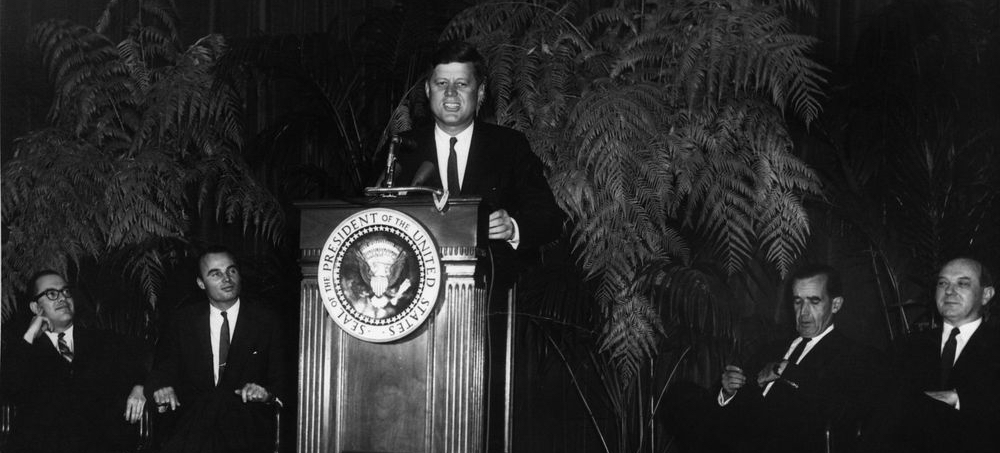
President John F. Kennedy’s public remarks on U.S. international broadcasting help clarify the policy environment in which Murrow operated. On February 26, 1962, in a speech marking the 20th anniversary of the Voice of America, Kennedy praised VOA’s commitment to accuracy while emphasizing that its mission differed fundamentally from that of private American media:
🎧 LISTEN FIRST
President John F. Kennedy delivers remarks at the 20th anniversary observance of the Voice of America (February 1962).
I believe that over the years, faced with this very difficult challenge, far more difficult than that of an American editor or a newspaperman, or a commentator on an American radio or television station, you have been able to tell our story in a way which makes it believable and credible.
Kennedy underscored that, because VOA spoke as the voice of the United States Government, its editors and broadcasters bore a higher burden of responsibility than those of privately owned domestic media.
This is an extremely difficult and sensitive task. On the one hand you are an arm of the Government and therefore an arm of the Nation, and it is your task to bring our story around the world in a way which serves to represent democracy and the United States in its most favorable light. But on the other hand, as part of the cause of freedom, and the arm of freedom, you are obliged to tell our story in a truthful way, to tell it, as Oliver Cromwell said about his portrait, “Paint us with all our blemishes and warts, all those things about us that may not be so immediately attractive.”
President John F. Kennedy Meets with Radio Free Europe Fund Group – March 6, 1961
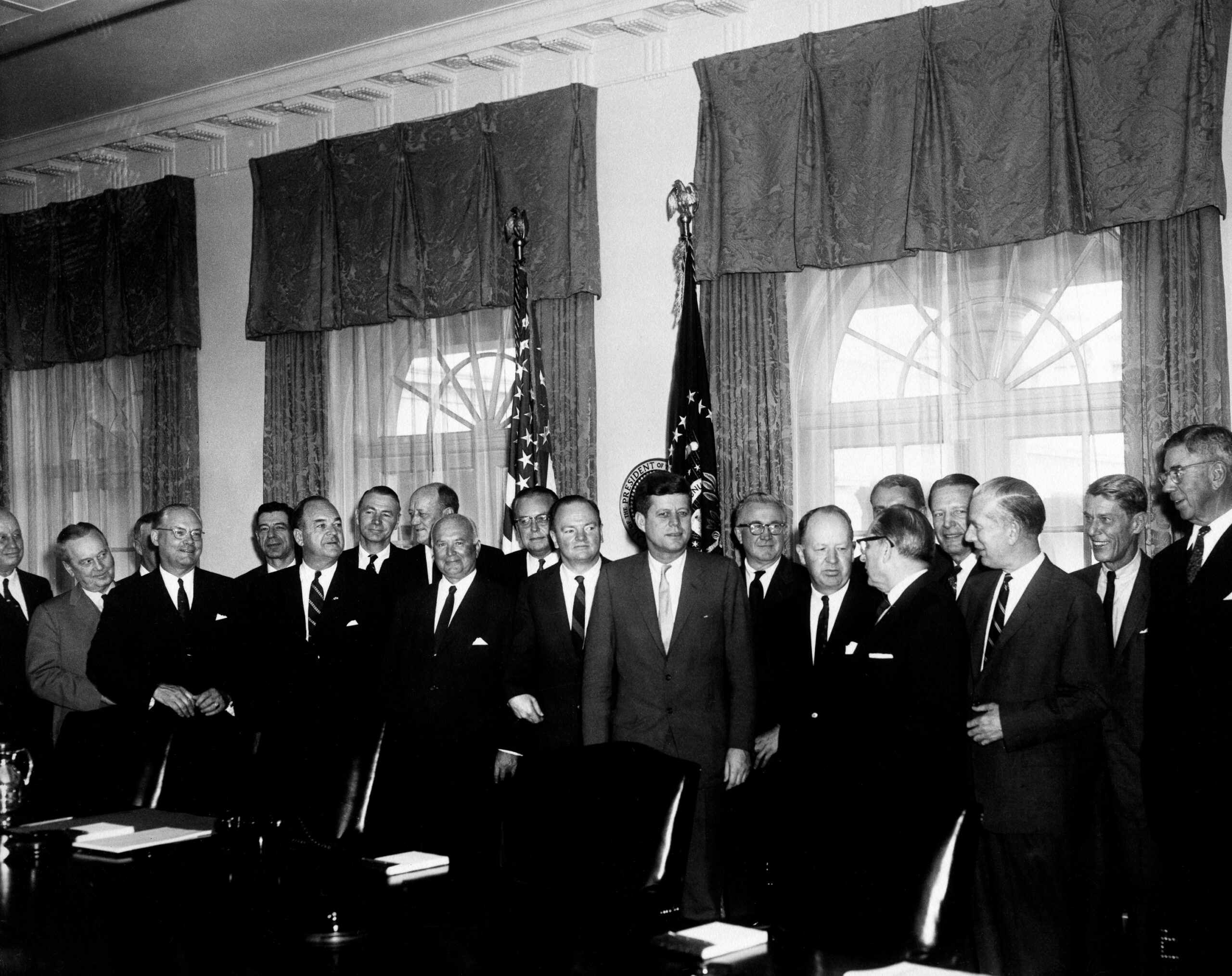
In remarks at a February 7, 1962 White House meeting with the Radio Free Europe Fund, Kennedy outlined a broader, more activist role for Radio Free Europe (RFE) and Radio Liberty (RL) — the CIA-supported surrogate radios staffed largely by refugees from communist regimes. He argued that VOA alone could not overcome censorship behind the Iron Curtain:
We have, as you know, a powerful instrument in the information world in the Voice of America. It will play a vital role in the resurgence of the East European countries. But it is not enough. The Voice of America is the voice of this Government. Radio Free Europe must be the voice not only of our people, but of the people of all of Europe. RFE must continue to help get the truth behind the Iron Curtain. It must give them information which their Soviet-dominated chieftains would keep from them.
President John F. Kennedy — Message to Support Radio Free Europe (1962)
From the “Broadcasters for Radio Free Europe” 33⅓ RPM Fundraising Record
This rare recording preserves President John F. Kennedy’s appeal on behalf of Radio Free Europe, issued around 1962 on a special 33⅓ RPM vinyl titled “Broadcasters for Radio Free Europe.” The record brought together well-known American voices — including Ronald Reagan, Raymond Burr, Shirley Jones, Robert Taylor, Robert Young, and Danny Thomas — lending their names and celebrity to what appeared to be a grassroots fundraising effort.
What listeners in 1962 did not know — and what Washington publicly denied — was that Radio Free Europe was not sustained primarily by small donations from ordinary Americans. By the time this record was produced, almost all of RFE’s operating budget came from classified congressional appropriations funneled through the CIA. The façade of private, voluntary support gave the U.S. government something extraordinarily useful during the Cold War: plausible distance. By presenting RFE as a civic enterprise rather than a state broadcaster, American officials could publicly disclaim responsibility for its programs, which in turn allowed RFE’s journalism to be far more independent, bold, and “surrogate” in character than would have been possible through the Voice of America — a U.S. government broadcasting arm overseen by USIA and subject to diplomatic pressures.
Kennedy’s message, therefore, captures a moment when the United States chose words over force — investing not only in nuclear deterrence and military alliances, but also in psychological, informational, and cultural power. This recording is part of that history: a reminder that the Cold War was fought not just at borders and checkpoints, but over airwaves.
🎧 LISTEN FIRST
President John F. Kennedy – Message to Support Radio Free Europe (February 1962).
Public Domain Notice: The spoken content of President John F. Kennedy reproduced here is a United States Government work created in the course of official duties and is therefore in the public domain under 17 U.S.C. § 105. Audio is presented for historical, educational, and research purposes.
Disclaimer: The vinyl compilation from which this excerpt was digitized was commercially manufactured by private parties in 1962. While the presidential portion of the recording is believed to be in the public domain, no claim is made regarding the copyright status of the compilation, its artwork, musical components, or the performances of other individuals included on the original record. This digitized excerpt is provided strictly for non-commercial, educational, and scholarly use. No endorsement by any rights holder or institution is implied. If you believe your rights are affected, please contact the Cold War Radio Museum.
These recordings framed the broadcasting landscape Murrow inherited: VOA as the government’s official voice, constrained by diplomacy, and RFE/RL as moral-political surrogates, free to speak as exiles to their captive nations. In his USIA position, Murrow did not oversee Radio Free Europe and Radio Liberty, but the State Department and USIA were known to share their views about RFE and RL broadcasts with the stations’ American management.
↑ Back to top · ▶ Back to Murrow audio
VI. The Berlin Voices: Clips from the Broadcast

Online edition note: This post presents spoken-word excerpts only. Musical performances are omitted (or reduced to a second or two when absolutely necessary for identification) due to rights considerations.
Berlin After August 13, 1961: A City Cut in Two
When the Berlin Wall was erected on August 13, 1961, it transformed daily life overnight — separating families, criminalizing movement, and intensifying surveillance. For many East Germans, radio became one of the last remaining connections to uncensored information and to a wider cultural world. Hearing these voices today, one can almost feel the tension — radio as the only bridge grandparents, spouses, and children could still cross.
What RIAS Was – and Why It Mattered
In the RIAS program itself, the host, Friedrich Luft, describes the station’s purpose in language that still reads like a broadcasting credo: RIAS did not try to dictate opinions, but to represent “different voices” in the democratic world, rejecting propaganda while insisting on truth and cultural freedom. RIAS broadcast excerpt transcript: “We don’t try to tell them what to think… We hate propaganda, but we love the truth…”
“We don’t try to tell them what to think. We tell them what the world thinks… We hate propaganda, but we love the truth…”73
That statement is not abstract. The program includes letters from listeners behind the Wall describing August 13 as “the blackest day in postwar German history” and calling RIAS “the most effective link between East and West.”
Listener letters excerpt: “Since August 13… you… have become the most effective link between East and West.”74
Murrow’s Presence: From Broadcast Legend to USIA Director
Murrow’s introduction places this Christmas broadcast within a broader U.S. public diplomacy strategy — one that relied less on slogans than on credibility. Murrow/VOA introduction describes RIAS as “a beacon of light” and a symbol of America’s commitment to Berlin.75
Earlier in 1961, Murrow addressed the National Press Club in Washington and answered questions in an extended Q&A session. Those primary documents are presented on a separate page as a museum “document room.”76
Online Audio Excerpts
How to listen: These clips are designed to be cleanly publishable online: spoken-word focus, minimal or no music. Time references reflect the museum transcript. Murrow–VOA broadcast frames RIAS as a “beacon of light” for listeners living under Communist oppression and introduces Friedrich Luft as host.77
Clip 2 — “We don’t try to tell them what to think…”
🎧 LISTEN FIRST
Friedrich Luft explains RIAS’s editorial philosophy: plural voices, truth over propaganda, culture as freedom. (December 1961).
Clip 3 — Letters from the Other Side of the Wall (spoken)
🎧 LISTEN FIRST
Listener letters describe fear, isolation, and the need to remain anonymous — while identifying RIAS as the essential link between East and West after August 13, 1961. (December 1961).
Clip 4 — Interview: An 18-Year-Old Border Policeman Who Defected
🎧 LISTEN FIRST
A short, restrained exchange with a young guard who crossed into the West — ending with a remarkably humane Christmas greeting to comrades still “standing at the wall.” (December 1961).
Clip 5 — “Music Knows No Boundaries” (U.S. Senator Hugh Scott and greetings from families)
When listening to this recovered Voice of America World-Wide English relay of 1961 segments of RIAS Christmas broadcasts, two moments stand out as a window into the emotional landscape of Berlin only months after the Wall rose.
First, a political voice crosses the divide. U.S. Senator Hugh Scott of Pennsylvania (Republican) speaks directly to East Berlin and East Germany, assuring those behind the “Communist prison wall” that Americans have not forgotten them. His words — “Die Mauer muss weg. The Wall must go.” — frame the broadcast not simply as holiday radio, but as an act of democratic witness from across an international boundary that had become, overnight, a fault-line of global politics.
Immediately afterward, the program pivots from geopolitics to human need. RIAS introduces its Sunday series, “Music Knows No Boundaries,” explaining that it now receives nearly 4,000 letters per month from people separated by the Wall—parents from children, spouses from spouses, grandparents from grandchildren. For listeners who could no longer meet, write freely, or cross the border even at Christmas, radio became what no checkpoint could ever be: a substitute for presence, a conduit of love, a place where words of hope could still travel.
This combination — a U.S. senator’s public vow and ordinary families’ private greetings — captures the broadcast’s full meaning. In 1961, the Wall sharpened and made politics more dangerous. But the voices preserved on this tape remind us that before it was a symbol, it was a wound inside homes and holidays — and radio, at least in moments like these, became the only bridge still standing.
🎧 LISTEN FIRST
U.S. Senator Hugh Scott and family messages across the Wall — East to West, West to East — demonstrating how radio substituted for blocked travel and censored correspondence. (December 1961).
Clip 6 — Willy Brandt’s Christmas Message
🎧 LISTEN FIRST
West Berlin’s governing mayor Willy Brandt describes the Wall cutting “across thousands and millions of families,” and expresses hope for freedom and international understanding in 1962. (December 1961).
Clip 7 — The Freedom Bell & Closing Pledge
🎧 LISTEN FIRST
The broadcast closes with the Freedom Bell’s symbolism and a pledge to resist tyranny — an audio artifact of Berlin’s moral front line. (December 1961).
↑ Back to top · ▶ Back to Murrow audio
VII. Murrow Inside Government – The Censorship Dilemma
Murrow’s candid National Press Club remarks gain deeper significance when paired with his internal memoranda, such as this confidential May 1961 request to the Bureau of the Budget, in which he explicitly defines U.S. international broadcasting as a tool of persuasion, quarantine, and ultimately regime weakening.
A full portrait of Murrow’s USIA tenure includes its tensions — especially the “Harvest of Shame”–BBC controversy and Murrow’s rarely-remembered public admission of error. Early in 1961, only weeks into his appointment, Murrow attempted to persuade the BBC not to rebroadcast “Harvest of Shame,” his own CBS documentary about migrant agricultural workers in the United States. He later regretted that action.
During a question-and-answer session with USIA staff members on March 24, 1961, a reporter from the Voice of America’s Pakistani Service pressed him on whether government officials had the right to restrict information simply because it might place the United States in an uncomfortable light. Murrow paused, and then answered with unusual candor for a government appointee.
Primary Source – Murrow Responds to a VOA Pakistani Service Reporter (Audio & Transcript)
🎧 LISTEN FIRST
USIA Director Edward R. Murrow responds to a Voice of America Pakistani Service reporter’s question about his attempt to persuade the BBC not to rebroadcast his CBS documentary “Harvest of Shame.” (May 1961).
Transcript (0:01–1:09)
Question came from the Pakistan service, direct and penetrating as I have learned to expect from all my friends in Pakistan. How, in view of the fact that there have been two editorials, do I view, uh, the program Harvest of Shame? Um, I view it, uh, as I did. Uh, it was a program produced for domestic consumption. As was suggested in one of the editorials to which you referred, uh, my telephone call was both foolish and futile, and that I did not become aware of which hat I was wearing.(laughter)(applause)
Uh, this may well be an accurate summary, but I still hope-(laughter)(applause) I hope that in spite of this, I shall still have a place to put the hat.(laughter)(applause)
Interpretive Note
Few U.S. officials of the era — or of any era — publicly admit mistakes. Murrow did so not defensively, but with clarity, dignity, and without seeking excuses. The exchange reveals a tension that defined his USIA years: a journalist who believed truth was the only durable weapon of democracy, operating inside a bureaucracy that often feared that same weapon.
Including this recording allows contemporary audiences to hear not only Murrow’s words, but his tone—the pauses, humility, and mastery of language that made him a uniquely credible communicator. It also underscores a larger point: in public diplomacy, moral authority is not conferred by policy or one’s government position, but earned through honesty.
The museum presents these materials to illuminate the structural dilemma of public diplomacy: how to defend a democracy abroad without denying uncomfortable truths at home.78 The Berlin Wall also reminds us that great broadcasts do not topple walls unless people are able — and willing — to push from the other side. U.S. international broadcasting failed to prevent communist victories in China, Cuba, or Vietnam, and even in Cuba today its impact is constrained by state power, repression, and fear. Repressive regimes remain in power in North Korea, Afghanistan, Russia, Iran, Venezuela, Gaza, and in other countries and territories. At best, public diplomacy can help restrain brutality, sustain hope, or keep truth alive — but it cannot force history where societies are not ready or where coercive regimes remain overwhelmingly dominant.
The VOA–RIAS program reveals the persistent structural tension at the heart of U.S. international broadcasting. VOA could speak about Eastern Europe — but it was surrogate broadcasters who spoke to Eastern Europe. The Voice of America — especially in English — served primarily as a symbol of American policy and values to global audiences, which were not America’s enemies, while U.S.-supported surrogate radios, such as RIAS in Berlin and Radio Free Europe and Radio Liberty in Munich, were built to do something fundamentally different. Their power came from vernacular language, cultural closeness, and the credibility of exile-journalists who understood exactly what was at stake. Murrow’s Christmas message, elegant and morally resonant, could symbolize American resolve — but the voice that East Germans trusted each morning and night was RIAS, speaking in their own language.
↑ Back to top · ▶ Back to Murrow audio
VIII. Artifact Description – Tape, Provenance, Label Notes
About This Recording
- Date on label: December 19, 1961 (with Murrow intro)
- Approx. duration: ~28 minutes (as labeled)
- Format: Reel-to-reel magnetic tape
- Online edition: spoken-word excerpts; music omitted or minimized
- Archive: Cold War Radio Museum
Primary Sources & Further Reading
- Murrow/USIA: National Press Club address (May 24, 1961) and Q&A (USIA press release scans) — see the document page linked below.
- RIAS Christmas program transcript (museum working transcript with time stamps).
- Edward R. Murrow, Question and Answer Session with USIA Staff Members, 24 March 1961 (museum working transcript with time stamps).
- Cold War Radio Museum: Murrow and the Harvest of Shame / BBC controversy page.
↑ Back to top · ▶ Back to Murrow audio
IX. Full Primary Source Transcripts
Primary Sources Index: Click an item to jump to the document group below. (All materials are reproduced for historical and educational purposes.)
- 1. Transcript: VOA WWEnglish magnetic tape — “RIAS Christmas Show” (Dec. 19, 1961) with Murrow introduction
- 2. USIA press release images: Murrow National Press Club speech
- 3. USIA press release — text-only transcript
- 4. Images: Q&A session following Murrow’s speech
- 5. Q&A session — text-only transcript
- 6. Confidential Murrow memorandum (May 17, 1961)
- 7. 1961 Sorensen–Kennedy file on RFE and VOA (folder introduction + documents)
- 8. White House memorandum: Kennedy meeting with the Radio Free Europe Fund
- 9. President Kennedy letter endorsing Radio Free Europe
- 10. Suggested remarks for President Kennedy — Radio Free Europe Fund (Feb. 3, 1962)
- 11. Remarks of President Kennedy on the 20th anniversary of VOA (Feb. 26, 1962)
- 12. Strictly Confidential memorandum on U.S. diplomatic and Radio Free Europe policy discussions (December 1958)
Transcript: Voice of America – WWEnglish Magnetic Tape – “RIAS Christmas Show” – December 19, 1961 (with Murrow Introduction)
The transcript below is based on a magnetic-tape recording labeled “The Voice of America – WWEnglish – RIAS Christmas Show – 12/19/61 (with Murrow Intro).” The recording contains a spoken introduction attributed to Edward R. Murrow, followed by English-language program segments from RIAS Berlin, interspersed with Christmas music. While joint VOA–RIAS programming of this kind was not routine, this example illustrates moments of cooperation and shared messaging at the height of the Cold War, shortly after the construction of the Berlin Wall.
The tape is housed in a Voice of America box within the Cold War Radio Museum collection. Whether this object represents an original master, a distribution copy, or a later duplication of VOA-originated material cannot be determined. This transcript is provided for research, educational, and documentation purposes. Musical segments and non-verbal audio are marked.
Note: Some musical passages in the original program are omitted or shortened in the online audio edition for rights reasons. Spoken-word content is reproduced here as a primary source transcript.
0:00–0:26 – Station Identification (German)
Speaker 1 • 0:00–0:26
Hier ist RIAS Berlin, eine freie Stimme der freien Welt.
0:27–3:03 – English Identification and Early History of RIAS
Speaker 2 • 0:27–1:03
This is RIAS Berlin, a free voice of the free world. Several times a day, over six million listeners in Communist-controlled East Germany hear this station identification. The initials R-I-A-S stand for Radio in the American Sector. Every day, 24 hours each day, the United States Information Agency’s German language station in Berlin beams its programs over seven medium wave, short wave, long wave, and FM transmitters to the population on the other side of the Berlin Wall.
Speaker 2 • 1:05–1:35
For most of the listeners in the Soviet-occupied zone of Germany, these broadcasts constitute their only link with the free world. The broadcast you’re about to hear will bring you excerpts of actual RIAS Christmas programs. This radio station is unique in the world and in the history of broadcasting. It was founded right after the end of World War II. Soviet troops had seized control of all radio facilities in Berlin, monopolizing the air.
Speaker 2 • 1:35–2:10
Everything they broadcast, news, commentary, reports, radio plays, even music programs, everything reflected the straight Communist Party line. Something had to be done quickly to counteract this propaganda barrage. In March 1946, a radio station was started by the U.S. military government in the American sector of the divided city. News was broadcast as news. Commentaries, reports, lectures brought thought and opinion from the outside world to audiences starved for the truth.
Speaker 2 • 2:10–2:40
A free voice began to ring out 100 miles behind the Iron Curtain. The success of the station was unbelievable. Letters, listener reaction, and encouragement poured in from all parts of Eastern Germany, from Poland, Czechoslovakia, Hungary, from Lithuania and Bulgaria, even from listeners in Moscow. From that day to this, RIAS has continued to be a beacon of light to the millions who, living in the darkness of Communist oppression, listen to it daily.
Speaker 2 • 2:41–3:03
It has become, in the divided city, a symbol of America’s faith in the people of Berlin, an underlining of our guarantee of the independence and welfare of West Berlin. Your host for this broadcast will be one of the many prominent personalities who regularly broadcast over RIAS, the dean of Berlin drama critics, Friedrich Luft.
3:05–6:21 – Friedrich Luft on Culture, Democracy, and Propaganda
Speaker 3 • 3:05–3:47
I, for instance, review plays and new films. That’s all I do, and I do it for 15 minutes every Sunday noon. But I talk about films and plays my listeners in the East will never be allowed to see, plays by Thornton Wilder, by Sartre, by T.S. Eliot, by Dürrenmatt, all French, American, British, Italian, or German films they shall never be allowed to view. Imagine that you were, for what reasons whatever, cut off from the artistic, the cultural, the political, the scientific, or even from the mere entertaining utterances of the more livelier part of this world.
Speaker 3 • 3:47–4:24
You would starve for truth. You would hunger for news. You would thirst for unbiased entertainment. Now, this is just what we from RIAS Berlin have to provide. It is, you might say, an easy job. Perhaps it is. But before all, it’s a good job and a necessary one. Things we in the West have come to take for granted, they are privileges, they are special treats, they are an outlook, and they mean hope for all our million listeners east of the Iron Curtain.
Speaker 3 • 4:24–5:10
We don’t try to tell them what to think. We tell them what the world thinks, and the world, as we know, thinks in many different ways. We don’t try to teach democracy. We try our best to represent the different voices in a democratic world as they are and as they sound. We hate propaganda, but we love the truth and we love the beauty of music and free thinking and drama and science and even jazz, and that we broadcast into what is called the silent zone of Germany as much as we can, as good and honest as we ever can.
Speaker 3 • 5:10–6:00
RIAS is more than a mere radio station. It voices the conscience and thought and happenings of the free world into that part of the world where truth is strangled and beauty is silent and thinking is dangerous. Now, will you listen with me to some items out of our program at this Christmas time? (choir singing) Here, for instance, is the RIAS Chorus, one of the many musical groups connected with this station and known throughout Europe.
Speaker 4 • 6:09–6:21
…and the home of the brave. (singing)
7:09–9:33 – Listener Letters from the Soviet Zone
Speaker 3 • 7:09–7:41
Do letters from the other side of the wall, do listeners’ opinions still reach us? They do. They reach us in hundreds and in thousands, and they show us that thousands and millions rely on this free voice of the free world as their only means of communication with what’s really happening. It’s safe to state that no radio station anywhere is listened to so eagerly. No other station has such a vital following as RIAS.
Speaker 3 • 7:41–7:45
Here are a few excerpts from letters from the Soviet zone.
Speaker 5 • 7:46–7:56
Since August 13, the blackest day in postwar German history, you, dear RIAS, have become the most effective link between East and West.
Speaker 4 • 7:56–8:06
Dear RIAS, we thank you from the bottom of our hearts for your programs which console us in this hour of misery and give us strength to bear our burden.
Speaker 5 • 8:06–8:25
I want to thank you on behalf of many of us who listen regularly to RIAS for your valuable broadcasts, which inform us objectively and give us hope and strength. Since August 13, we have experienced frightful events. We will continue to listen to RIAS because you understand the bitter reality of our lives.
Speaker 4 • 8:25–8:36
Berlin has been closed off and we are now trapped in a concentration camp. We all of East Germany cry out to America and to the Western world, help us.
Speaker 5 • 8:36–8:45
Dear RIAS, we need you. Never forget us. I must remain anonymous. In a free Germany, I could have signed my name.
Speaker 4 • 8:45–8:54
Dear men and women of RIAS, for your objective and always truthful news and commentaries, accept the heartfelt thanks of millions of us.
Speaker 5 • 8:54–9:11
What is happening today in East Berlin and in the Soviet zone is indescribable. There is not only a shortage of food, but also of the everyday things of life. Oppression by the Communist Party bosses is unimaginable. Within this infamous wall, there is only tyranny.
Speaker 4 • 9:11–9:33
Dear RIAS, the deeper one travels in the Soviet zone, the greater becomes your importance. Let me say, strengthen your broadcasts so that they can be heard better in every corner of our prison paradise. Give us the antitoxins to combat the poison of Communist ideology. Thank you, RIAS, for all you have done. Do more.
9:35–11:42 – VOPO Defections and Interview with an 18-Year-Old Border Policeman
Speaker 3 • 9:35–10:02
But letters are not the only means of penetrating the Iron Curtain. More than 100 VOPOs, members of the Communist People’s Police (Volkspolizei), have thrown away their weapons and have come over to this side of the divided city since the wall came up, every time in great danger, every time risking their lives. Here’s one of these refugees in uniform interviewed by a RIAS reporter.
Speaker 4 • 10:15–10:17
You were stationed last at Dreilinden.
Speaker 7 • 10:18–10:22
Yes, in the 11th Company of the 13th Battalion of the Border Police.
Speaker 4 • 10:22–10:29
Christmas is approaching, and as a young man who stood guard at the wall, you must no doubt have wondered how you would have celebrated the Christmas holidays.
Speaker 7 • 10:29–10:43
I can tell you quite honestly, and this is true for everybody, that the morale of the troops will be at the zero point or even worse. There are even cases, and this is no exaggeration, where members of the border police flung themselves on their beds and cried.
Speaker 4 • 10:44–10:47
You don’t appear to be very old. If I may ask, how old are you actually?
Speaker 7 • 10:47–10:48
18 years of age.
Speaker 4 • 10:48–10:52
Just 18. Did you attend school before becoming a border guard?
Speaker 7 • 10:52–10:55
Yes, I graduated in June and I had a job.
Speaker 4 • 10:55–10:57
What did you want to do after graduation?
Speaker 7 • 10:57–10:59
I wanted to study foreign trade.
Speaker 4 • 10:59–11:03
Would you like to send a greeting to your comrades of the border police station at the wall?
Speaker 7 • 11:03–11:19
Yes, I would like to wish all my comrades still standing at the wall at Christmastime to keep their spirits up and not think too much of the events happening at home because this will only depress them more, and perhaps, after all, things may change.
Speaker 3 • 11:21–11:42
Christmas in the East. And here as a matter of contrast, Christmas in West Berlin’s Sportpalast. 8,000 children invited by RIAS to sing together, to hear the Christmas message, and to be merry in a peaceful gathering. 8,000 children singing an old German Christmas carol.
12:32–18:40 – Music, Artists, and Youth Orchestras (Descriptive Narration)
Speaker 3 • 12:32–12:56
Works of great artists are broadcast from this station day after day. Here, you have the voice of one of the greatest singers of the world today, Dietrich Fischer-Dieskau, who, by the way, is a citizen of West Berlin, one of RIAS’s local and most frequent guests.
Speaker 3 • 14:10–14:32
Dance music in modern style is from time to time banned in Eastern Germany. Therefore, the RIAS Dance Orchestra is one of the main temptations, attractions and stimulations especially younger listeners get from this station.
Speaker 3 • 16:12–16:29
And here, our youth orchestra, founded during the blockade, composed of pupils, students, young amateurs from both parts of the city. But now former members of this orchestra in the East can only listen to the music their friends play for them.
Speaker 3 • 18:04–18:08
And this is the Children’s Choir, RIAS …
Speaker 3 • 18:40–19:16
Important visitors from abroad are invited to speak to RIAS listeners in East and West.
19:16–23:41 – Senator Hugh Scott and “Music Knows No Boundaries”
Speaker 3 • 19:16–19:21
This is what Senator Hugh Scott of Pennsylvania said recently.
Speaker 9 • 19:21–20:08
I want to extend my heartfelt Christmas greetings to the people of East Germany and East Berlin over RIAS, the free voice of the free world, in Berlin. As a member of the United States Senate, I want to assure all those Germans who live now on the other side of the Communist prison wall that Americans have not forgotten them, and that we hope that the Christmas message may help them to carry the heavy burden, and to realize that in the United States, as in Germany, we feel too that the time must come when Die Mauer muss weg.
Speaker 3 • 20:08–20:38
Die Mauer muss weg. The wall must go. This wall has led to a special program broadcast every Sunday for 90 minutes. It is called Music Knows No Boundaries. Here listeners in the West can send musical greetings to their relatives, their friends and acquaintances they are no longer allowed to meet or speak to in person. The popularity of this program is at the same time touching and pathetic.
Speaker 3 • 20:38–20:52
Nearly 4,000 letters asking us to send musical greetings to their loved ones in the East reach us every month. The program runs as follows. (instrumental music plays)
Speaker 10 • 21:13–21:48
Dear listeners, here again, as on every Sunday, is Regina Pfeiffer, bringing you greetings from West to East and from East to West. Because it is Christmastime, RIAS has been asked much more than usual to transmit family greetings. And so, Annie and Herbert from Tegel send all their love to their mother at Pankow in East Berlin.
Speaker 10 • 21:48–22:23
Deep affection and love to Grandpa and Grandma at Treptow in East Berlin, from their children, Margot, Ernst and Bodo at West Berlin, Bamberger Strasse. Here’s a letter from Australia. Wolfgang, Ruth, Michael and Peter, living at Siemer, send all their love to their parents and grandparents in East Berlin. A lonely mother at Potsdam greets with all her heart her children, Wolfgang and Nanny and little Sabina in West Berlin.
Speaker 10 • 22:23–23:00
Best Christmas wishes for Rolf and Bern, and especially for my dearest husband, Erich, in West Berlin, from Gila and her mother at Pankow, East Berlin. Dear Erich, for 12 years, this is the first Christmas Eve we have to celebrate alone, separated by the wall. Continue to keep up your courage. And here again is a letter from overseas, this time from Battle Creek, Michigan in the USA, sent by Anna, Martha, Gertrude and Franz.
Speaker 10 • 23:00–23:38
Best wishes and love to all their family members, three families in all, at Frankfurt (Oder), East Germany. Frau Vera in West Berlin sends all her love to her blind father at Jena, East Germany. Hans and Betty at Hanover send their kindest remembrances and best Christmas wishes to Mother and Dad at Magdeburg, East Germany. And now a song requested by those parents and children, relatives and friends in East and West, Freiheit, die ich meine.
Speaker 10 • 23:38–23:41
Freedom Which I Think Of. (instrumental music plays)
24:41–26:15 – Willy Brandt’s Christmas Message
Speaker 3 • 24:41–24:47
And here, ladies and gentlemen, the governing mayor of Berlin, Willy Brandt.
Speaker 1 • 24:47–25:21
Ladies and gentlemen, I’m very glad I have this opportunity to say a word to the friends of Berlin all over the world. This has been a difficult year for Berlin. And, uh, in August this year, a terrible wall has been established which not only goes across a city, but also goes across thousands and millions of families.
Speaker 1 • 25:22–26:02
This has been a year full of dangers for freedom and world peace. I hope that 1962 will be a good year for freedom, justice, and international understanding, and by that, for my city of Berlin. May I, ladies and gentlemen, express my gratitude and that of my fellow Berliners for all of the expressions of understanding, sympathy and support which we have been privileged to receive.
Speaker 1 • 26:02–26:15
All my good wishes are with you. May I wish you, may I wish all of you, a merry Christmas and a happy New Year.
26:25–27:57 – The Freedom Bell and Closing Pledge
Speaker 3 • 26:25–26:59
This is the Freedom Bell, ringing from the West Berlin City Hall, gift of the American people to Berlin, heard every day at noon in East and West. And no wall, no fortification, no Iron Curtain can silence the message inscribed on this bell, which has become, since 1950, a true symbol of this gallant city.
Speaker 3 • 27:00–27:05
Speaker 2 • 27:05–27:57
I believe in the sacredness and dignity of the individual. I believe that all men derive the right of freedom equally from God. I pledge to resist aggression and tyranny wherever they appear on Earth.
2. Images: USIA Press Release — Murrow National Press Club Speech
What it is: Scanned pages of the USIA press release distributing Murrow’s National Press Club remarks. Why it matters: Documents Murrow’s public framing of U.S. information policy at a key moment in the early Kennedy administration.
Images of the USIA Press Release (Murrow National Press Club Speech)
The images presented here are high-resolution scans of the original United States Information Agency (USIA) press release distributed to journalists in advance of Edward R. Murrow’s address before the National Press Club on May 24, 1961. This document reflects how the U.S. Government formally announced Murrow’s role, message, and framing of international information policy. Providing the original images allows researchers, scholars, and students to verify typography, wording, spacing, line-breaks, and contextual cues in the primary source as it was circulated in 1961.
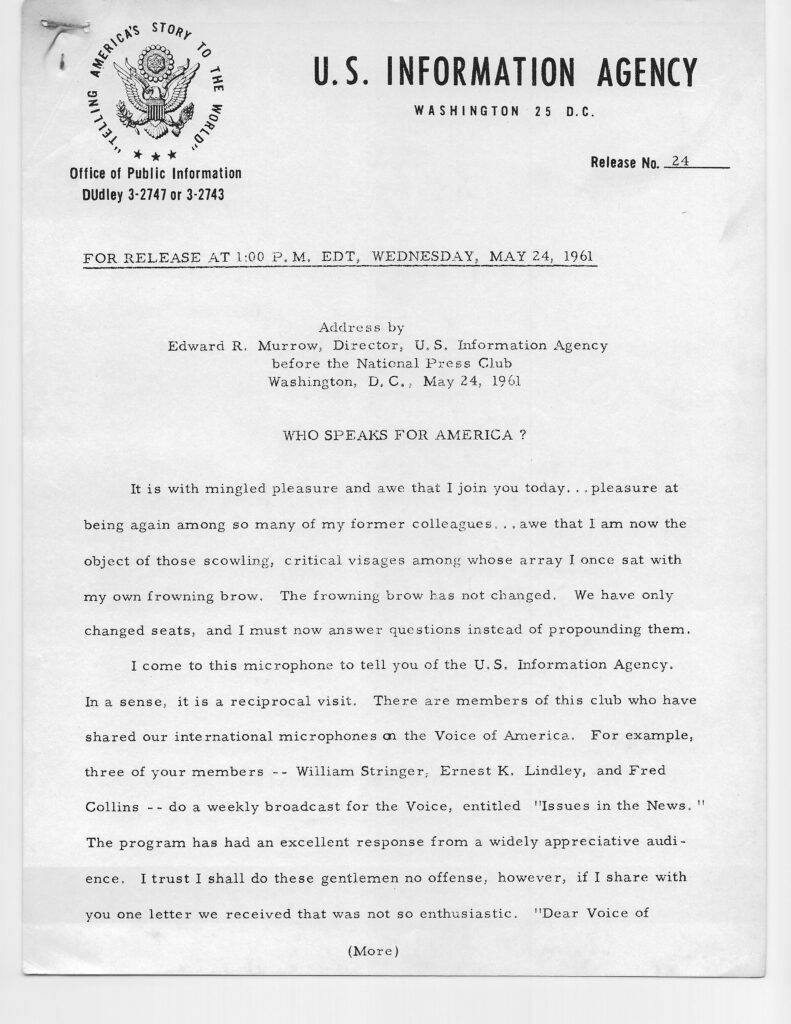
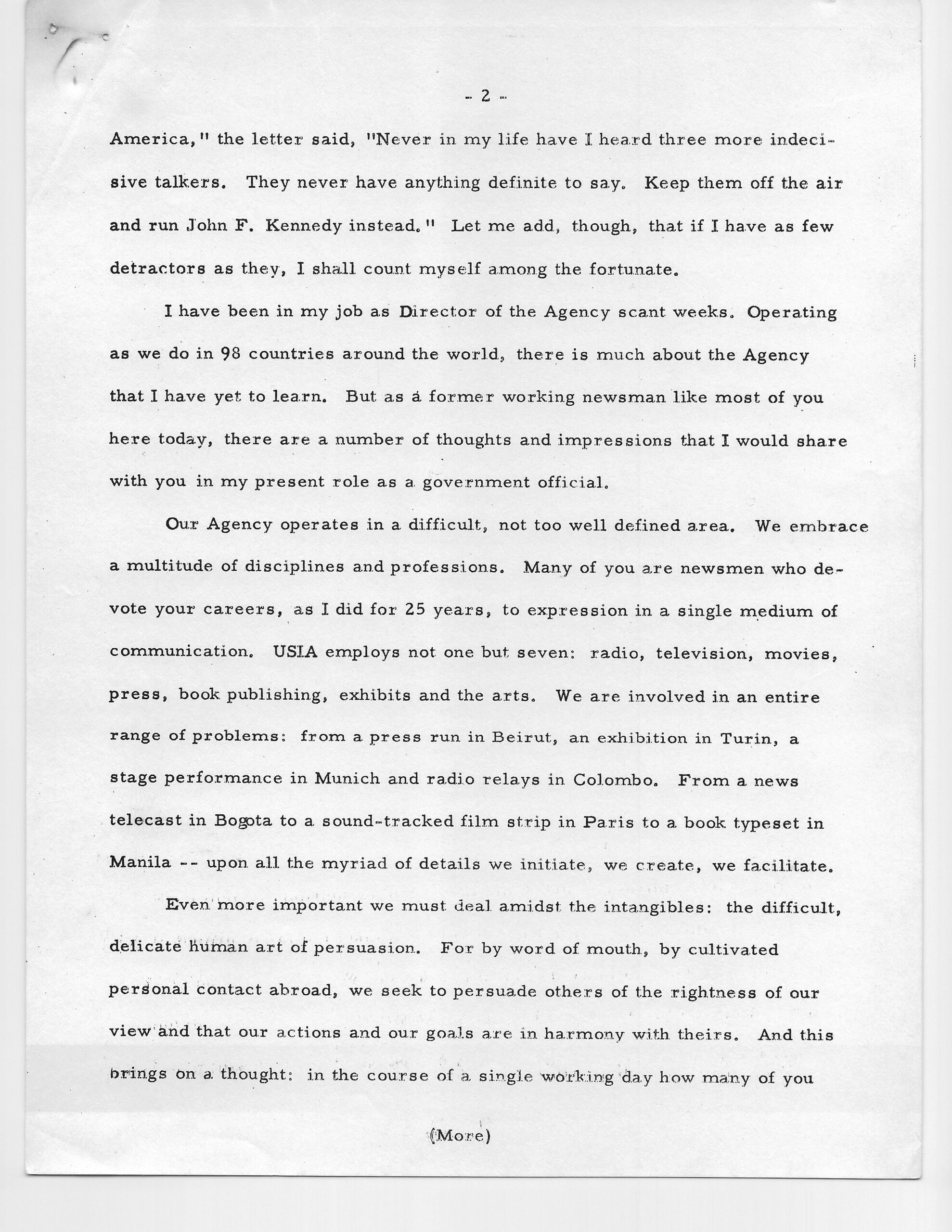
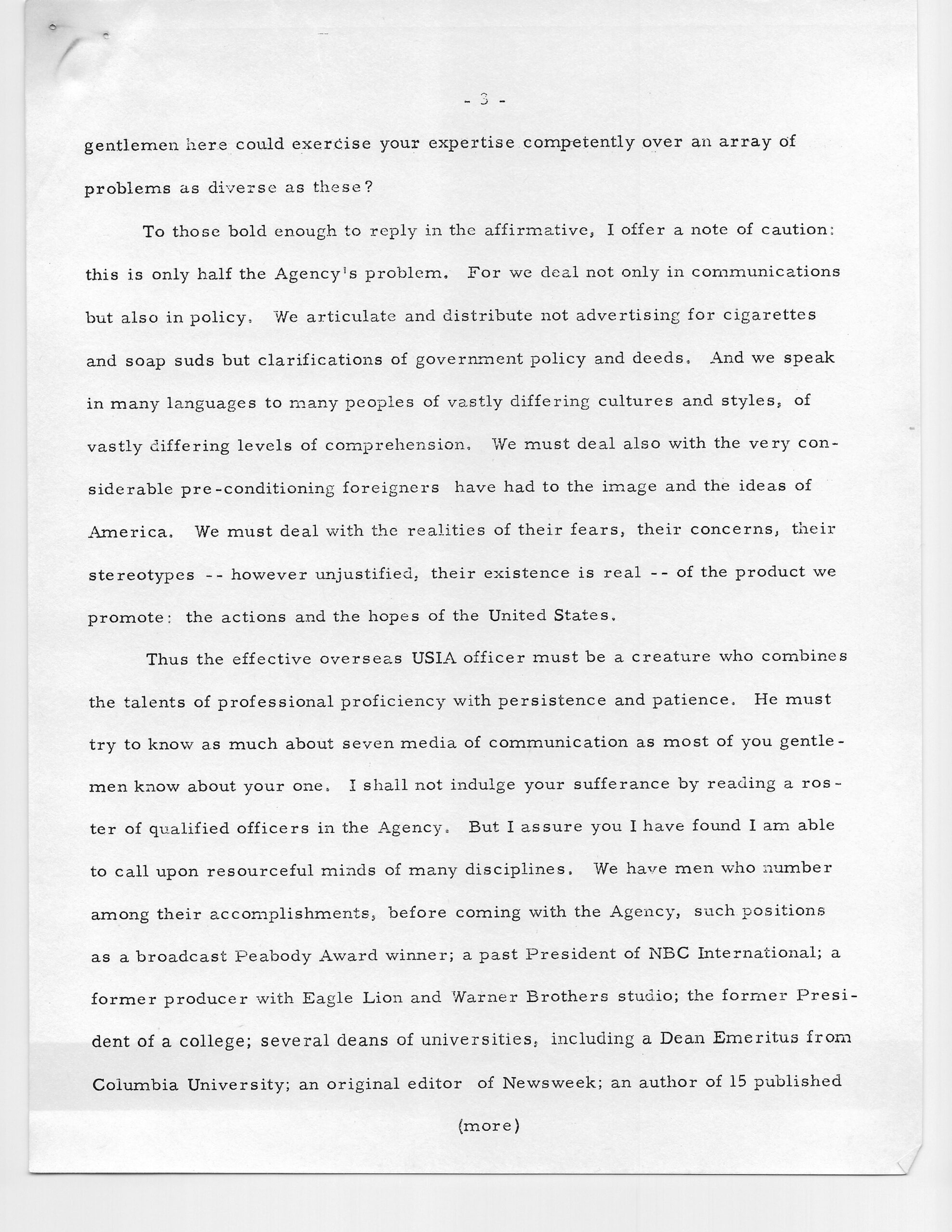
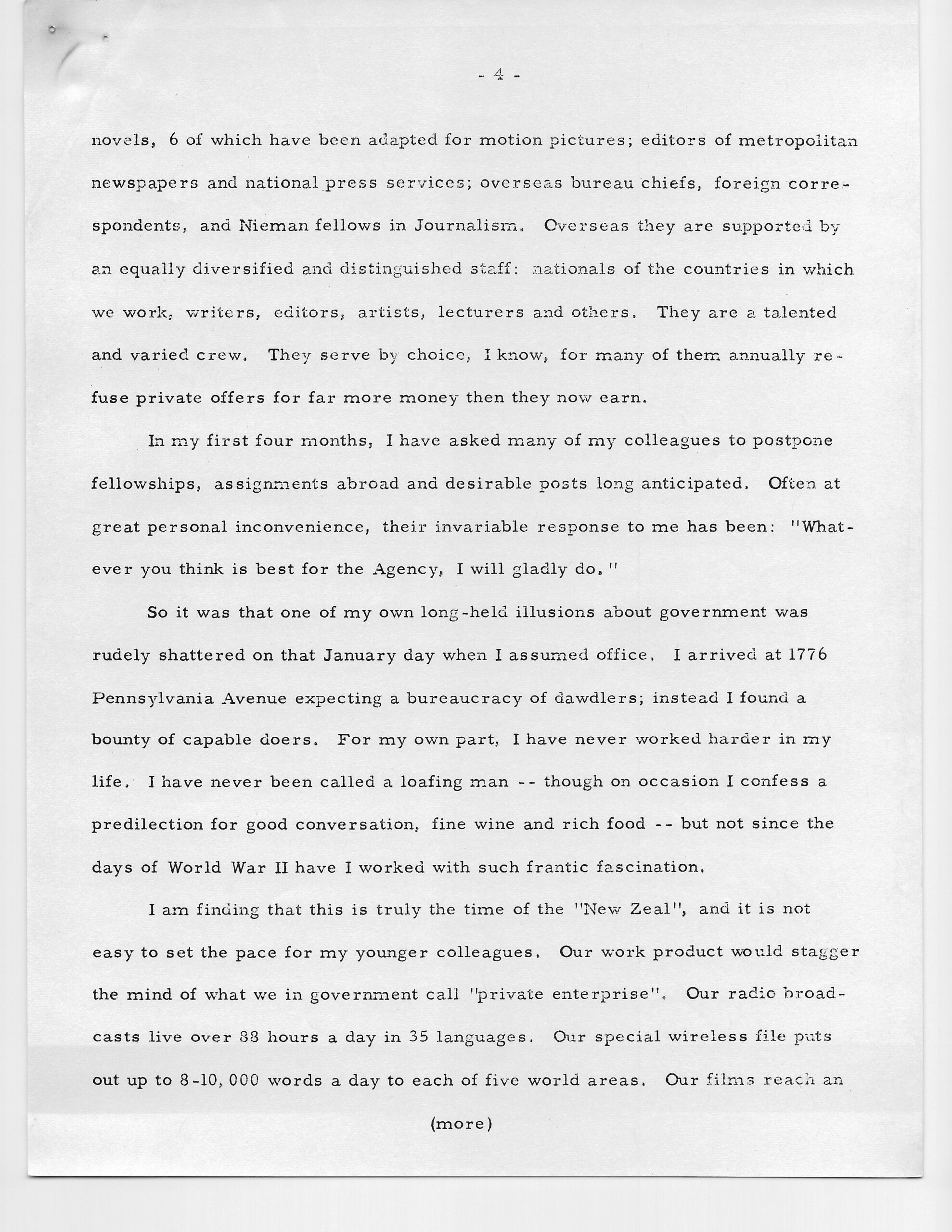
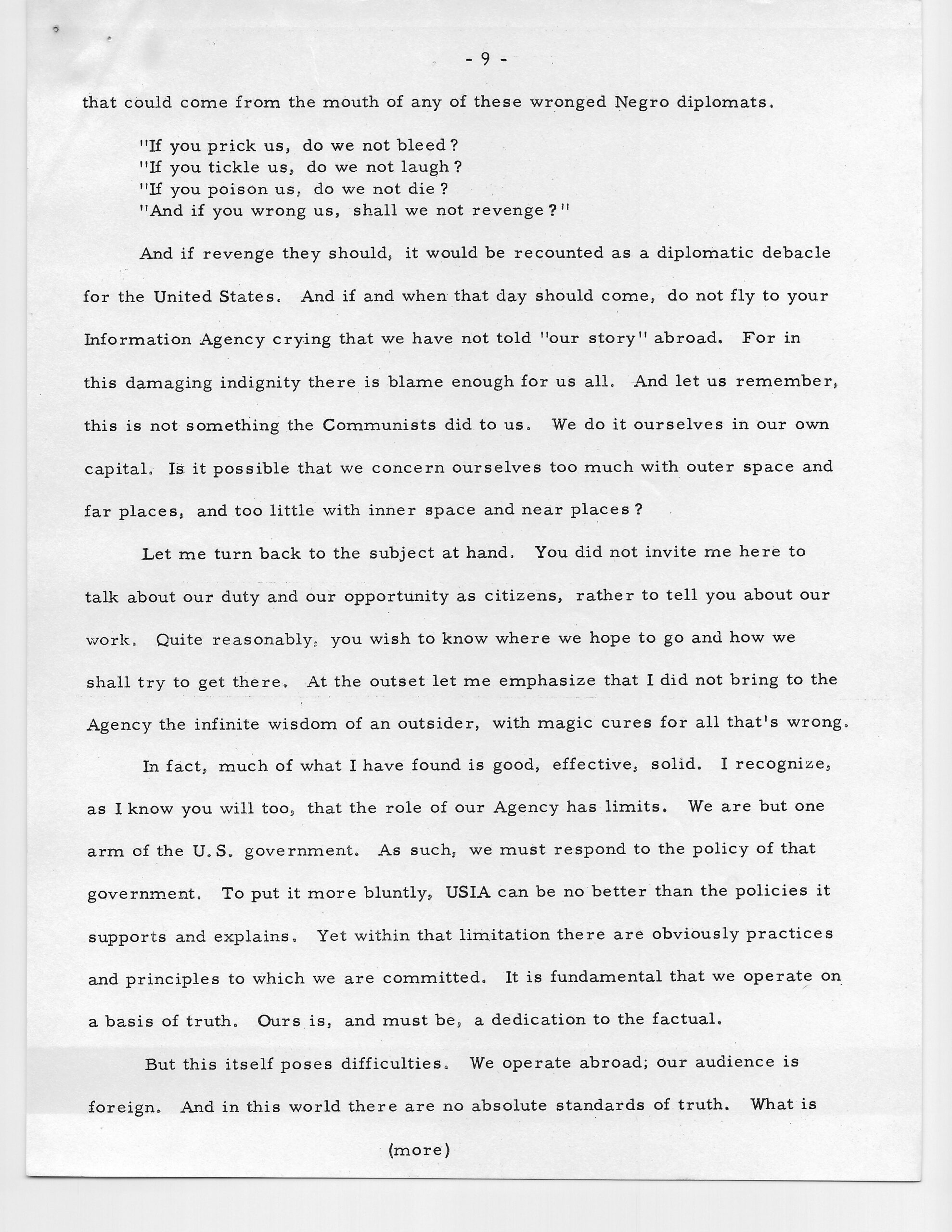
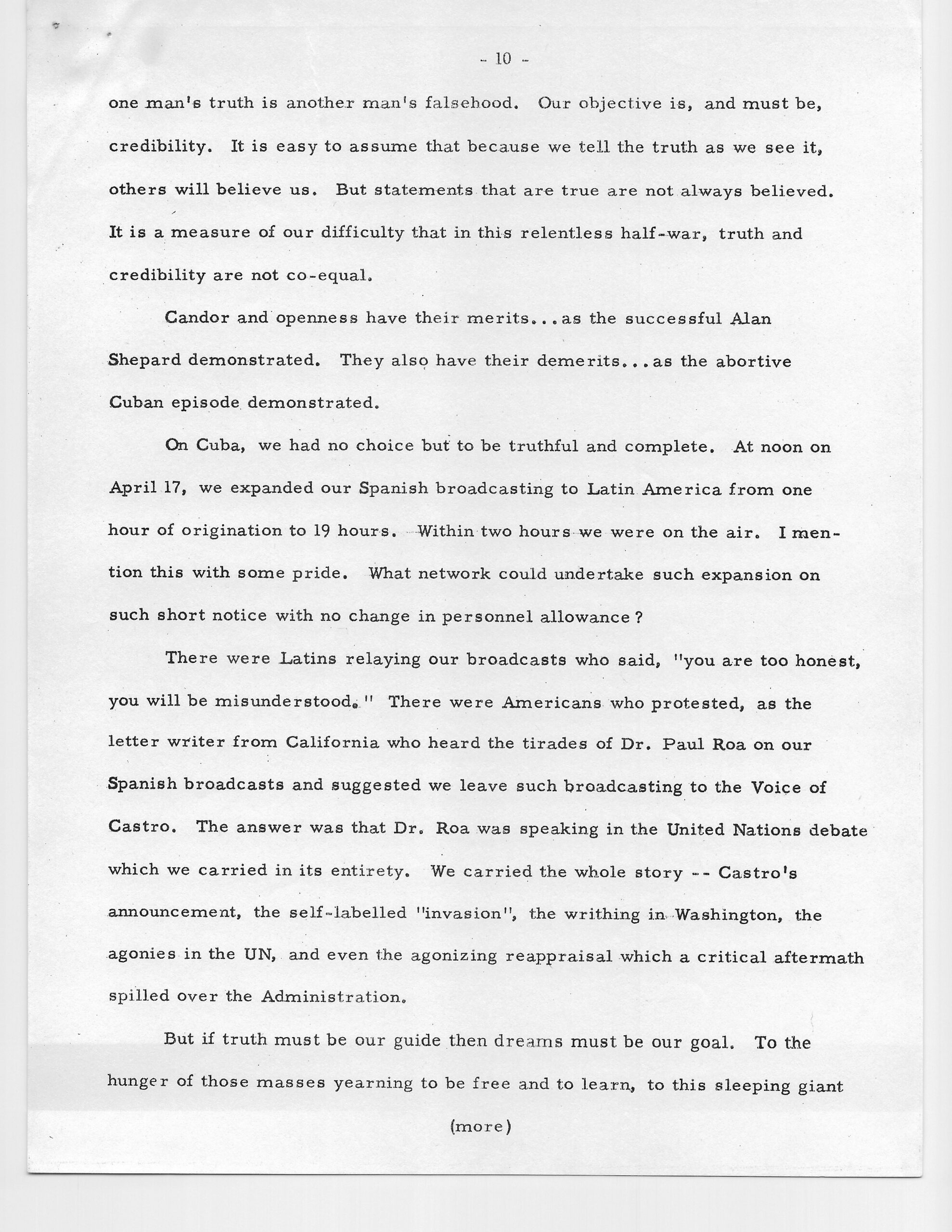
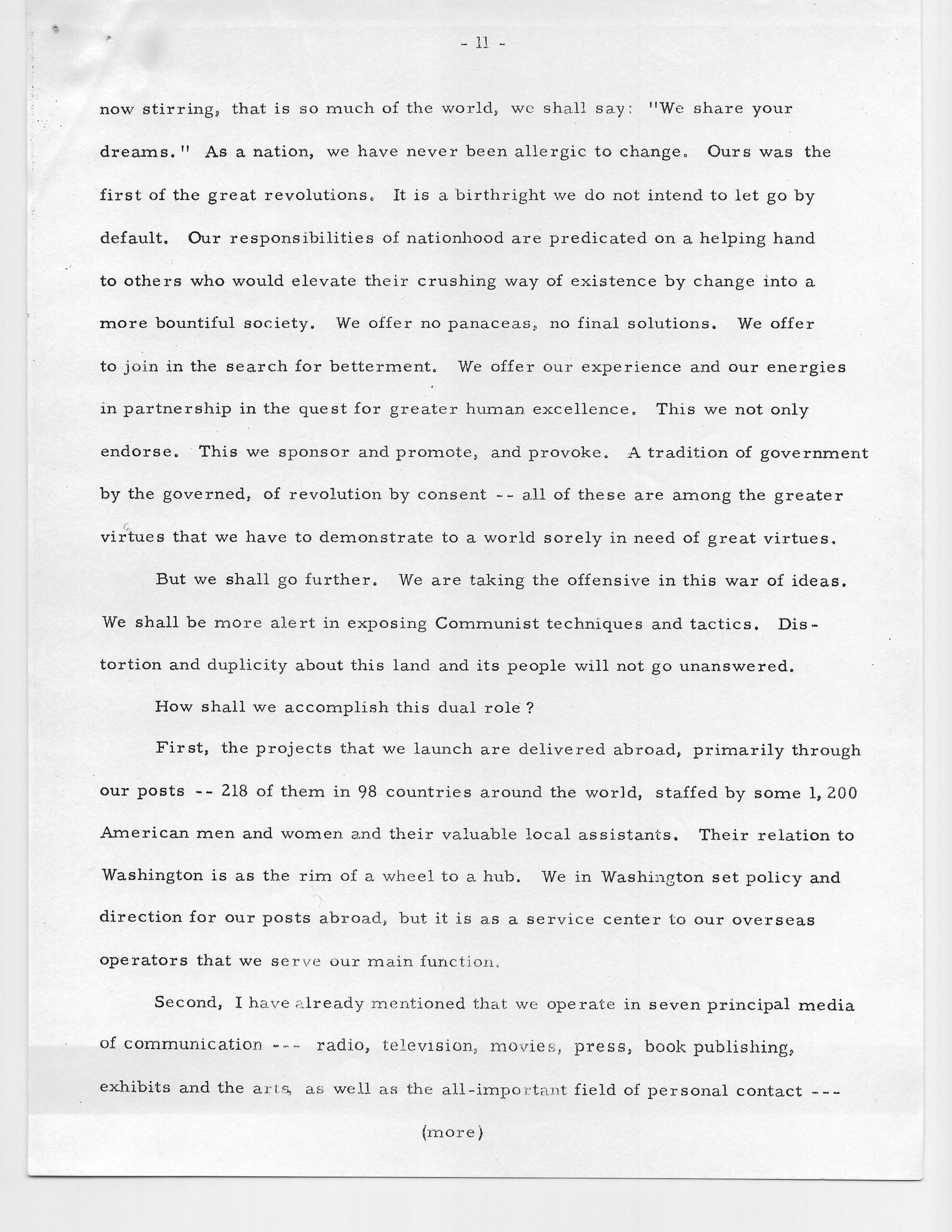
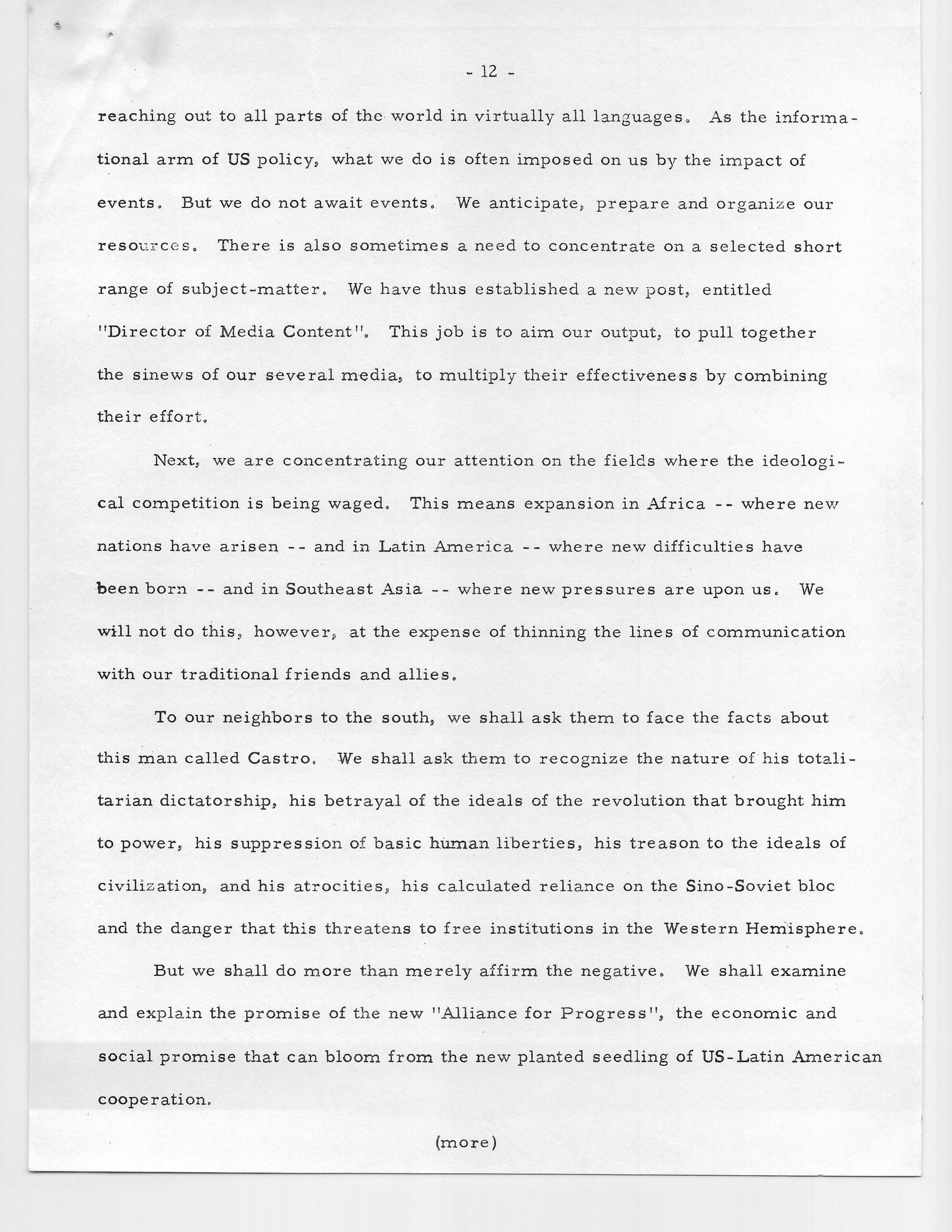
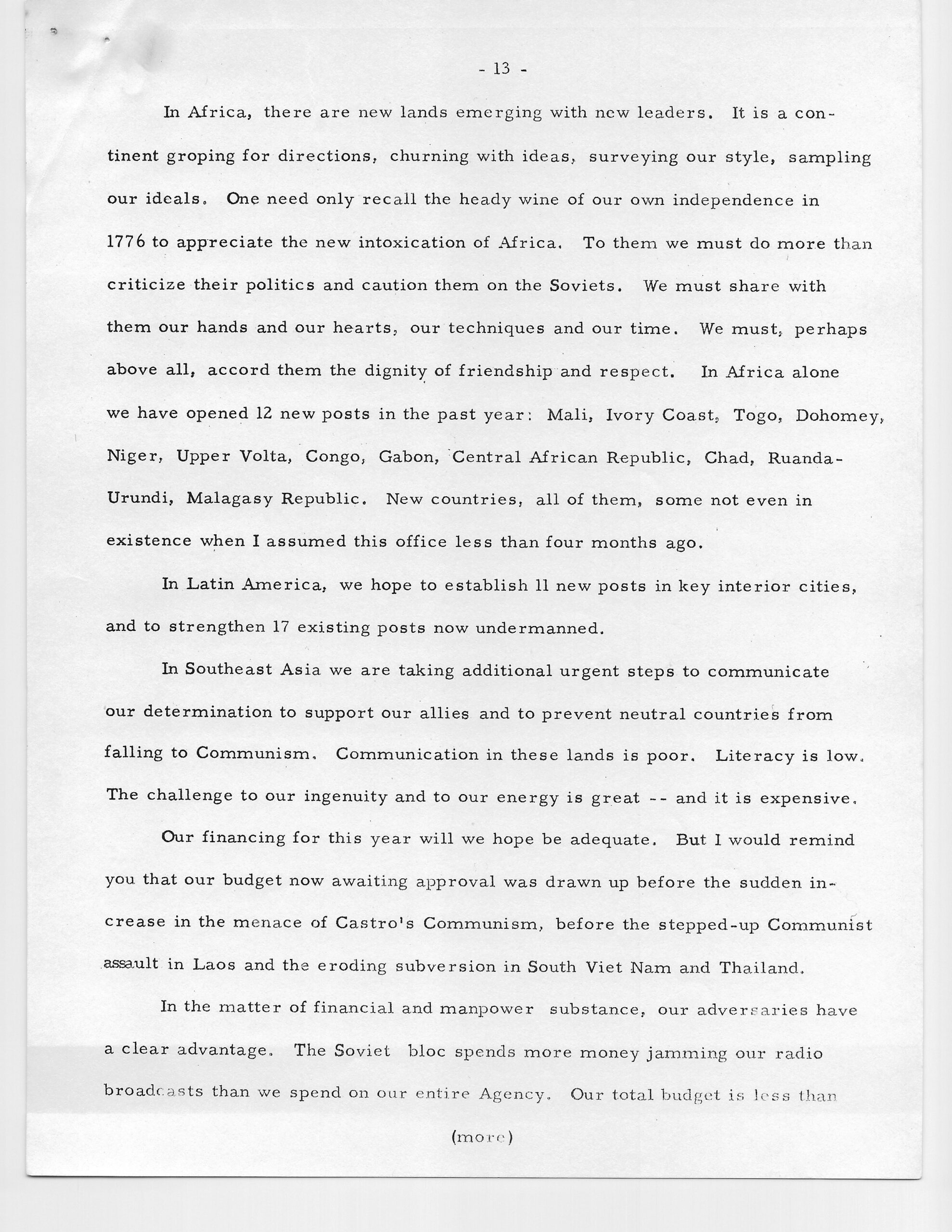
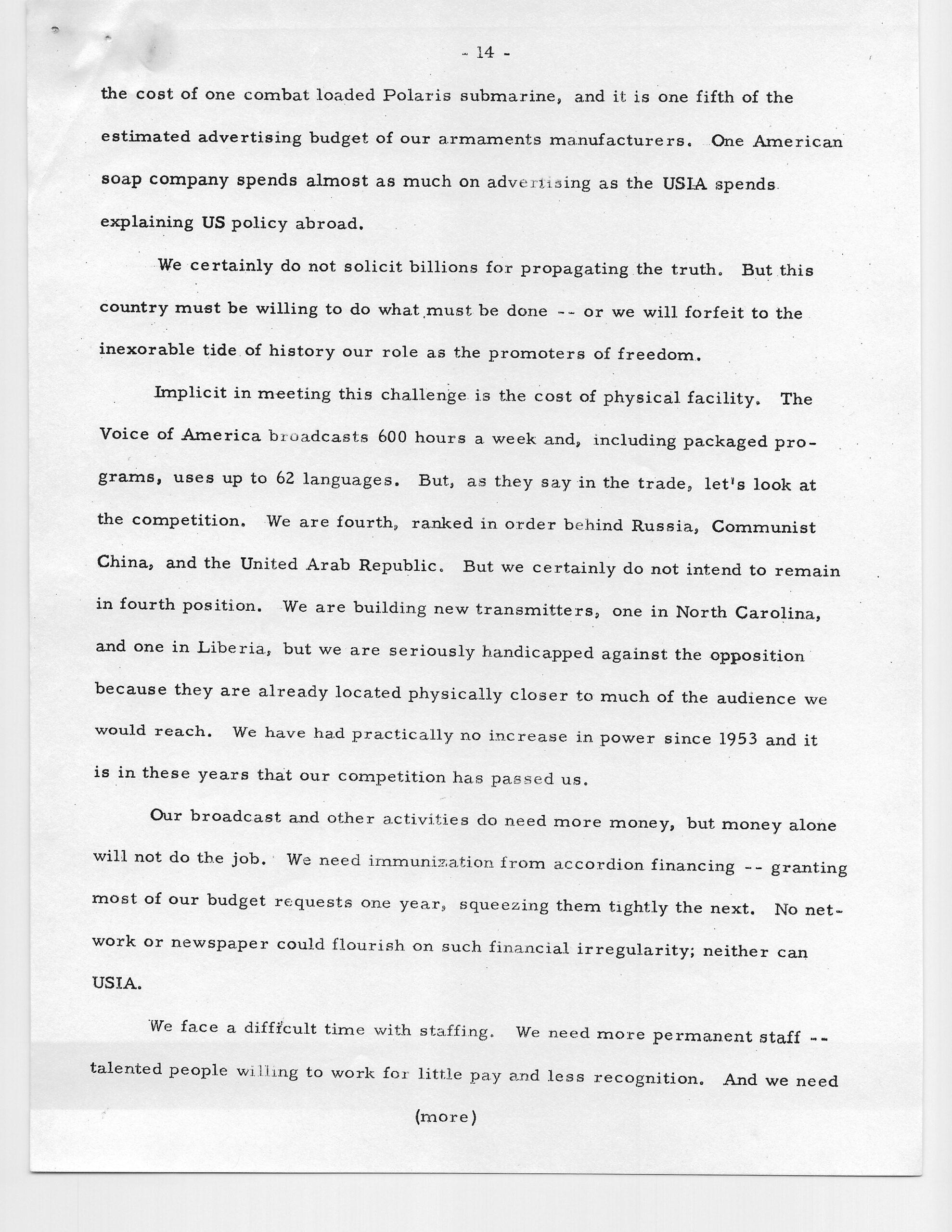
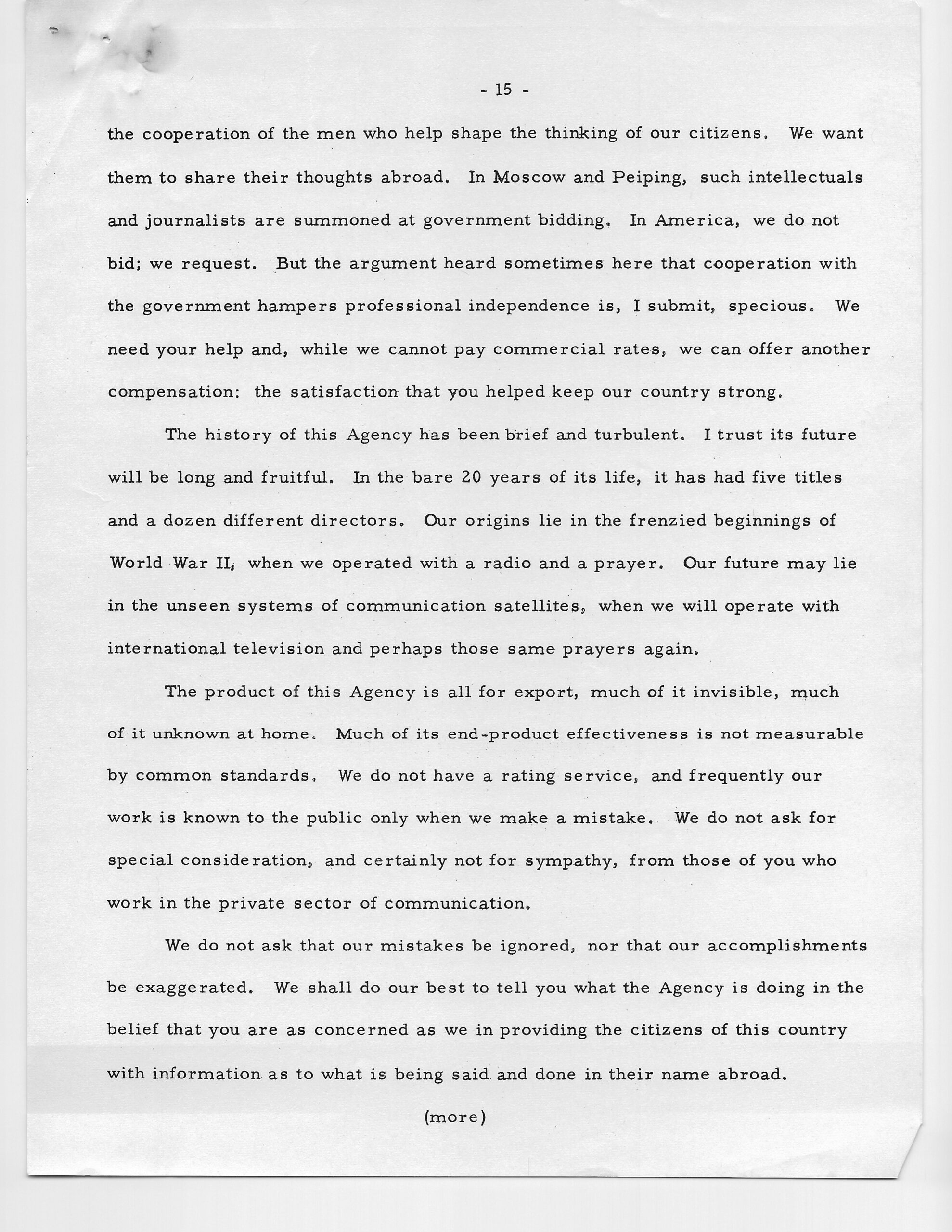
3. Text-Only Transcript: USIA Press Release — Murrow National Press Club Speech
What it is: Plain-text transcript of the USIA press release version of Murrow’s speech. Why it matters: Provides a searchable, quotable text that corresponds to the scanned pages reproduced above.
Introduction — Text-Only Transcript of the USIA Press Release
The PDF document below is a faithful reproduction of the full text of the 1961 USIA press release announcing Murrow’s National Press Club speech. It is provided for accessibility, research citation, and classroom use.
↑ Back to top · ▶ Back to Murrow audio
4. Images: Q-and-A Session Following Murrow’s Speech
What it is: Scanned pages documenting the question-and-answer session following Murrow’s public remarks. Why it matters: Captures contemporaneous concerns and clarifications about U.S. information policy that do not appear in the prepared speech.
Introduction — Images of the Q-and-A Session Following Murrow’s Speech
These images reproduce the full eight-page government-issued transcript of the Q-and-A session that followed Murrow’s May 24, 1961 National Press Club address. In this exchange, Murrow responded to pointed questions about censorship, government transparency, relations with the State Department, and whether the Voice of America should report U.S. racial injustice. Presenting the original scans preserves archival integrity and makes visible marginal spacing, typeface, and formatting consistent with government document reproduction of the early 1960s.
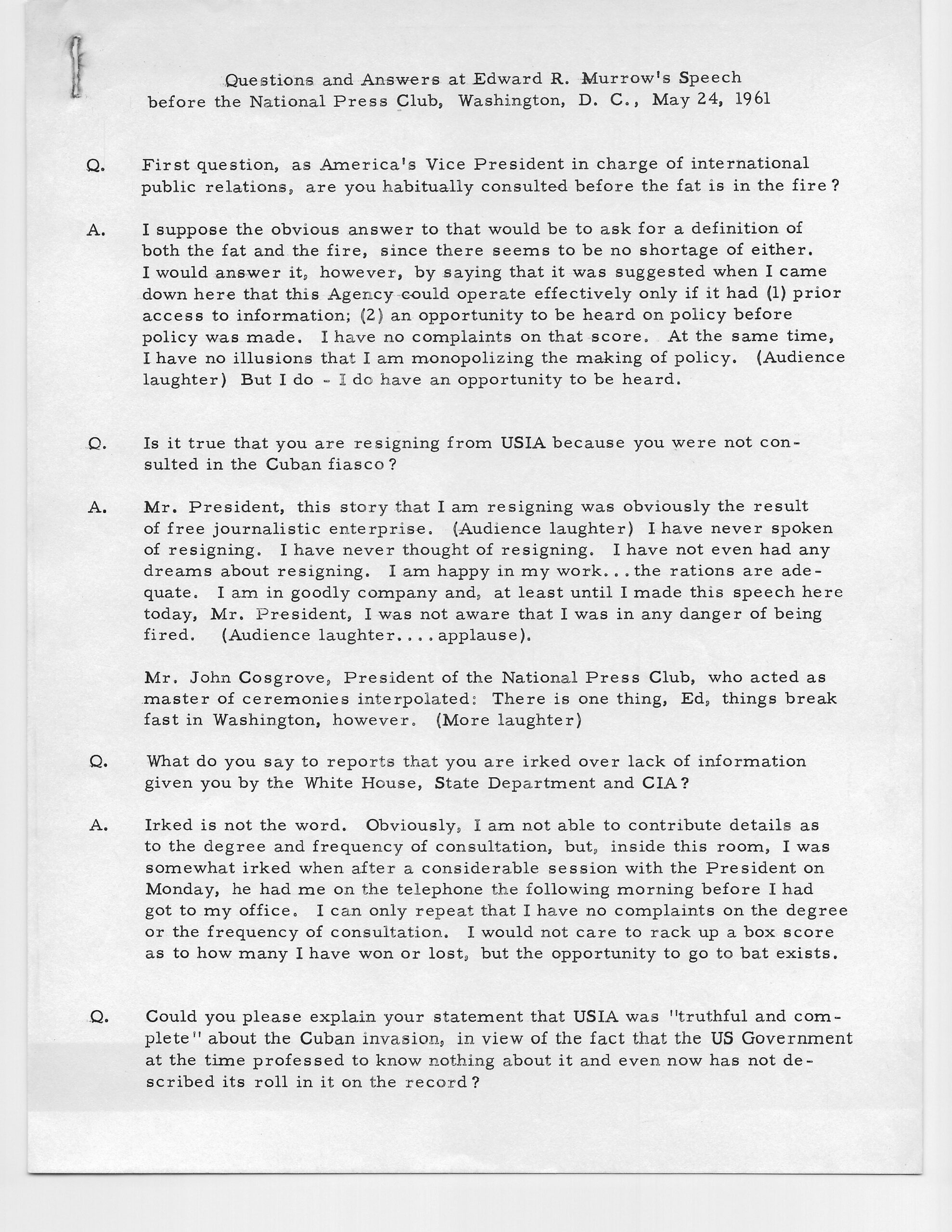
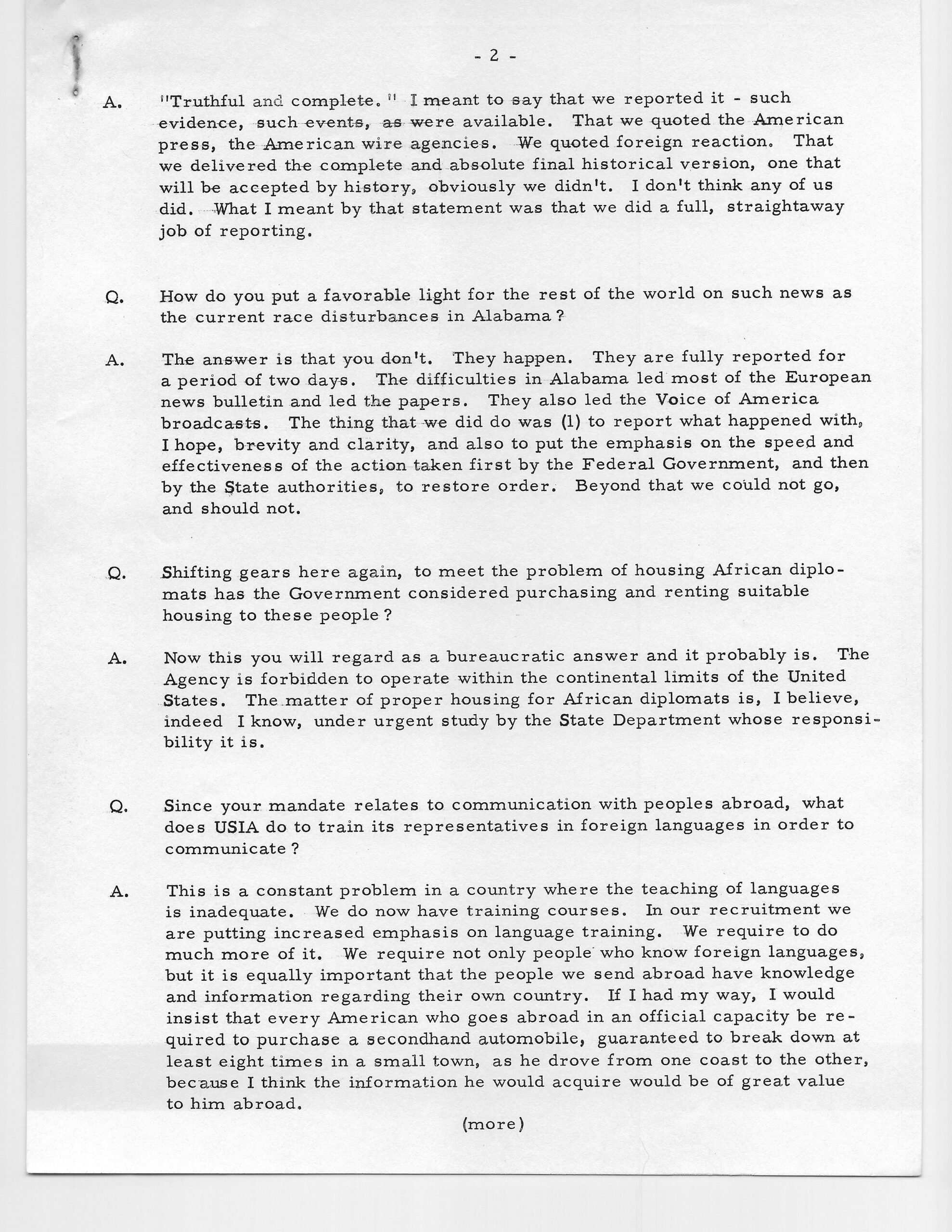
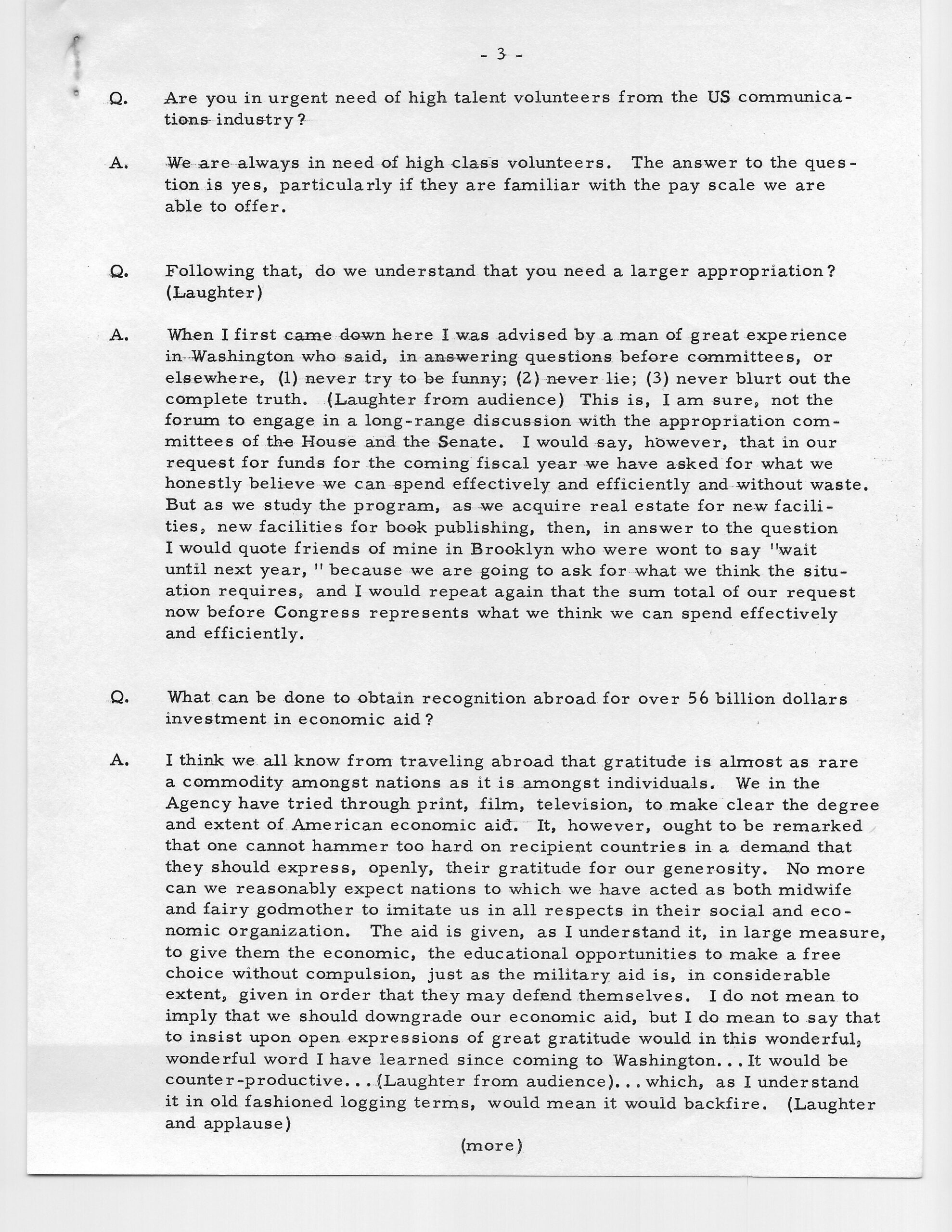
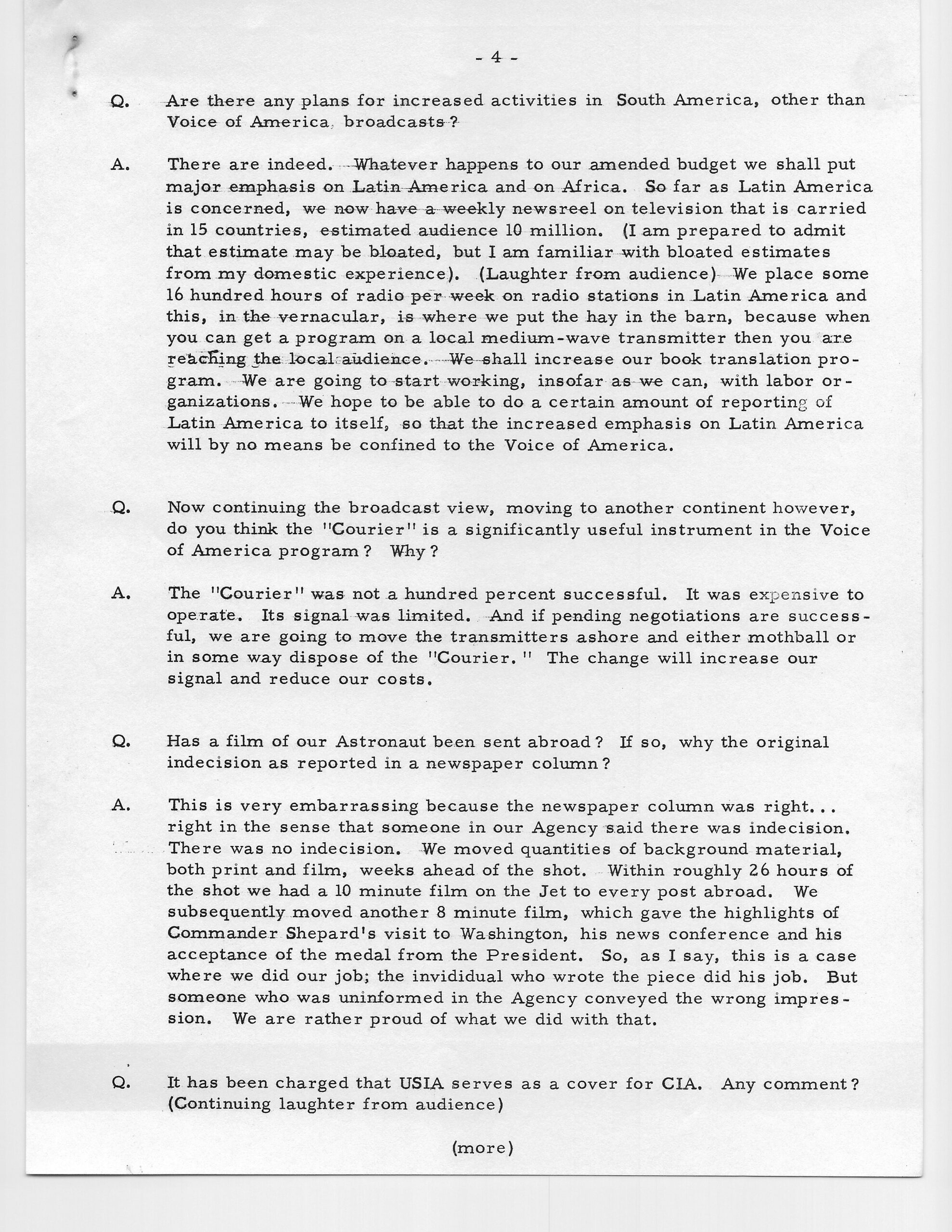
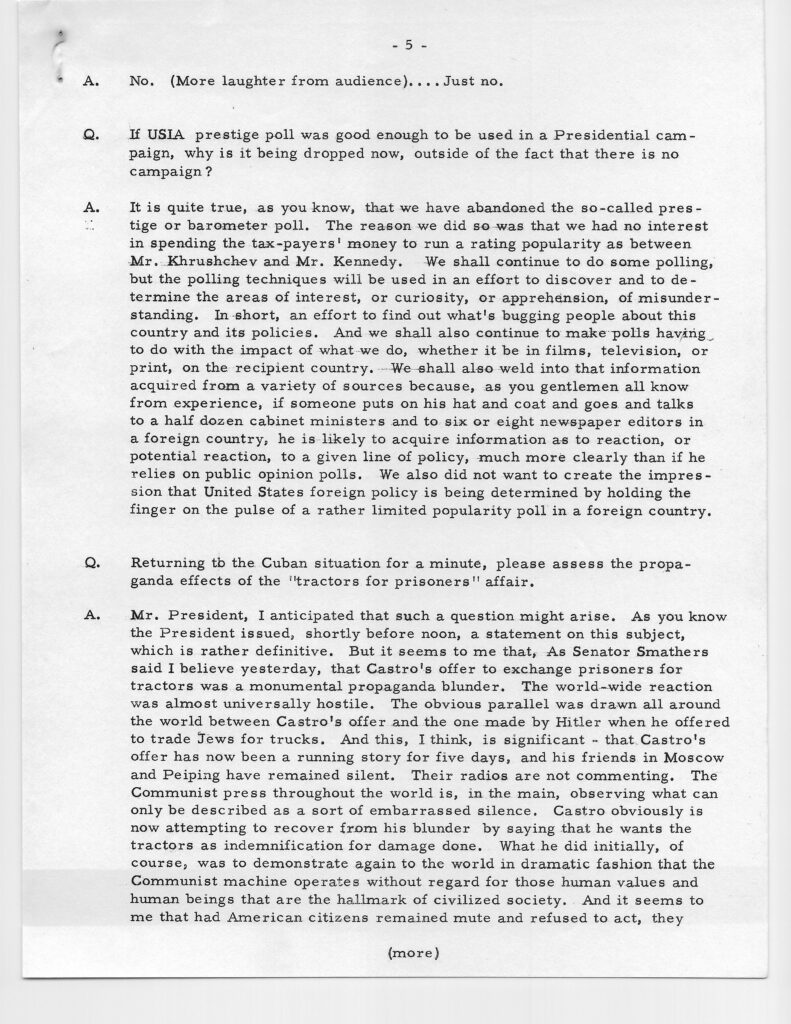
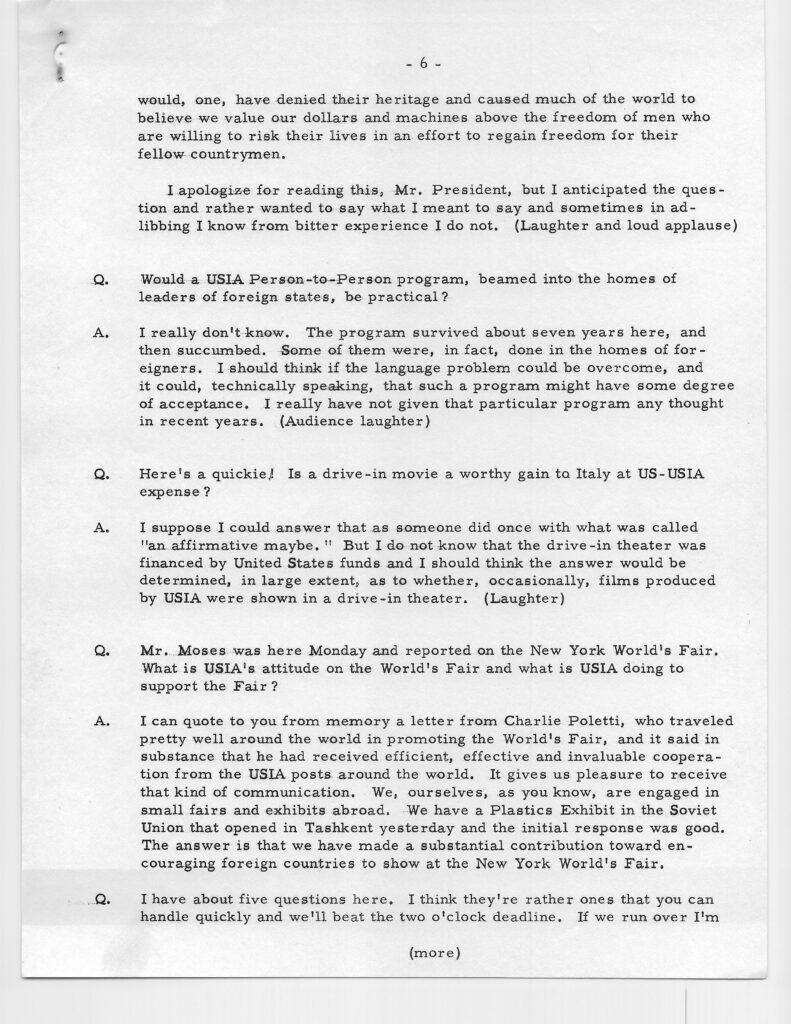
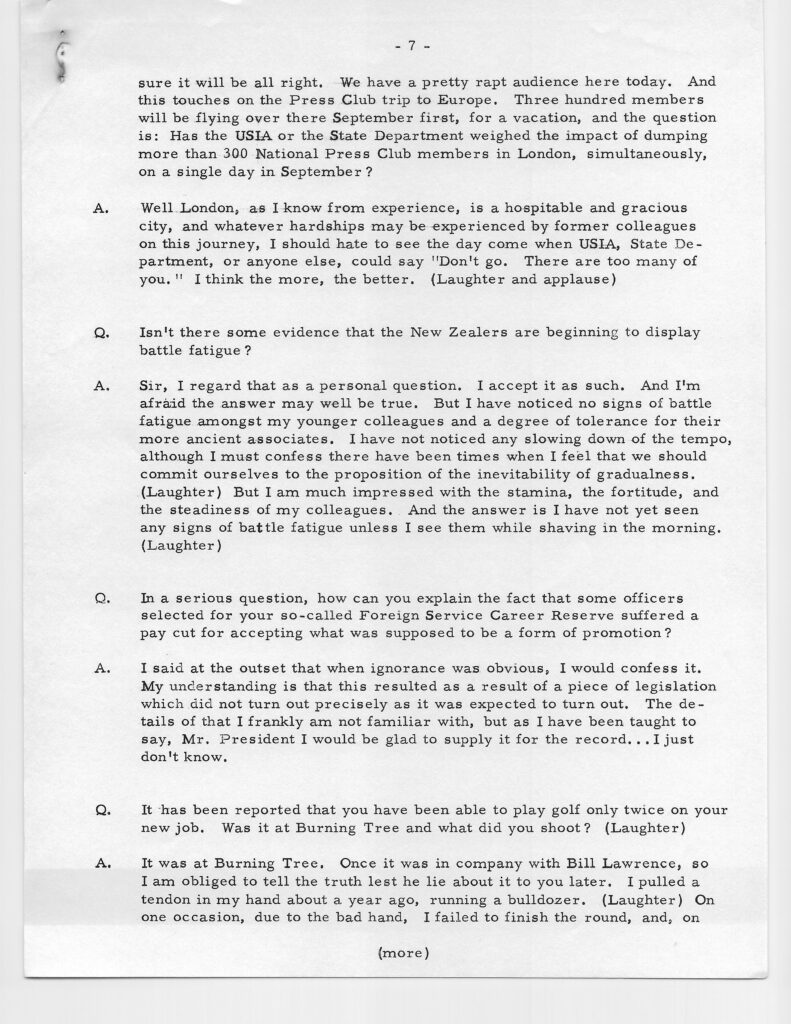
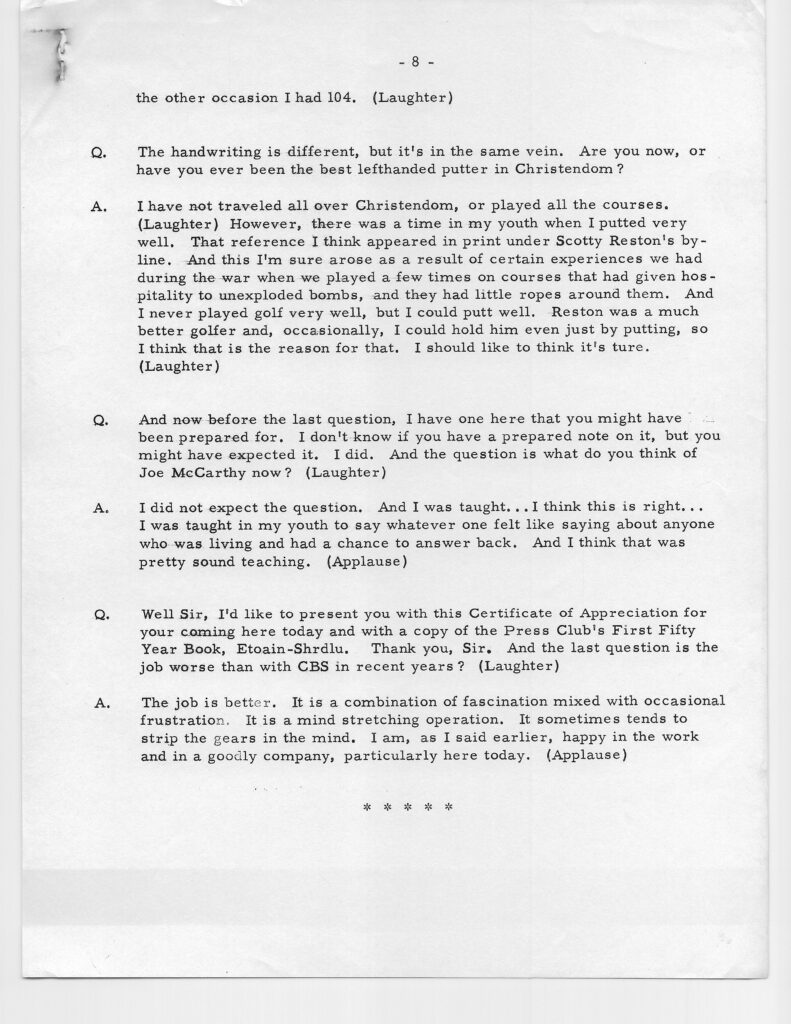
↑ Back to top · ▶ Back to Murrow audio
5. Text-Only Transcript: Q-and-A Session Following Murrow’s Speech
What it is: Plain-text transcript of the Q-and-A session pages reproduced above. Why it matters: Enables searching, quoting, and cross-referencing without relying on image-only scans.
Introduction — Text-Only Transcript of the Q-and-A Session
The PDF below provides a downloadable transcription of the questions and answers exchanged after Murrow’s National Press Club speech. It is supplied so that scholars, journalists, and educators may quote or study Murrow’s answers in a searchable format.
6. Confidential Murrow Memorandum (May 17, 1961)
What it is: A confidential internal memorandum authored under Murrow’s USIA leadership. Why it matters: Provides documentary evidence of how Murrow viewed the information conflict with the Soviet Bloc from inside government.
Additional Primary Source – Confidential Murrow Memorandum (May 17, 1961)
The following document is a declassified United States Information Agency memorandum written by USIA Director Edward R. Murrow and sent to David E. Bell, Director of the Bureau of the Budget, on May 17, 1961 — only eight weeks into Murrow’s tenure. Although the agency header and several pages carry the designation “CONFIDENTIAL,” the document is now publicly available. It offers one of the clearest statements, in Murrow’s own words, that U.S. international broadcasting and public diplomacy were intended not only to “tell America’s story” but to counter, isolate, and weaken communist regimes.
This text is included here as a primary source because it reveals the strategic mindset guiding U.S. international broadcasting policy in 1961: Murrow explicitly argues for funding to expand Voice of America shortwave hours, develop local radio placement, and wage an “energetic campaign of persuasion” aimed at Latin America, Cuba, Southeast Asia, and Africa. The memorandum, therefore, contextualizes the 1961 VOA–RIAS Berlin broadcast within a wider global effort — one in which information was a weapon. In his U.S. government position, Murrow willingly used information warfare, if not propaganda, for U.S. goals — contradicting VOA’s myth of Murrow as a purely neutral journalist even in his USIA role.
⸻
UNITED STATES INFORMATION AGENCY
WASHINGTON
OFFICE OF THE DIRECTOR
May 17, 1961
CONFIDENTIAL (Declassified)
Dear Mr. Bell:
Political developments of the past two months make it imperative that USIA:
(1) Obtain from Congress substantially all of the $118.6 million requested in our FY 1962 budget submission, and
(2) Obtain from Congress an additional $2,405,700 which will permit us to make an immediate and significant contribution to the success of new U.S. programs stemming from recent crises in Latin America and Southeast Asia.
We were able to anticipate much of the need in Latin America when we asked for an increase of $5.1 million in our budget submission over the current FY 1961 level of $9.3 million. What we could not anticipate was the sudden and dangerous increase in the menace of Castro-Communism stemming from the crushing defeat of the Cuban landings.
We were able to anticipate our needs in Africa where new leaders of new nations are being subjected to tremendous pressure from the Sino-Soviet Bloc. But if Congress does not appropriate substantially all the $118.6 million requested, we will be unable to build the base for an effective information-cultural program in Africa. Forces hostile to us are moving ahead rapidly.
Mr. David E. Bell
Director
Bureau of the Budget
CONFIDENTIAL (Declassified)
They are not short of funds or manpower; they are not waiting for legislative decisions or new fiscal years.
We were not able, however, to anticipate the stepped-up Communist propaganda-subversion assault on South Viet-Nam, and the critical situation created by the impact of the Lao and Viet-Namese situations on Thailand. Action, and fast action, is required if the Free World position in Indo-China is to be maintained. We propose such action in our supplemental request.
This supplemental appropriation request of $2,405,700 is for expanded radio and television activities in Latin America and Southeast Asia in direct support of new United States Government programs in those areas.
⸻
Latin America
Castro’s defeat of the force that landed in Cuba April 17 bore dramatic witness to the extent of his Communist Bloc supplied military build-up, as it did to the efficacy of the police state control mechanisms he and his Communist helpers have fastened on Cuba. His success in dealing with a landing that evidently had U.S. support heightened his stature, thus augmenting his ability to promote subversion and insurrection in other countries.
It now seems certain that the Castro-Communists will move fast to exploit their new-won advantages. Castro’s expenditures for propaganda are believed to equal USIA’s, the Soviet Bloc’s far to surpass. A new 100-KW short-wave transmitter now makes Castro audible everywhere in the area. Castro-Communist subversive activities are on the rise; one Communist diplomat has boasted openly of imminent “Fidelista” revolutions in several countries.
CONFIDENTIAL (Declassified)
Decisions by the President call for an energetic campaign of persuasion—by diplomacy and propaganda—to unify Latin America against Castro, to isolate and “quarantine” him, to nullify his potential for subversion, and ultimately so to weaken him in Cuba and in the rest of Latin America that his Cuban opponents (and Hemisphere pressures) can overthrow him. The decisions call for equally energetic efforts to rally Latin Americans to the President’s “Alliance for Progress,” in which the United States promises to cooperate with them in realizing the just aspirations they have conceived for betterment of their social and economic lot.
In this campaign, assignments of major importance devolve upon the U.S. Information Agency.
In the 1962 budget presentations, the Agency based its request for substantial increases for Latin America on the argument that the limited, capital-city program directed chiefly to national opinion leaders of past years no longer sufficed, that the Castro-Communists’ bypassing of leaders to appeal to the people made it necessary for USIA, too, to go directly to the people. This necessity is sharpened with the events of April 17 and afterward.
We must convey to the Cuban people and to the people of Latin America the facts about:
- The nature of Castro’s totalitarian dictatorship, his betrayal of his revolution’s announced purposes, its suppression of all basic human freedoms, its persecution of the Catholic church, its brutalities and inhumanities, its treason to the ideals of Western civilization, its repudiation of elections, its calculated subservience to the Sino-Soviet Bloc, and its very real threat to the Inter-American system and to the free institutions of the countries of the Western hemisphere.
- The promise President Kennedy’s “Alliance for Progress” holds out that in this decade democratically conceived, U.S.-supported economic and social reforms will realize the rightful aspirations of the Latin American peoples. (This requires intensive reporting to the Cubans and other Latin American peoples about the successes achieved under this cooperative program.)
The Agency’s 1962 budget presentations already earmark substantial funds for the second, or positive, aspect of its task in Latin America. With the additions proposed in this supplemental request, assuming Congressional approval of the original budget, we believe these funds will be adequate for that purpose. Hence most of the supplemental funds requested are to deal with the new situation created by the emergent Castro threat.
It is in radio and television—the two media that reach directly the illiterate and the semi-literate, the people to whom the Castro appeal is chiefly directed—that substantially increased efforts are proposed.
Of this new request:
- $585,600 would be spent to increase short-wave broadcasting in Latin American languages from a total of eight hours daily, planned in the original budget request, to a total of twenty-two hours. In this new total, twelve hours would be in Spanish to Latin America generally; six hours in Spanish directed particularly to Cuban audiences; and four hours would be in Portuguese to Brasil.
- $448,400 would be used for a threefold increase in the production of packaged radio programs to be supplied to local medium-wave radio outlets. A part of this proposal is the purchase of special radio receivers and tape recorders to be loaned to stations which could not otherwise rebroadcast VOA programs.
- $531,300 is proposed to provide additional television programs for placement on Latin American TV stations, with particular emphasis on countering the Castro-Communist menace.
⸻
Southeast Asia
The deteriorating political and military situation in Southeast Asia calls for urgent additional steps to communicate the determination of the United States to (1) support our allies and maintain them as allies, and (2) prevent neutral countries from falling to Communism.
The success of Communist forces in Laos and Viet-Nam has had repercussions throughout the area. Neutral Cambodia shows signs of becoming more susceptible to pressures by the Communist Bloc. Large parts of Viet-Nam, an ally, are under the control of Communist guerrillas. Thailand, also an ally, has become increasingly concerned over its security.
Communications in these countries range from barely adequate to extremely poor. Literacy is low. In those circumstances, new and additional direct broadcasting by the Voice of America in local languages, relayed where possible over local stations, becomes increasingly urgent and important.
Our request provides for an increase from 1½ to 4½ hours of daily broadcasting to Southeast Asia in Lao, Cambodian, Thai, and Viet-Namese. This voice of freedom will seek to lift the hearts and renew the hope of beleaguered Viet-Namese villagers, fearful Laotians, and skeptical Thais. The cost for FY 1962 is $580,000.
The balance of the request—$260,400—is needed for administrative costs related solely to increased programs proposed.
⸻
We are in a war both hot and cold, a war for men’s minds as well as their bodies, a war for men’s souls as well as their goods. This Agency could operate for four hundred years on one year’s appropriation for the Defense Department. We do not dispute the spending of vast sums for physical defense. Nor are we asking billions for propaganda—propagation of the truth. But if we are unwilling to do what must be done to preserve and promote our ideals, we may have alien ideas imposed on us and our allies.
As never before, USIA urgently needs adequate resources to do the job which must be done—not only the funds requested herein but also substantially all of our original request.
My colleagues and I are available to meet with your staff to justify this request in more detail.
Copy to:
Mr. Theodore C. Sorensen
Special Counsel to the President
Sincerely,
Edward R. Murrow
Director, United States Information Agency
CONFIDENTIAL (Declassified)
Curator’s Note
This memorandum and the other exhibits in this article are significant because they portray Murrow not as a CBS journalist but as a U.S. government strategist operating at the height of the Cold War. His language — speaking of “propaganda,” “quarantine,” and using radio to “weaken” hostile regimes — reveals the degree to which U.S. international broadcasting was conceived as an instrument of national policy rather than a purely journalistic enterprise. While later generations often invoke Murrow as an icon of media independence, these primary sources show that, in 1961, he accepted that democracy sometimes required forceful persuasion abroad. They are also a rare example of Murrow speaking and writing candidly about the Voice of America’s role in psychological and political conflict, offering an invaluable window into the internal mindset behind public diplomacy at a moment of global crisis.
↑ Back to top · ▶ Back to Murrow audio
7. Policy Debates over U.S. International Broadcasting: The 1961 Sorensen–Kennedy File on Radio Free Europe and the Voice of America
What it is: A set of internal documents preserved in the Theodore C. Sorensen Personal Papers reflecting early Kennedy administration debate over VOA, USIA, and Radio Free Europe. Why it matters: Shows that some advisers argued for curbing RFE’s independence—recommendations President Kennedy ultimately did not adopt.
Policy Debates over U.S. International Broadcasting: The 1961 Sorensen–Kennedy File on Radio Free Europe and the Voice of America
Introduction to the Folder
This folder contains a set of confidential internal documents prepared and circulated in early 1961 during the first months of the Kennedy administration, reflecting a high-level reassessment of U.S. international broadcasting policy toward Eastern and Central Europe.
Preserved in the Theodore C. Sorensen Personal Papers at the John F. Kennedy Presidential Library and Museum, the materials document a moment of intense internal debate over the future roles of the Voice of America (VOA), the United States Information Agency (USIA), and Radio Free Europe (RFE). The folder includes a critical analytical memorandum evaluating U.S. information services, as well as related correspondence showing how the document circulated among President Kennedy’s closest advisers.
Although the memorandum presents itself as a policy analysis, its sharply negative assessment of Radio Free Europe and its recommendations to curb RFE’s independence were not adopted by President Kennedy. Subsequent events—including Kennedy’s public support for the Radio Free Europe Fund—suggest that the President ultimately rejected the memorandum’s core conclusions. The documents are reproduced here in full as primary evidence of internal policy debates, not as authoritative judgments.
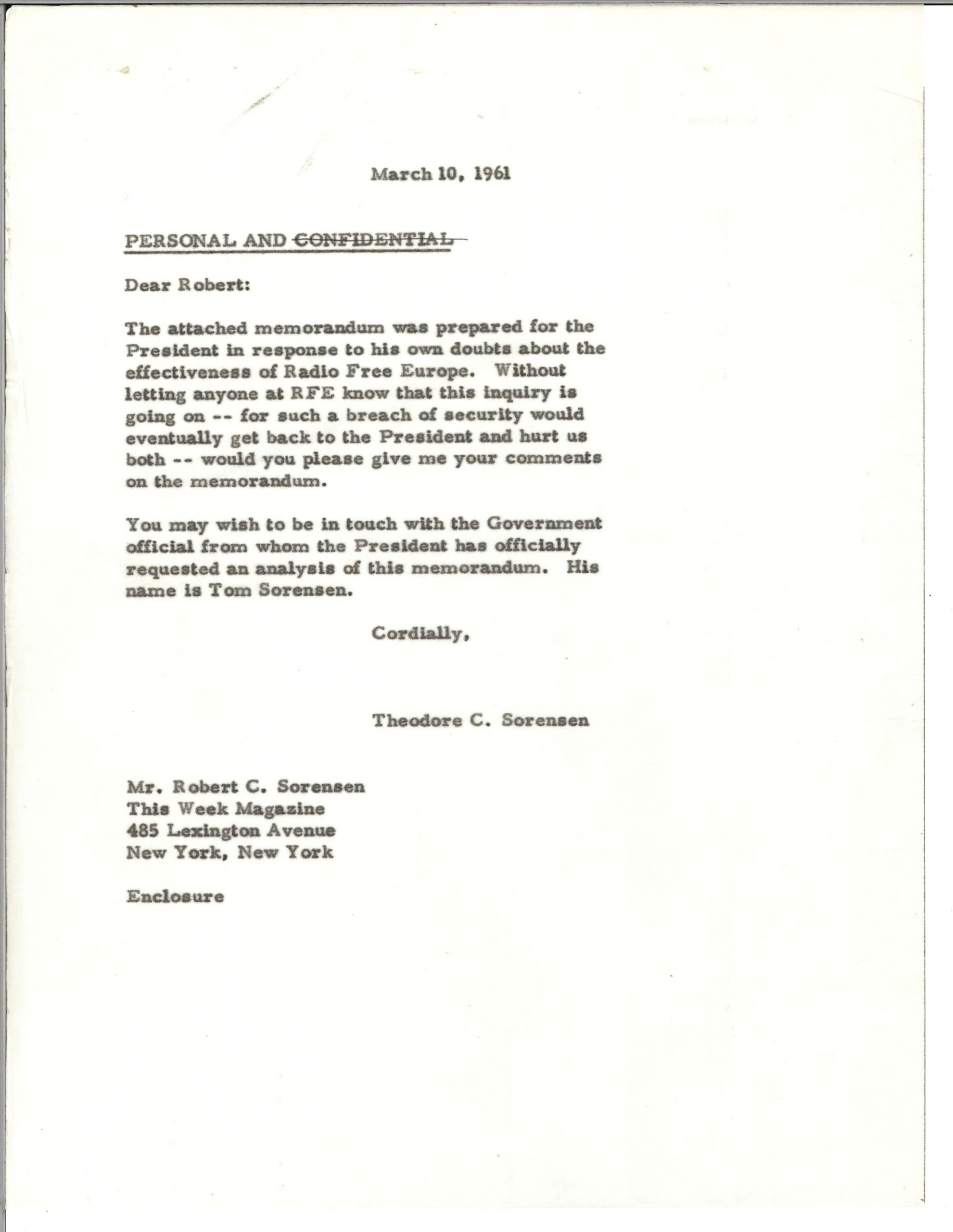
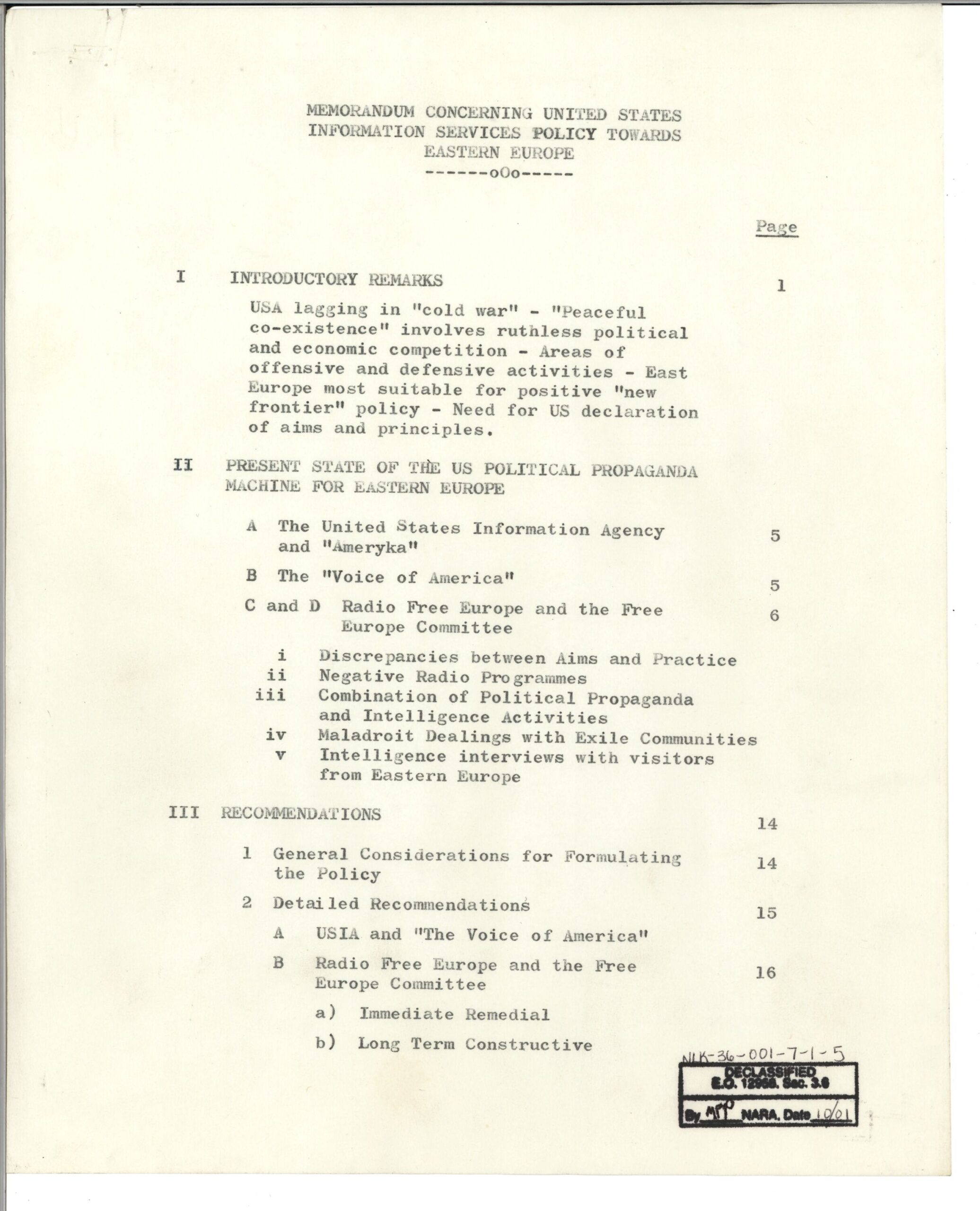
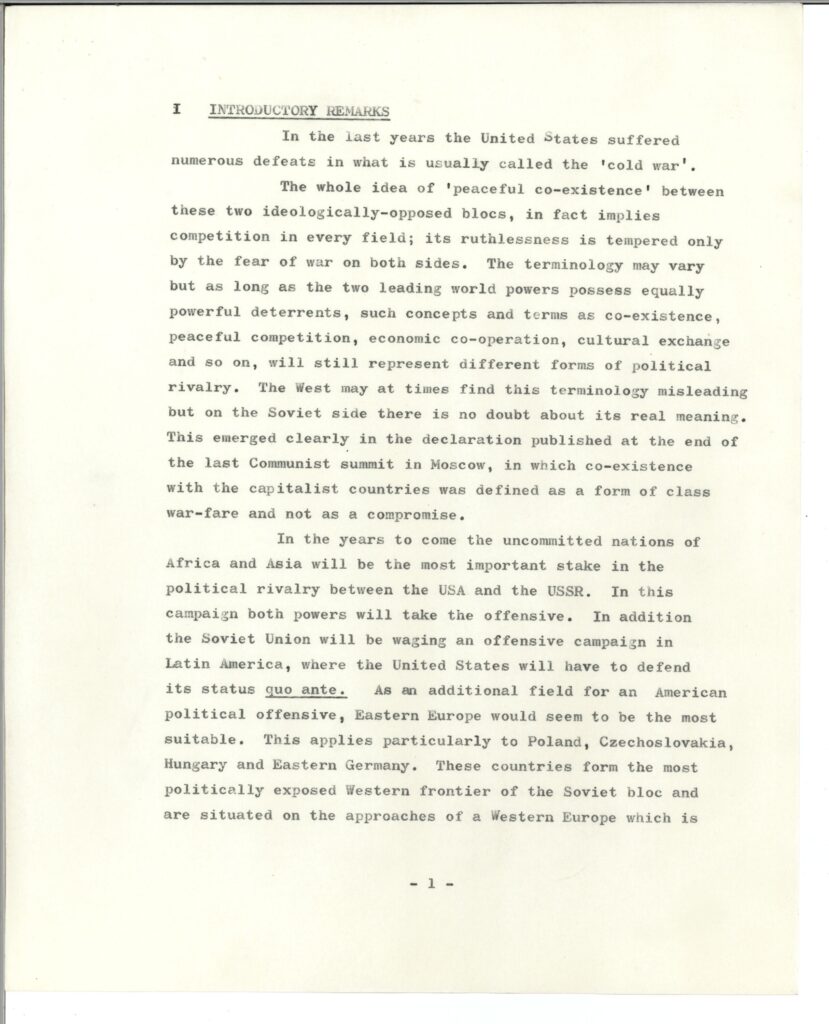
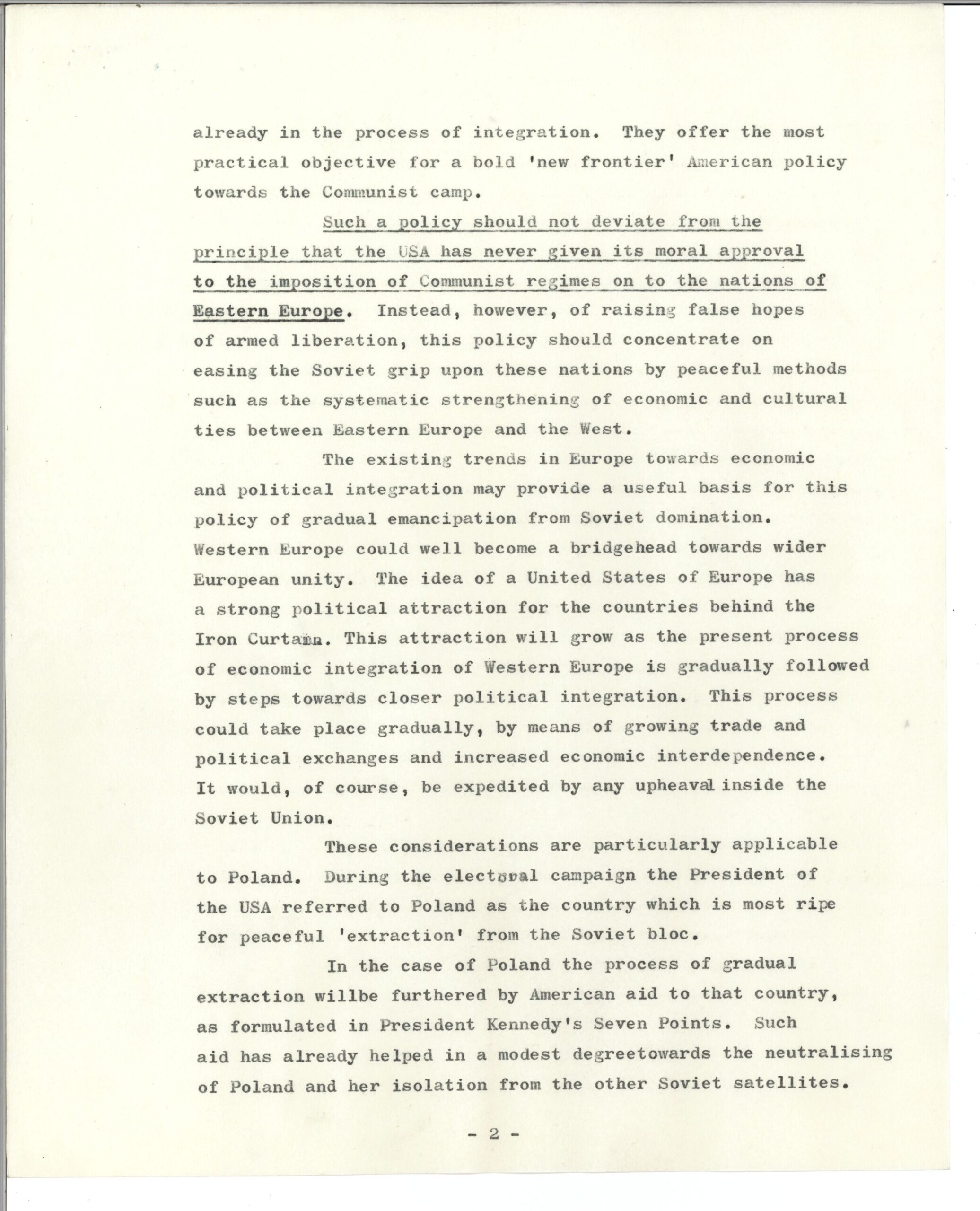
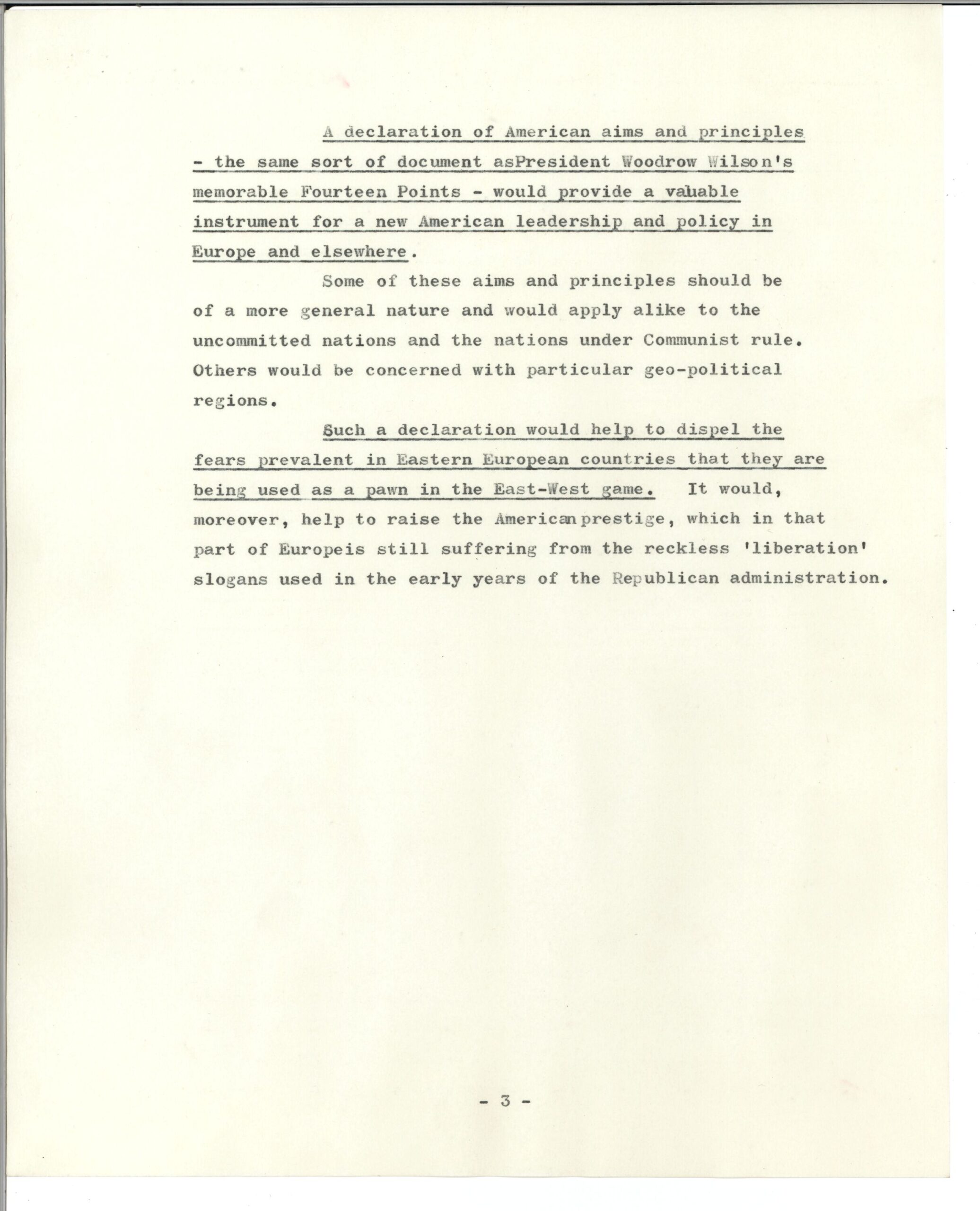
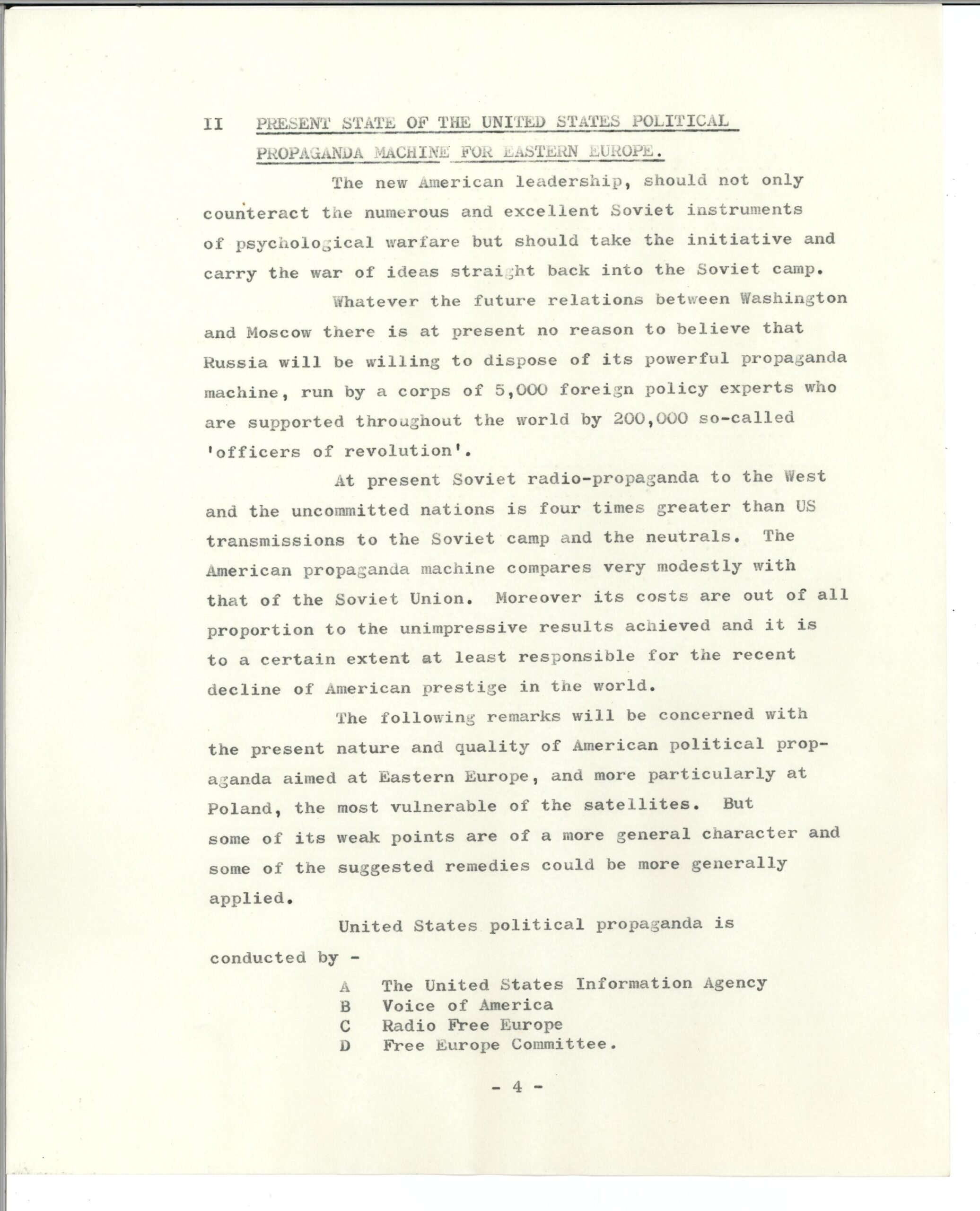
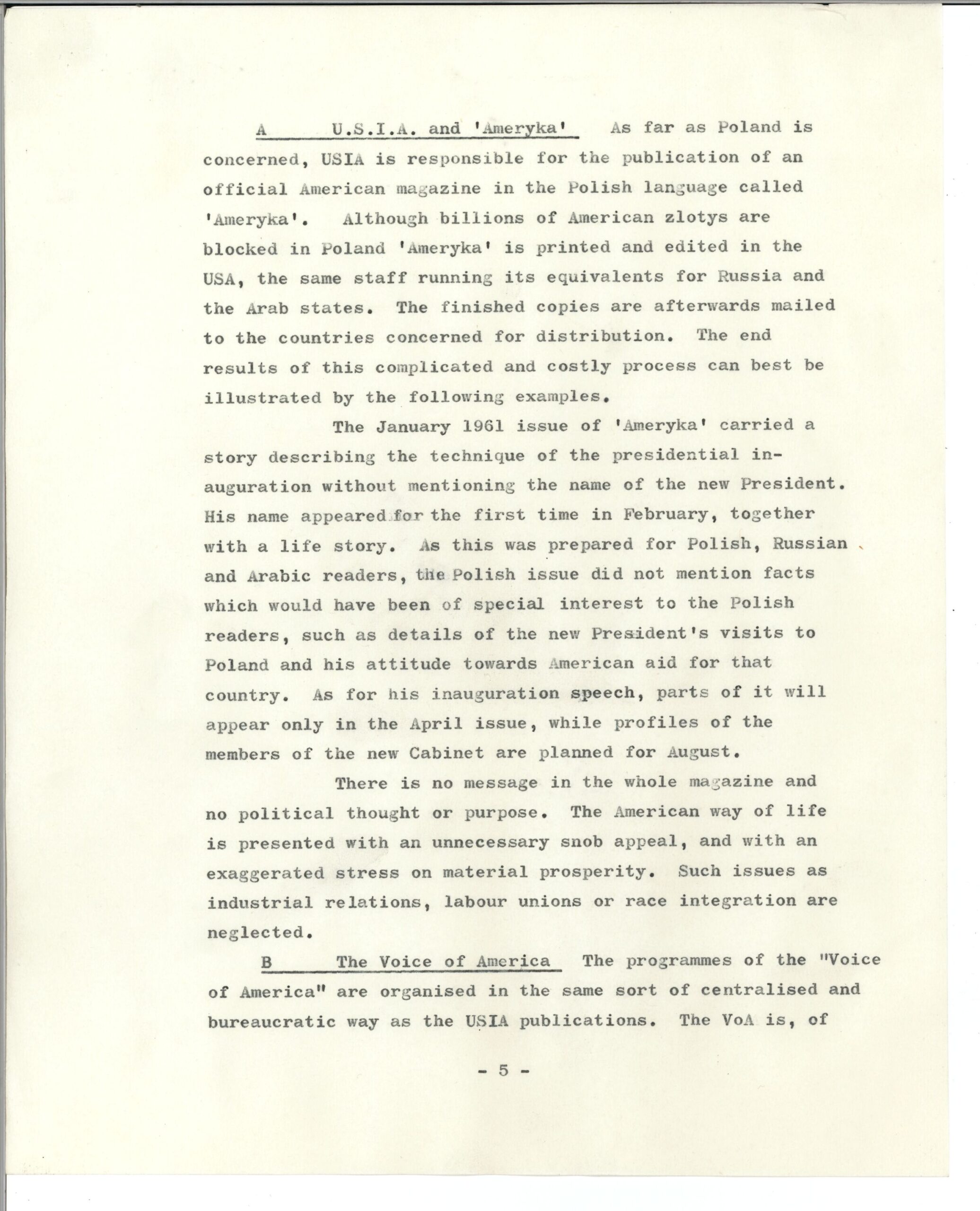
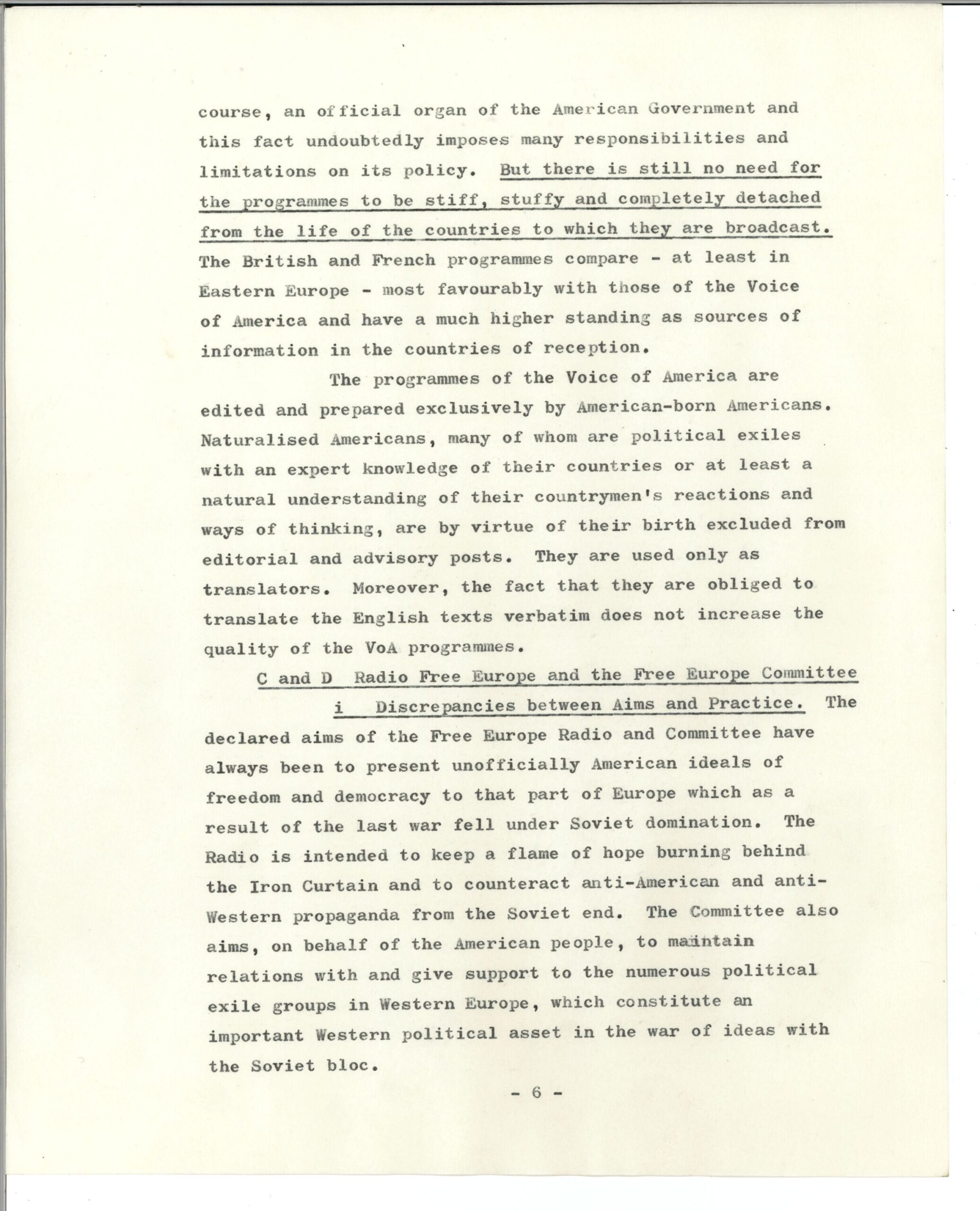
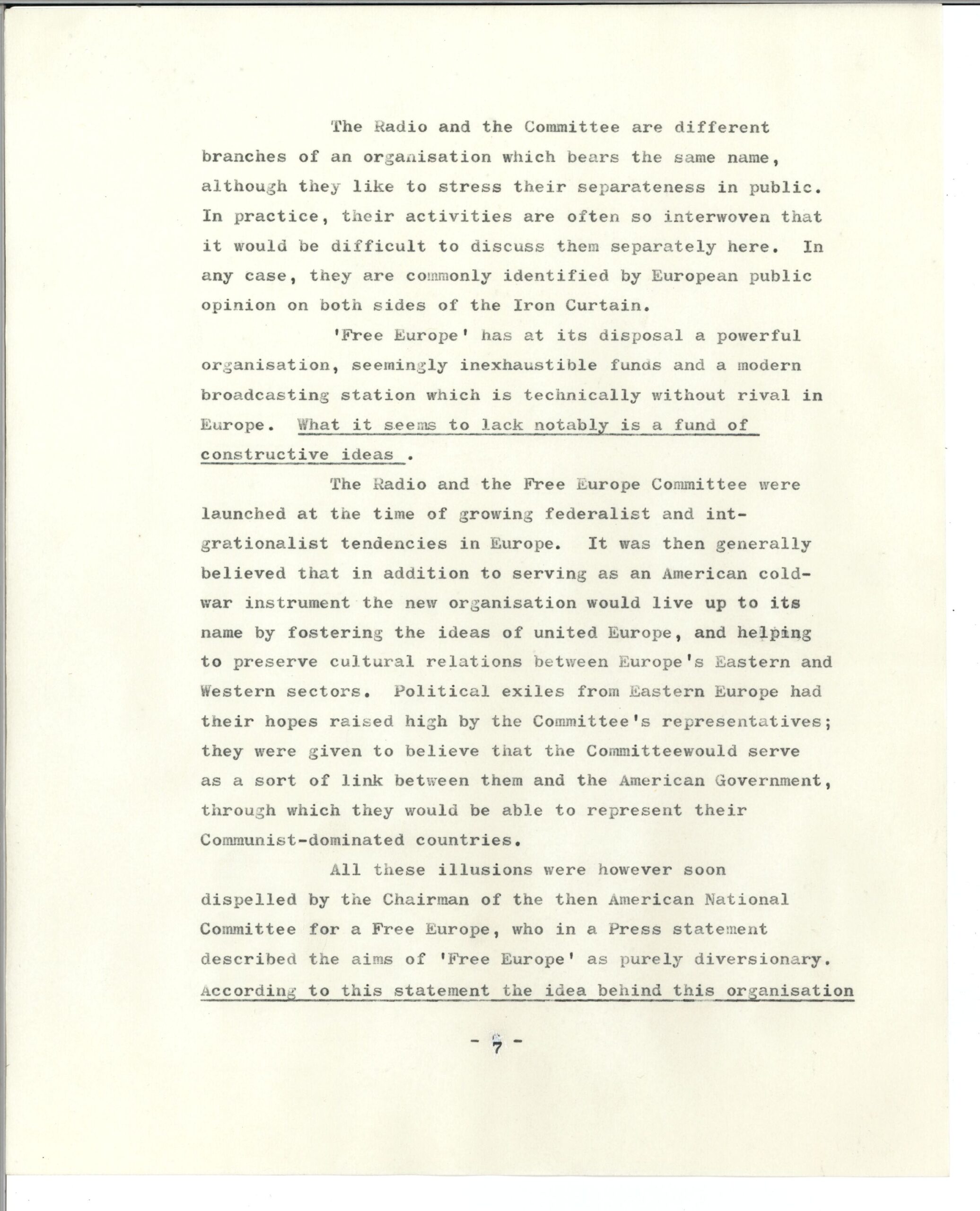
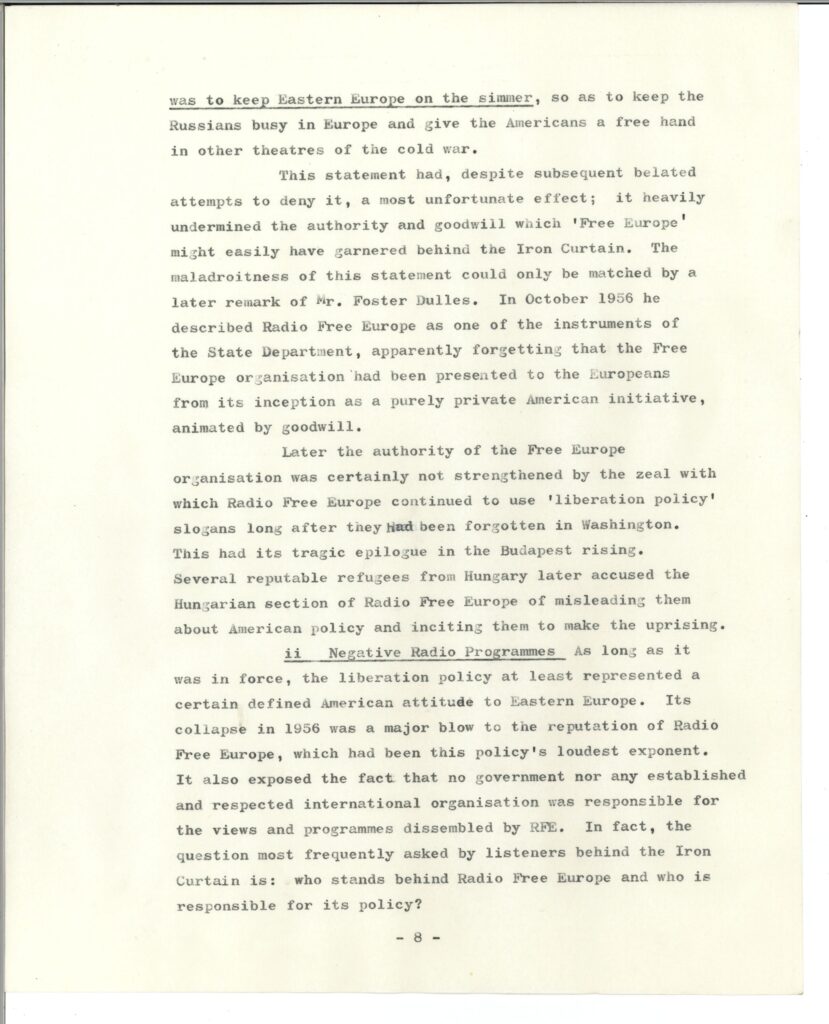
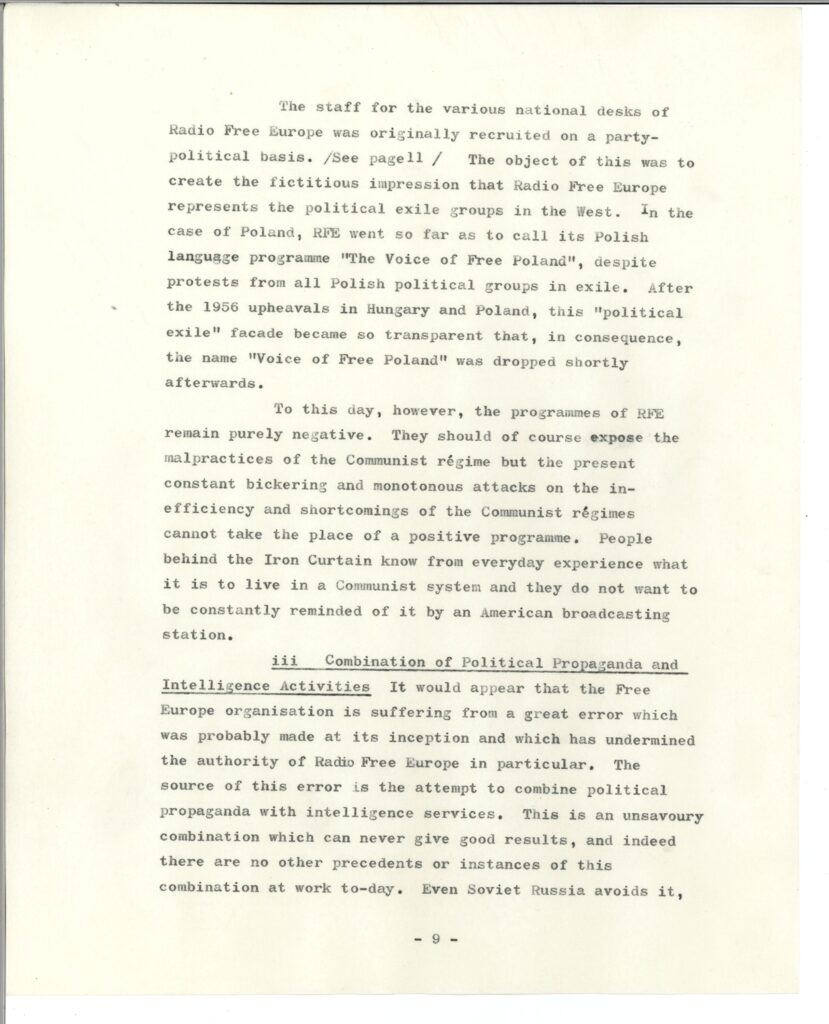
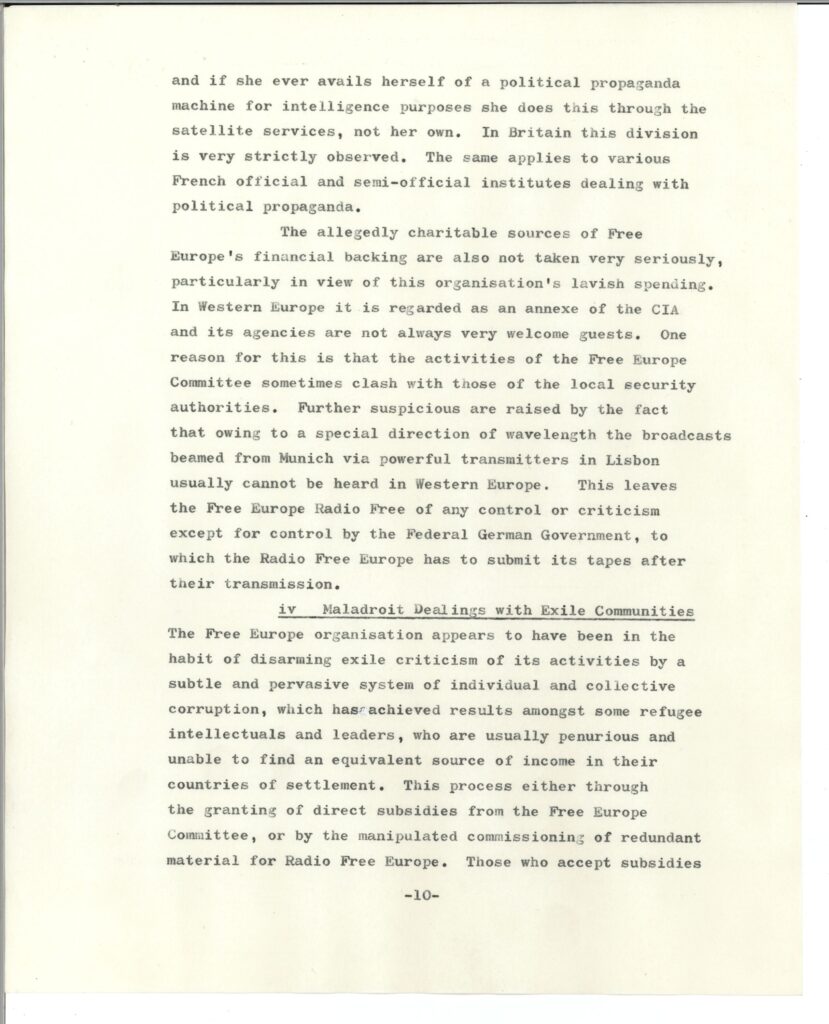
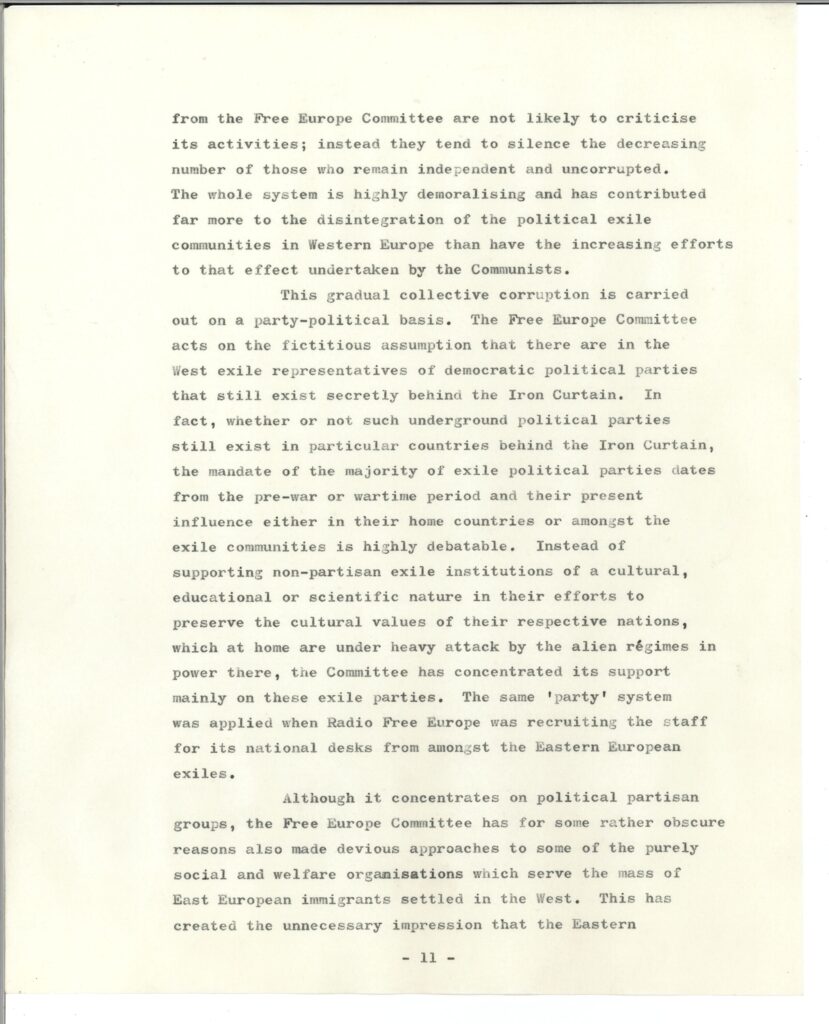
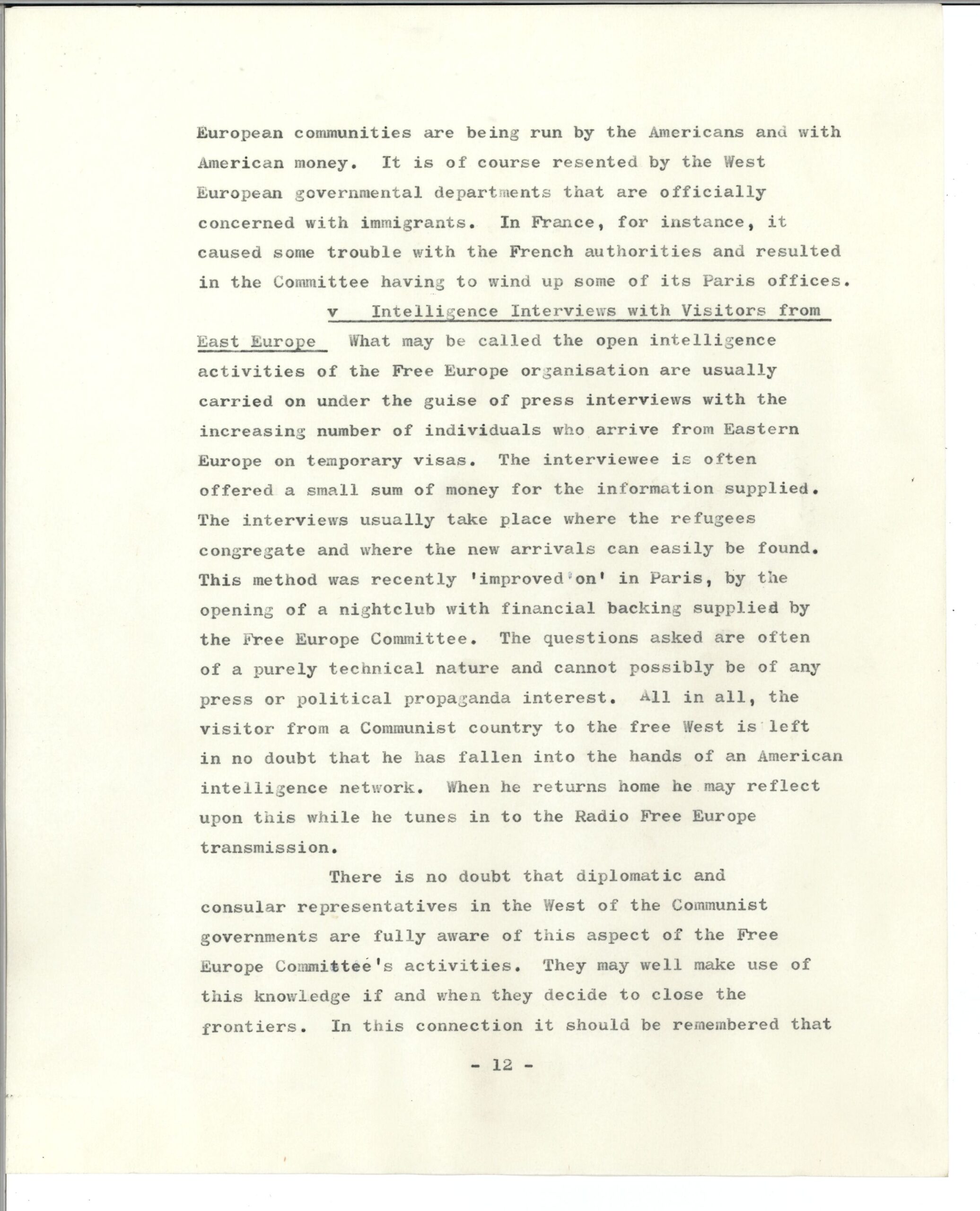
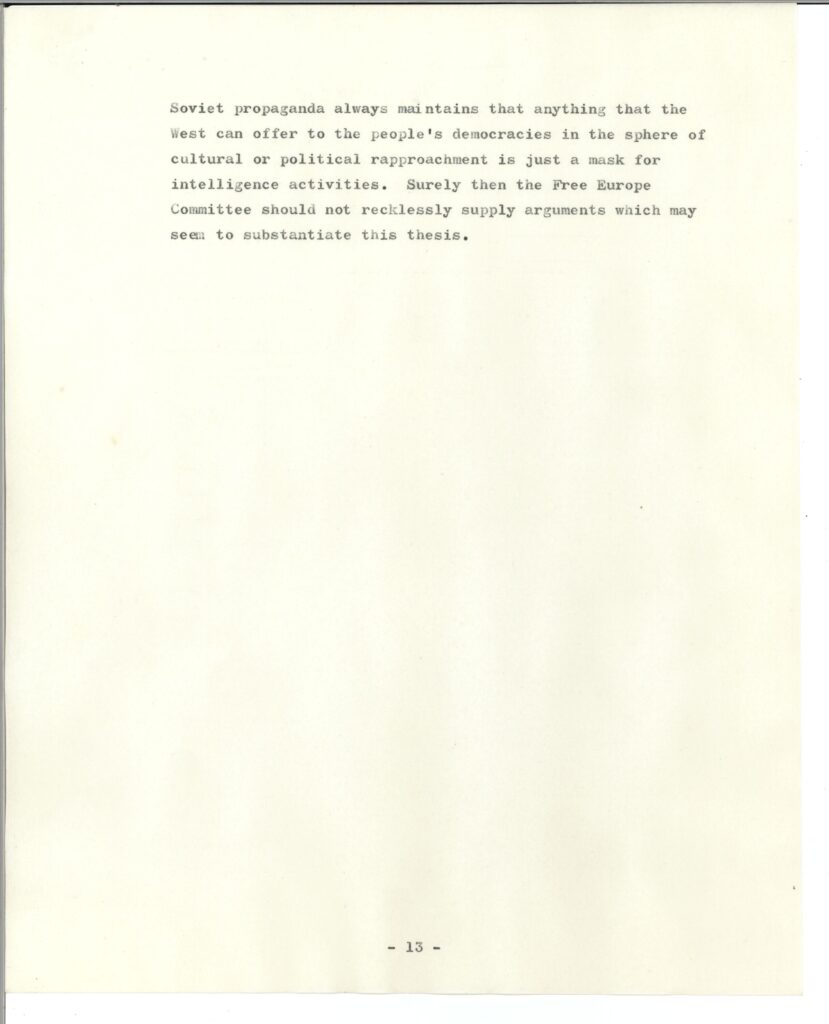
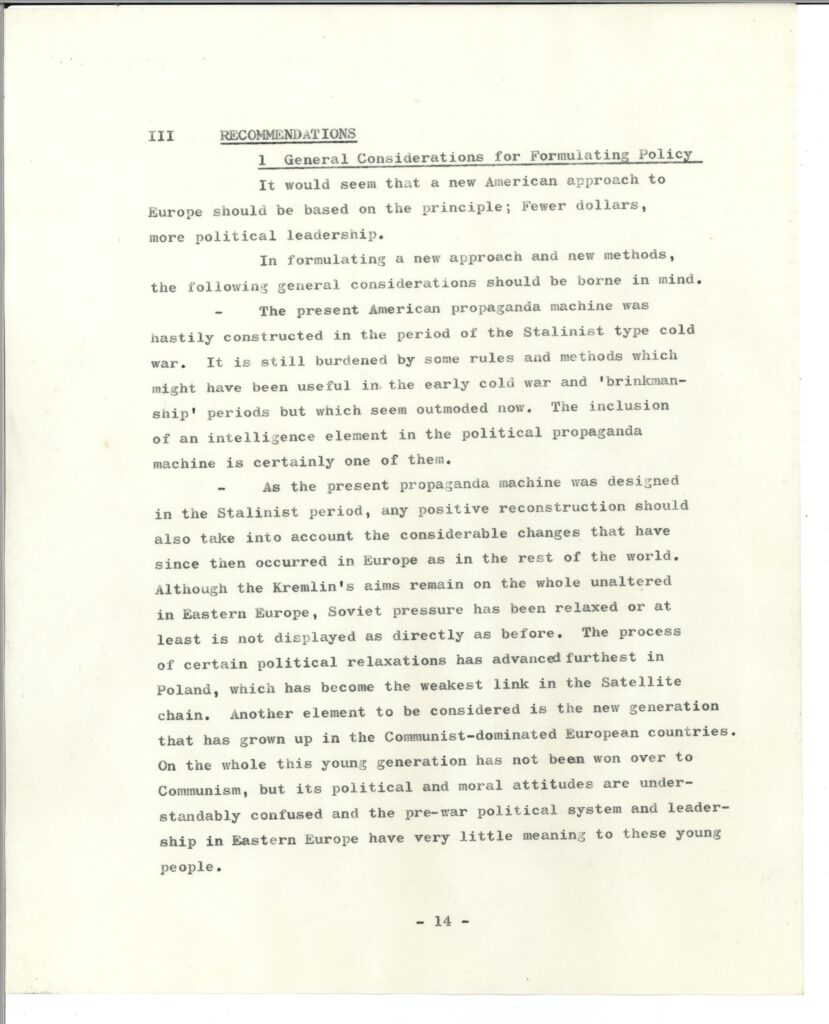
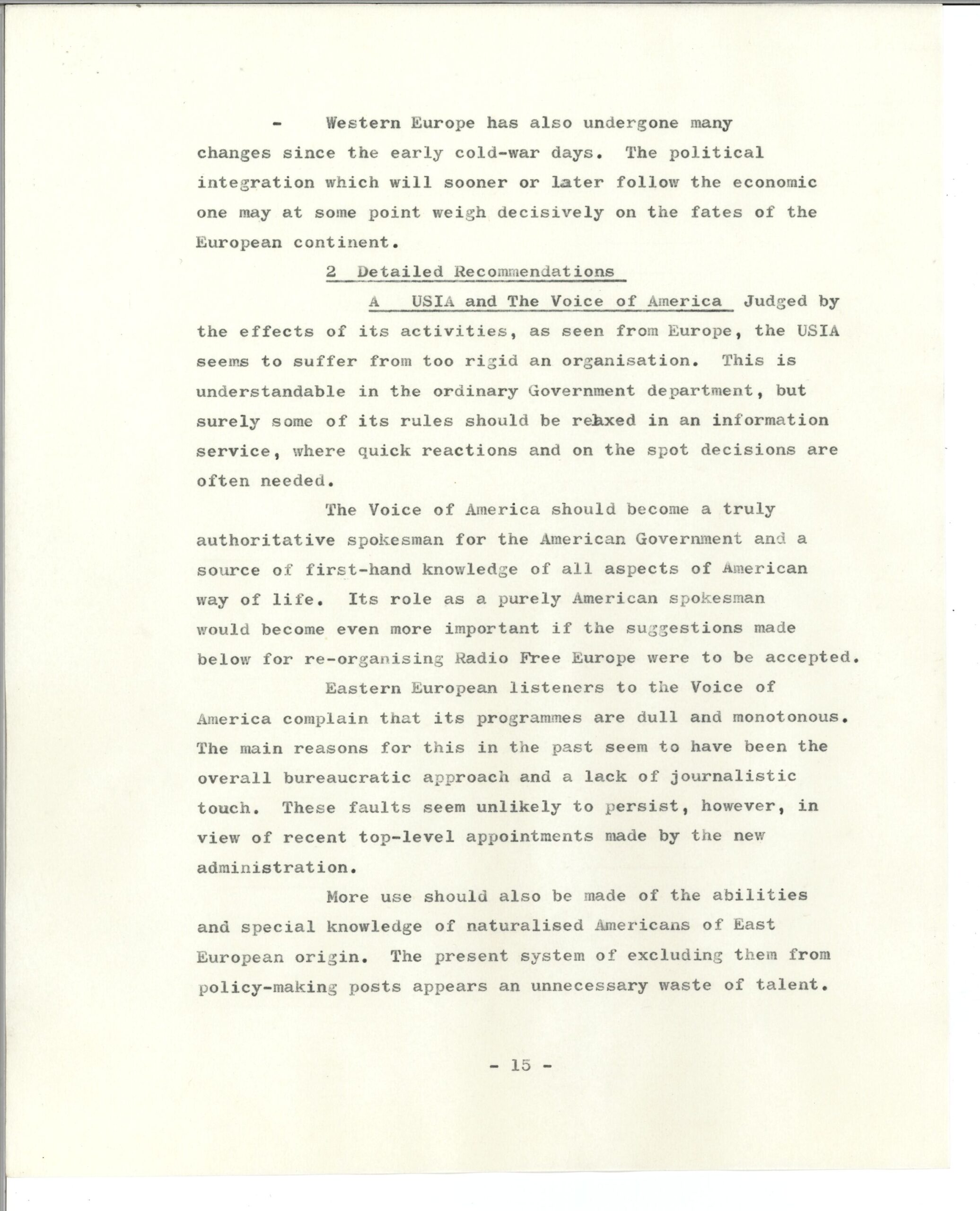
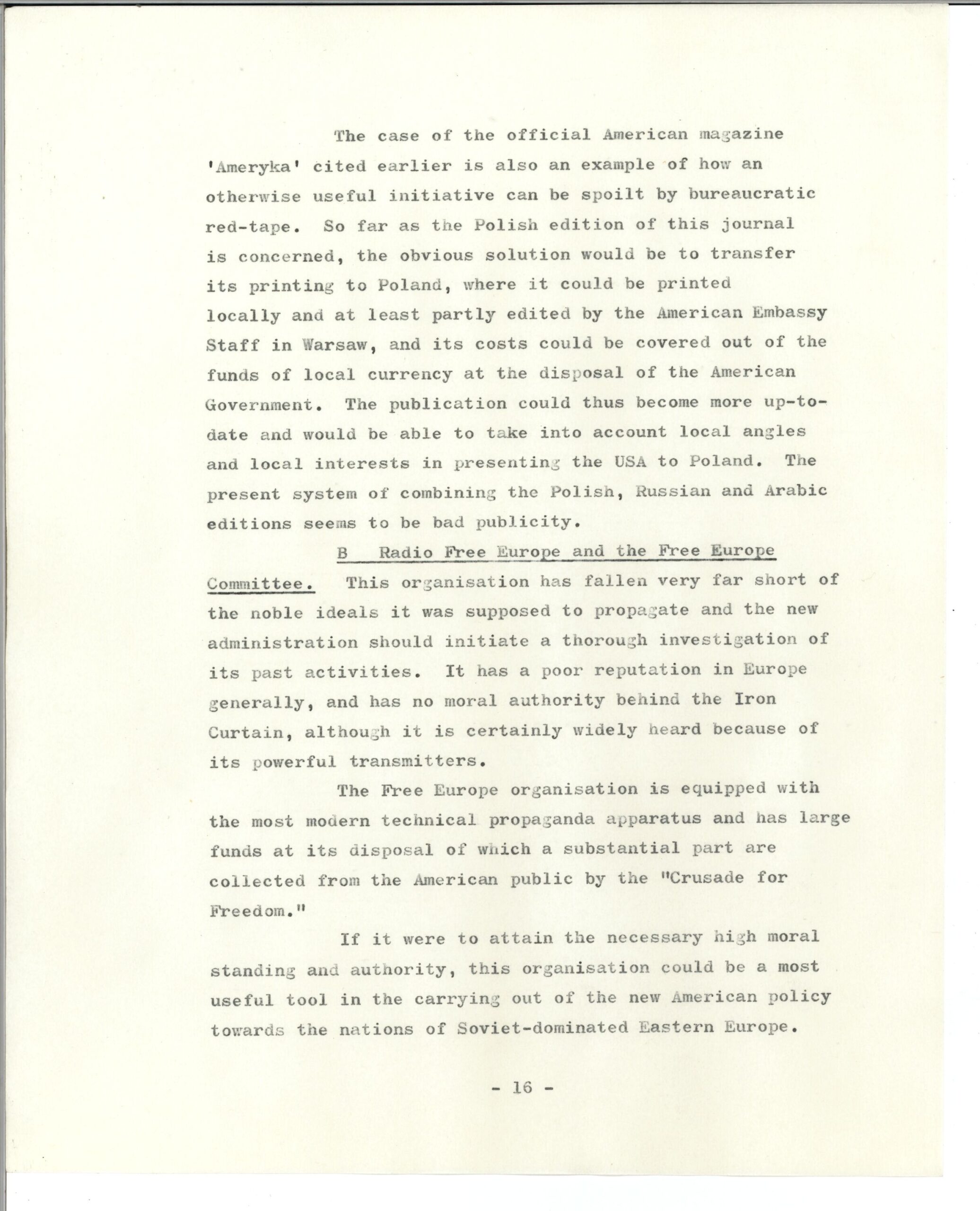
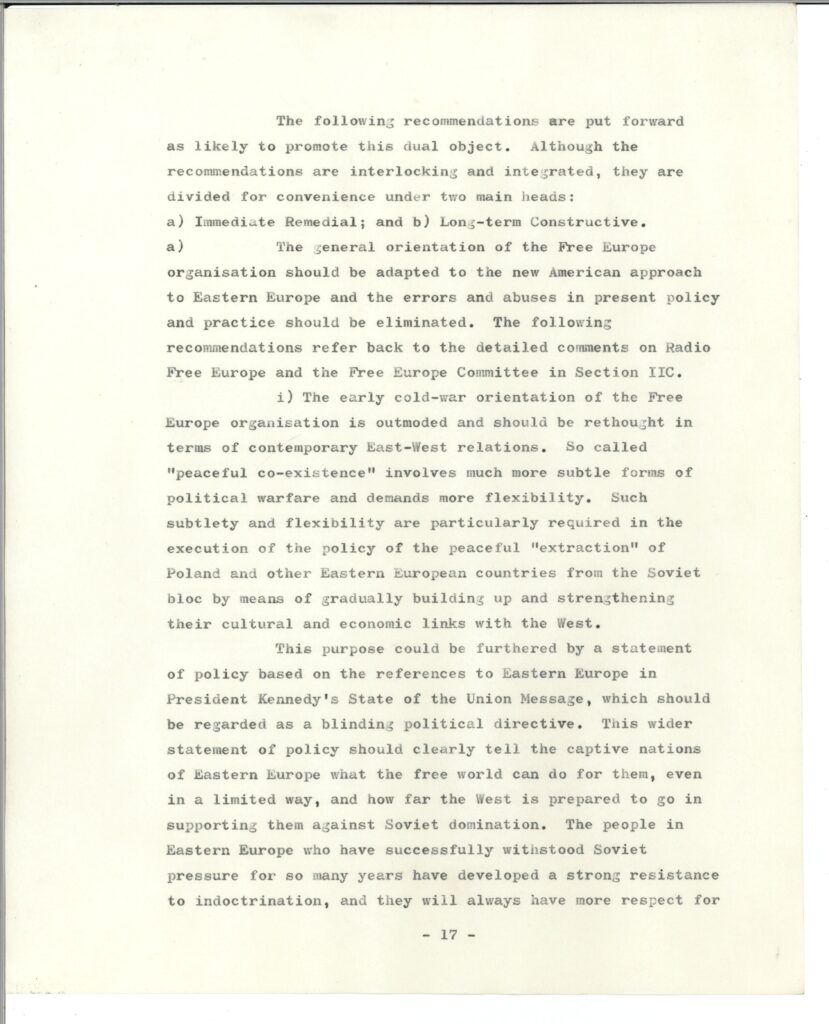
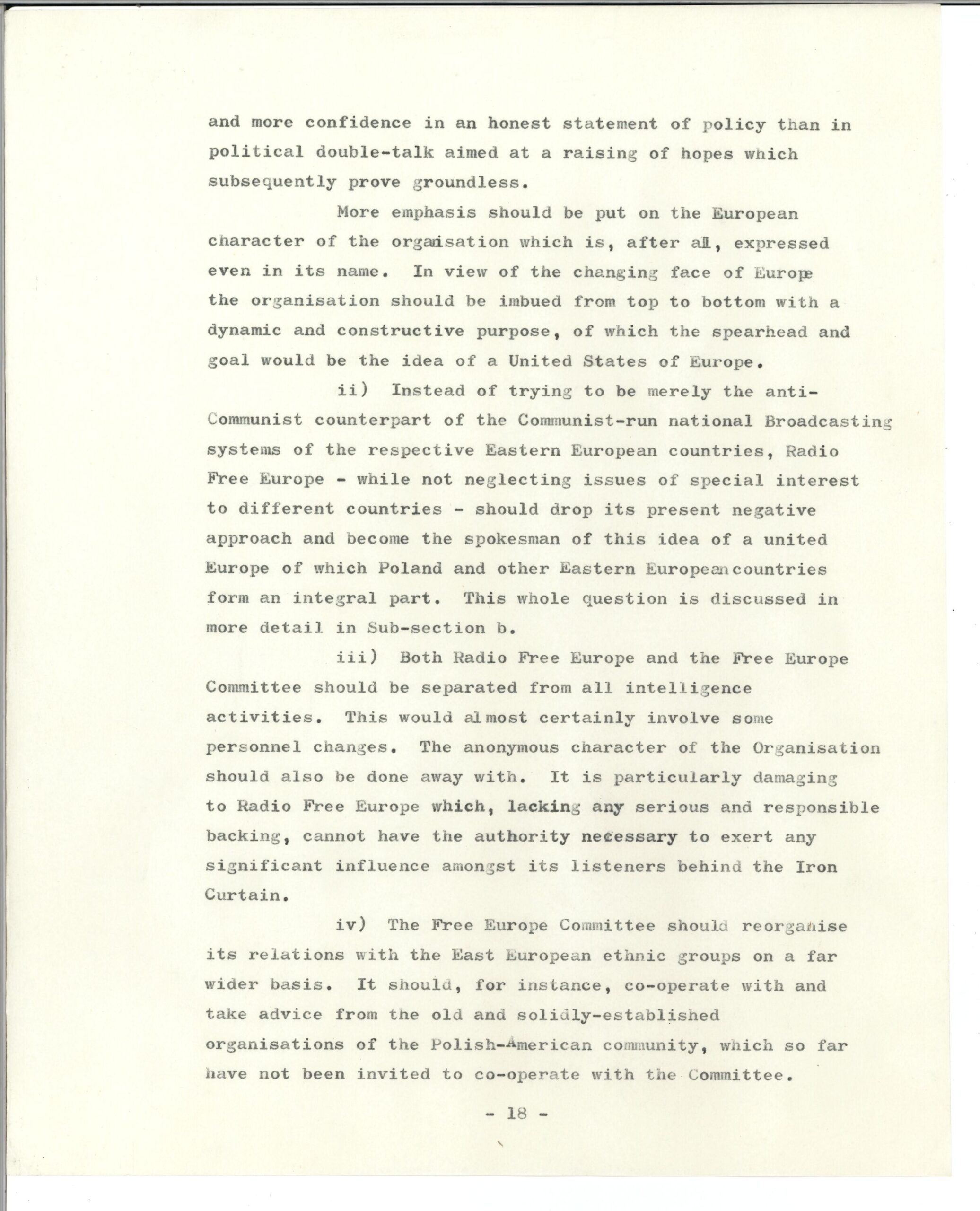
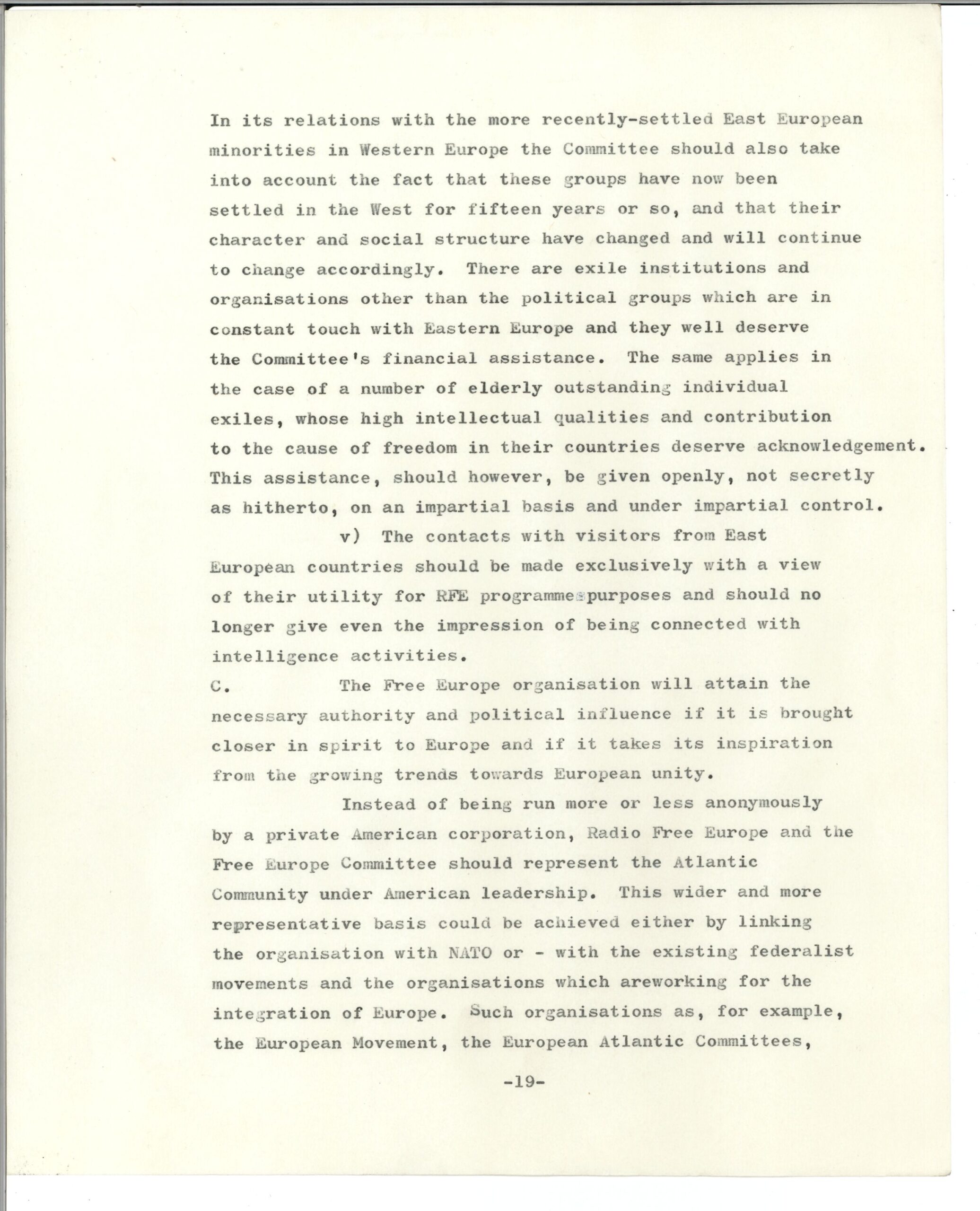
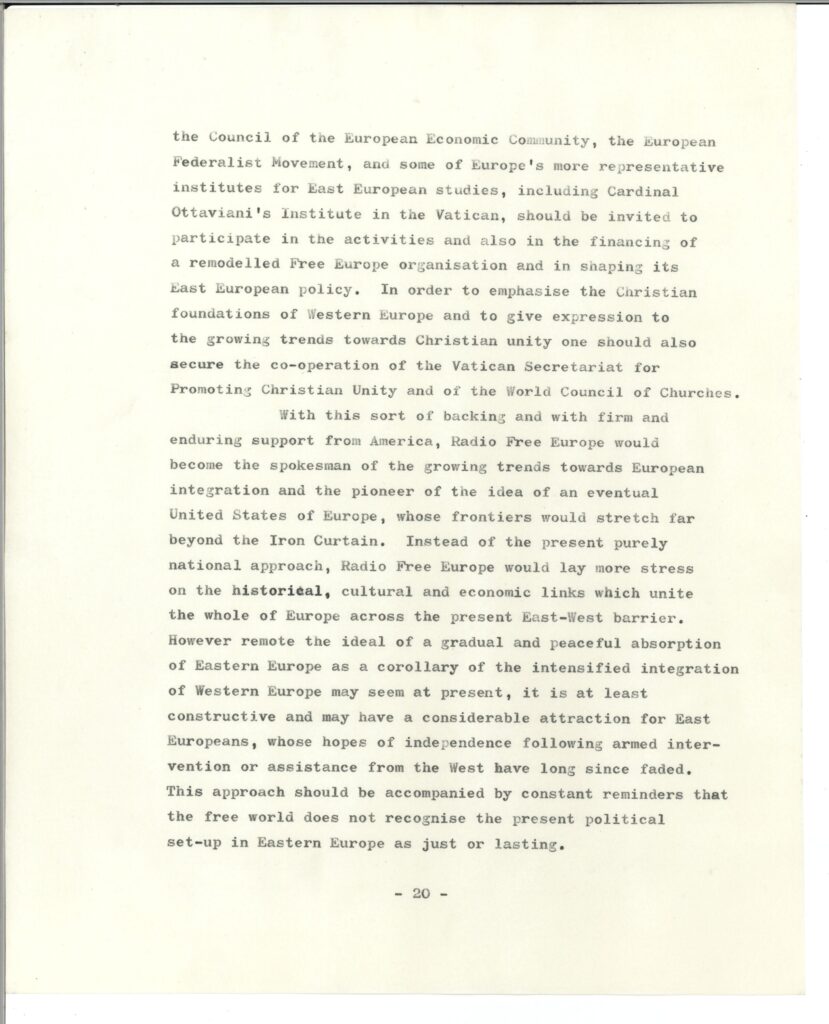
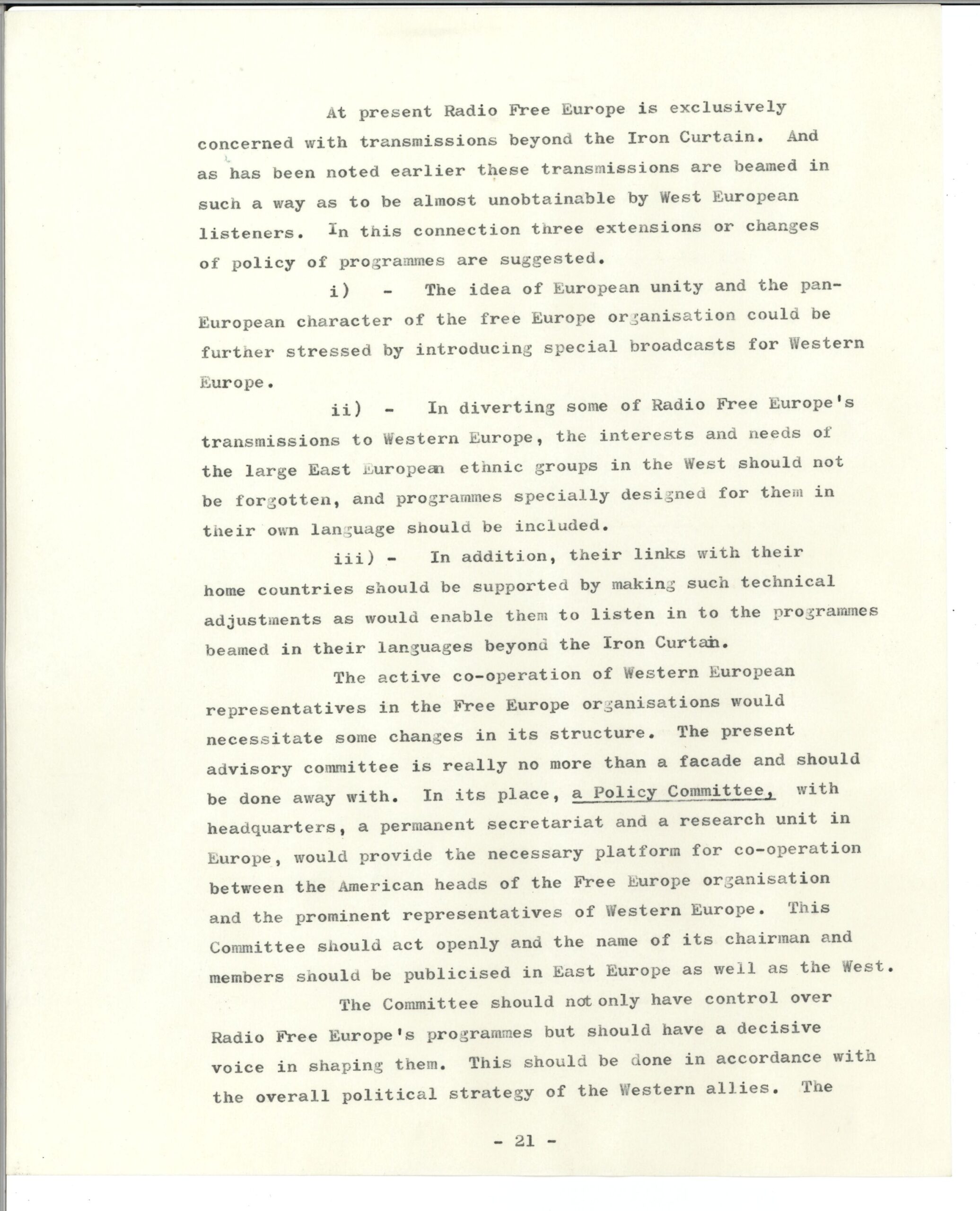
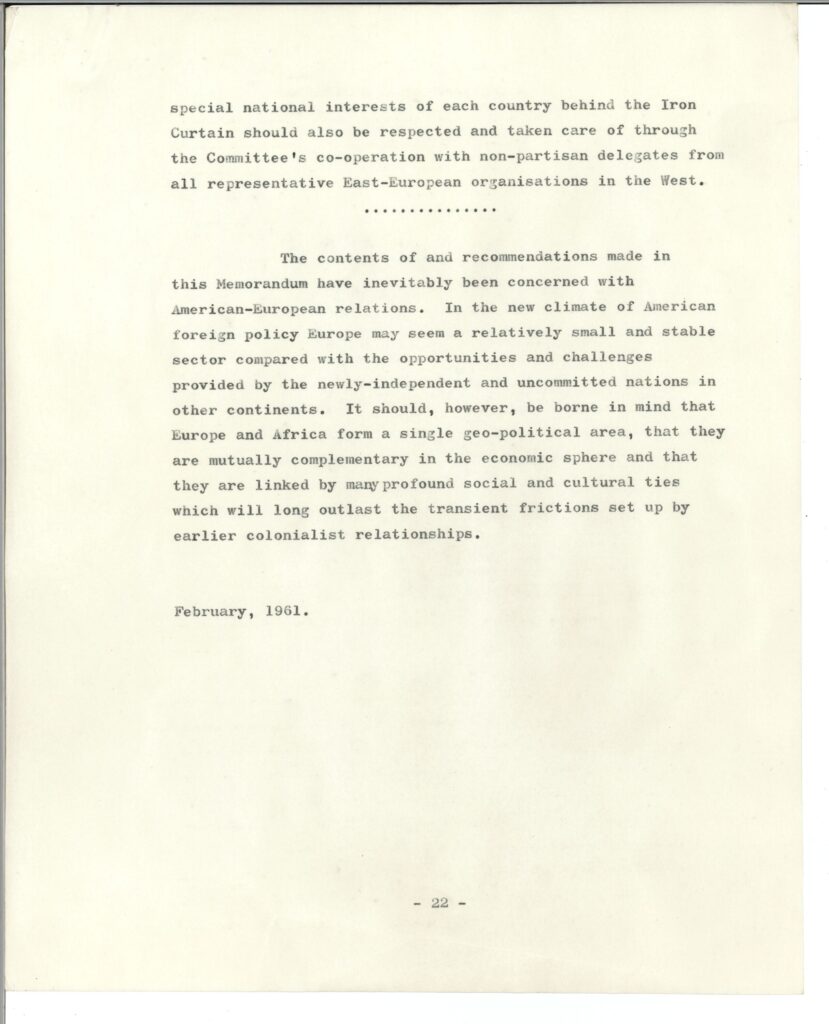
↑ Back to top · ▶ Back to Murrow audio
8. White House Memorandum on President Kennedy’s Meeting with the Radio Free Europe Fund (February 6, 1962)
What it is: White House briefing memorandum prepared for President Kennedy ahead of his meeting with the Radio Free Europe Fund. Why it matters: Documents Kennedy’s awareness of political sensitivities while underscoring continued engagement and support.
White House Memorandum on President Kennedy’s Meeting with the Radio Free Europe Fund
Date: February 6, 1962
Author: McGeorge Bundy
Recipient: John F. Kennedy
This White House memorandum, prepared by National Security Adviser McGeorge Bundy, briefed President John F. Kennedy ahead of his February 7, 1962 meeting with representatives of the Radio Free Europe Fund. The document acknowledges that the President had reservations about the Fund—widely understood to concern the public fiction of private fund-raising—but emphasizes that Kennedy nevertheless agreed to meet with its leadership and that his attitude would “make a great deal of difference” to the program’s success.
The memorandum reveals Kennedy’s awareness of the political sensitivities surrounding Radio Free Europe while simultaneously underscoring his continued engagement. Rather than signaling withdrawal or retrenchment, the document shows a President weighing tone and presentation while sustaining support for RFE’s broader mission as an instrument of U.S. Cold War strategy.
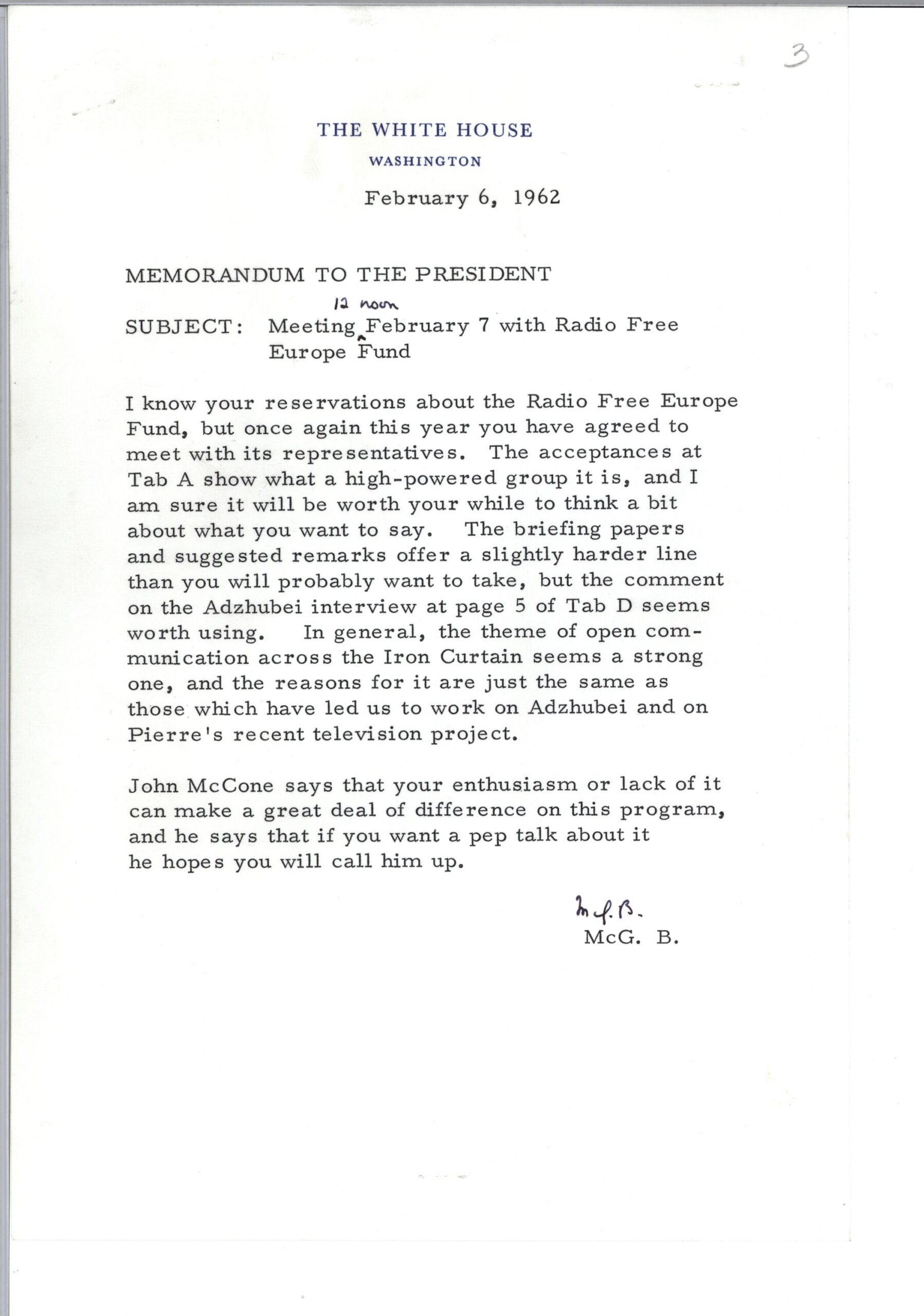
↑ Back to top · ▶ Back to Murrow audio
9. President Kennedy’s Letter Endorsing Radio Free Europe (February 7, 1962)
What it is: President Kennedy’s signed letter to Charles H. Kellstadt affirming Radio Free Europe’s mission. Why it matters: A clear statement of presidential support for surrogate broadcasting despite internal doubts expressed elsewhere.
President Kennedy’s Letter Endorsing Radio Free Europe
Date: February 7, 1962
Author: John F. Kennedy
Recipient: Charles H. Kellstadt
Written the day after his meeting with Radio Free Europe Fund representatives, this signed letter from President Kennedy to Charles H. Kellstadt, Chairman of the Fund and Chairman of Sears, Roebuck & Company, constitutes an unequivocal public endorsement of Radio Free Europe. Kennedy praises RFE for providing “reliable news and information” to people “walled in from freedom” and describes the broadcasts as “a window on reality” for societies subjected to censorship and jamming.
The letter is significant because it directly contradicts contemporaneous internal memoranda that questioned RFE’s effectiveness and recommended curtailing its independence. Despite private reservations about the mechanics of fund-raising, Kennedy here affirms RFE’s moral and strategic value, confirming that he viewed surrogate broadcasting as a vital element of America’s Cold War “war of ideas.”
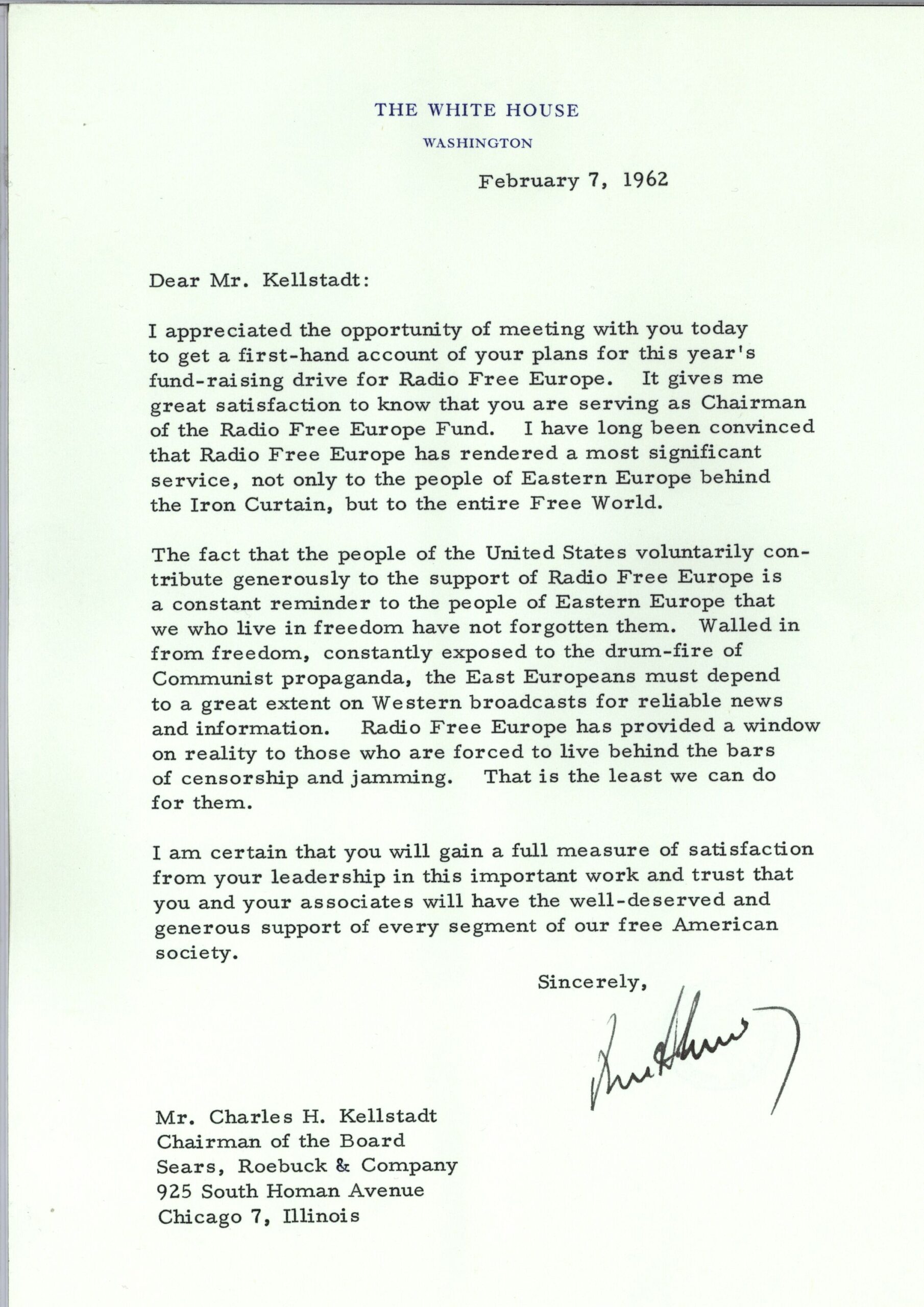
Taken together, these two documents demonstrate that President Kennedy distinguished between political sensitivities surrounding Radio Free Europe’s public presentation and unwavering support for its mission.
↑ Back to top · ▶ Back to Murrow audio
10. Suggested Remarks for President Kennedy — Radio Free Europe Fund (February 3, 1962)
What it is: Draft/suggested remarks prepared for President Kennedy in connection with Radio Free Europe Fund activities. Why it matters: Shows how the administration considered presenting support for RFE in public-facing language during a politically sensitive period.
Suggested Remarks for President Kennedy — Radio Free Europe Fund (February 3, 1962)
Joint Draft, cleared by U. Alexis Johnson — President’s Office Files, John F. Kennedy Library
These pages reproduce a White House draft of suggested remarks prepared for President John F. Kennedy in advance of a February 7, 1962 meeting in support of the Radio Free Europe Fund. The document, cleared by Deputy Under Secretary of State U. Alexis Johnson, outlines the administration’s rationale for assisting Radio Free Europe, emphasizing its strategic role in countering communist influence in Eastern Europe during the Cold War.
These are reference copies only; the original archival materials are held by the John F. Kennedy Presidential Library and Museum, within the President’s Office Files (Digital Identifier JFKPOF-106-006, “Radio Free Europe Fund”).


↑ Back to top · ▶ Back to Murrow audio
11. Remarks of President John F. Kennedy on the 20th Anniversary of the Voice of America (February 26, 1962)
What it is: Draft and/or press copies of President Kennedy’s remarks marking the 20th anniversary of the Voice of America. Why it matters: A primary statement linking VOA’s mission to U.S. Cold War public diplomacy during the Kennedy administration.
Remarks of President John F. Kennedy on the 20th Anniversary of the Voice of America – February 26, 1962
This transcript reproduces President John F. Kennedy’s official remarks delivered on February 26, 1962, at the twentieth anniversary of the Voice of America. The speech was issued by the Office of the White House Press Secretary and reflects early–1960s U.S. policy, placing international broadcasting—under the United States Information Agency—at the center of Cold War communications strategy. Kennedy’s remarks acknowledge VOA’s origins during World War II, emphasize truthful reporting as a national responsibility, and link VOA’s mission to global democratic values and the geopolitical contest with the Soviet Union.
These pages are reference copies only. The original archival materials are held by the John F. Kennedy Presidential Library and Museum within the President’s Office Files, Series 03: Speech Files. (Digital Identifier: JFKPOF-037-020)
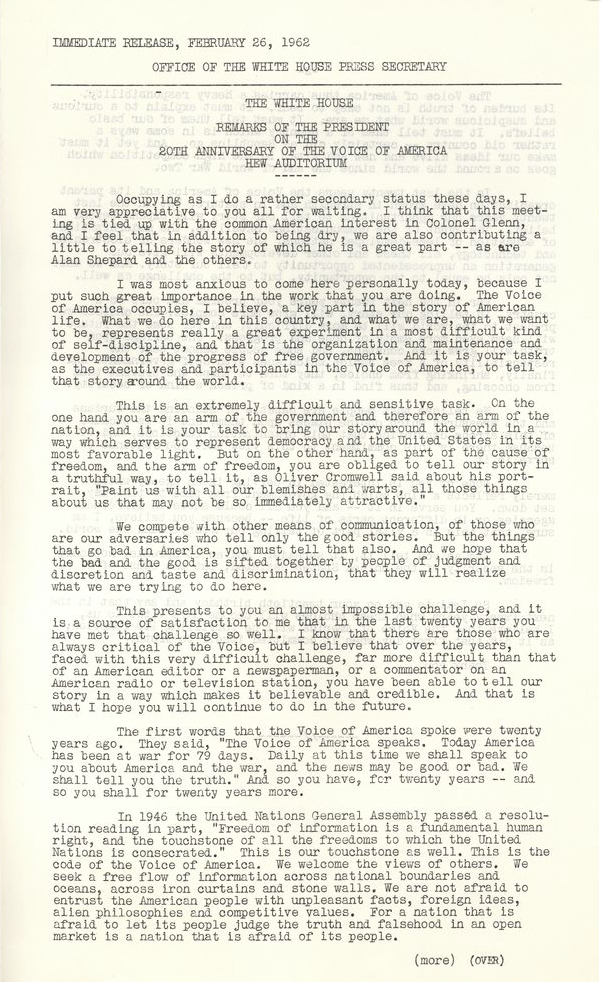

↑ Back to top · ▶ Back to Murrow audio
12. Strictly Confidential Memorandum on U.S. Diplomatic and Radio Free Europe Policy Discussions (December 1958)
What it is: A three-page internal memorandum marked “Strictly Confidential,” reporting on a conversation held on December 23, 1958, between U.S. diplomatic officials and Radio Free Europe advisers in Munich concerning U.S. information policy toward Eastern Europe and the role of Radio Free Europe.
Why it matters: A rare primary source documenting how critiques of Radio Free Europe circulated within U.S. diplomatic and policy channels during the late 1950s—illustrating internal debates over surrogate broadcasting, the influence of foreign disinformation on U.S. officials, and the tensions between diplomatic engagement and information warfare at the height of the Cold War.
Report on a Confidential Conversation Concerning Radio Free Europe and U.S. Policy (December 1958)
This document is a four-page internal memorandum reporting on a conversation held on December 23, 1958, involving U.S. diplomatic officials and Radio Free Europe advisers in Munich. Participants included Thomas Donovan of the U.S. Embassy in Warsaw; William E. Griffith, then serving as a senior political adviser at Radio Free Europe; representatives of the U.S. Consulate General in Munich; and other officials engaged in discussions of U.S. information policy toward Eastern Europe.
Marked “Strictly Confidential,” the memorandum reflects the sensitive nature of interagency and liaison discussions during the Cold War, particularly those concerning Radio Free Europe’s role, effectiveness, and relationship to U.S. diplomatic objectives. Documents of this type were routinely circulated among U.S. government officials and U.S.-funded organizations such as Radio Free Europe, often without explicit attribution, and were intended to inform internal deliberations rather than public debate.
The memorandum is significant for illustrating how critiques of Radio Free Europe—some of which echoed narratives promoted by communist regimes—circulated within U.S. diplomatic and policy channels, and how such views were contested by other U.S. officials and institutions. It provides a valuable primary source for understanding the interaction between diplomacy, surrogate broadcasting, and information warfare during the late 1950s.
Provenance and Rights Note
The authorship of this document is not explicitly identified. It appears to be an internal report prepared for restricted circulation among U.S. diplomatic officials and Radio Free Europe advisers. While marked “Strictly Confidential,” such designations were commonly used during the period to limit internal distribution and do not indicate current legal restrictions on publication. The document is reproduced here for historical and educational purposes. No known copyright restrictions apply.
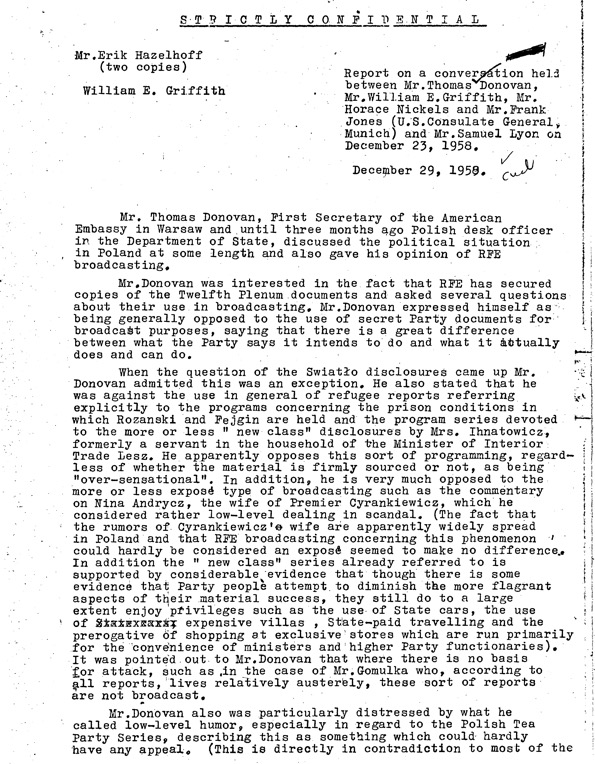
↑ Back to top · ▶ Back to Murrow audio
NOTES:
- Ann M. Sperber, Murrow: His Life and Times (New York: Freundlich Books, 1986), 644.
- Ambassador Arthur Bliss Lane wrote in 1948 that an interesting feature of the Polish American Congress (PAC) leaders’ meeting with President Roosevelt at the White House on October 11, 1944, was the placement of a large map of Poland in the room where the President received his visitors. The map showed Poland’s pre-war boundaries. The photos of the meeting, widely reproduced by Polish American media, were interpreted as FDR’s endorsement of Poland’s independence and territorial integrity. See Arthur Bliss Lane, I Saw Poland Betrayed: An American Ambassador Reports to the American People (Indianapolis and New York: Bobbs-Merrill Company), 1948, 219.
- Ibid.
- Dwight D. Eisenhower, The White House Years: Waging Peace 1956-1961 (Garden City: Doubleday & Company, 1965) 279.
- According to General Dwight D. Eisenhower, the World War II Supreme Commander, communist-inspired excesses by early VOA broadcasters threatened the safety of U.S. troops when Voice of America programs ridiculed tactical agreements reached by him with some of the Vichy France and Italian leaders to lure them out of their former cooperation with Nazi Germany. President Eisenhower noted in his memoir published in 1965 that President Roosevelt put a stop to VOA’s “insubordination.” See Dwight D. Eisenhower, The White House Years: Waging Peace 1956-1961 (Garden City: Doubleday & Company, 1965) 279.
- Julius Epstein, “The O.W.I. and the Voice of America,” reprint from the Polish American Journal, Scranton, Pennsylvania, 1952.
- Shortly after leaving VOA, Howard Fast published a 41-page propaganda booklet, The Incredible Tito: Man of the Hour (New York: Magazine House, 1944).
- Arthur Krock, “President Rebukes OWI for Broadcast on Regime in Italy,” The New York Times, July 28, 1943, A5.
- James Warren, “The Struggle to Propagate the Truth,” U.S. News & World Report, December 30, 2015.
- Amanda Bennett, “Trump’s ‘worldwide network’ is a great idea. But it already exists,” The Washington Post, November 27, 2018.
- Ann M. Sperber, Murrow: His Life and Times, 211.
- Ibid.
- Ibid. Ann M. Sperber cites Robert E. Sherwood’s telegram to Harry L. Hopkins, January 9, 1942; Hopkins’s telegram to Murrow, January 10, 1942; and Murrow’s telegram to Hopkins, January 19, 1942.
- “Report of the Radio Advisory Committee to the Assistant Secretary of State for Public Affairs,” Department of State Bulletin 16 (May 25, 1947): 1038.
- Ibid., 1039.
- Ibid., 1040.
- Orson Welles and John Houseman reportedly caused panic in much of the United States with their 1938 Mercury Theatre on the Air production of H. G. Wells’ The War of the Worlds, which mixed genuinely sounding but fake evening radio news bulletins with dramatic descriptions of an alien invasion.
- See Under Secretary of State Sumner Welles’s 1943 memorandum. State – Welles, Sumner, 1943-1944, From Collection: FDR-FDRPSF Departmental Correspondence, Series: Departmental Correspondence, 1933 – 1945 Collection: President’s Secretary’s File (Franklin D. Roosevelt administration), 1933 – 1945, National Archives Identifier: 16619284.
- Claude “Cliff” Groce, interview by Jack O’Brien, The Association for Diplomatic Studies and Training, Foreign Affairs Oral History Project, February 8, 1988, transcript, pp. 18–19 (PDF).
- Gregory M. Tomlin, Murrow’s Cold War: Public Diplomacy of the Kennedy Administration (Lincoln: Potomac Books, 2016), 179.
- Shawn J. Parry-Giles, The Rhetorical Presidency, Propaganda, and the Cold War, 1945–1955, (Westport; Praeger, 2002), 187.
- Ibid.
- Groce interview, “Murrow’s Two Deputies Were a Trial for VOA,” p. 23.
- Groce interview, p. 24.
- Robert E. Sherwood, Director, Overseas Branch, Office of War Information; RG208, Director of Oversees Operations, Record Set of Policy Directives for Overseas Programs-1942-1945 (Entry363); Regional Directives, January 1943-October 1943; Box820, National Archives.
- Office of War Information, “Official Dispatch: WALOA 14984 to Ramble from Sherwood (Paraphrase),” January 14, 1944, OWI Form 4, Expediting Section, Record Group 208, Records of the Office of War Information, U.S. National Archives, College Park, Maryland. Declassified Authority 735006.
- Groce interview, “VOA During the Cuban Missile Crisis — 1962,” p. 27.
- Groce interview, pp. 26–28.
- VOA – Voice of America English News, “Activist Angela Davis Representing the Powerful Forces of Change Women’s March,” January 21, 2017, https://www.voanews.com/a/angela-davis-representing-the-powerful-forces-of-change-womens-march/3686331.html; Paul Farhi, “GOP senators blast Voice of America for Hamas ‘militants’ terminology,” The Washington Post, November 29, 2023.
- The analogy to Hamas terminology relates to VOA’s contemporary language debates. It is not offered as a moral equivalence, but to illustrate how Murrow understood propaganda as requiring clarity of moral language — and how VOA’s coverage of Castro’s death in 2016 differed sharply from how Murrow viewed Castro in 1961.
- Carroll, Persuade or Perish, 149–152.
- Owen Lattimore, “New Road to Asia,” National Geographic, December 1944, p. 567.
- Ann M. Sperber, Murrow: His Life and Times, 235.
- See Elmer Davis’s testimony before the Madden Committee of the U.S. House of Representatives, which investigated the Katyn massacre. Also see Howard Fast’s autobiography Being Red, John Houseman’s memoirs Unfinished Business, and Jan Ciechanowski’s book Defeat in Victory.
- Edward R. Murrow, In Search of Light: The Broadcasts of Edward R. Murrow 1938–1961 (New York: Alfred A. Knopf, 1967), 236–37.
- Virgil H. Fulling, Chief of the Voice of America Latin-American News Service, testimony before the U.S. Senate Permanent Subcommittee on Investigations, Committee on Government Operations, chaired by Sen. Joseph R. McCarthy, February 20, 1953, in State Department Information Program—Voice of America, 83rd Cong., 1st sess. (Washington, DC: U.S. Government Printing Office, 1953). Available at https://hdl.handle.net/2027/umn.31951d02130675v?urlappend=%3Bseq=173%3Bownerid=13510798903306273-193 (accessed February 26, 2026).
- Transcript via American Rhetoric, “Edward R. Murrow – Response to McCarthy on CBS’ See It Now,” https://www.americanrhetoric.com/speeches/edwardrmurrowtomccarthy.htm. Used here for historical commentary and educational purposes under U.S. Fair Use (17 U.S.C. § 107).
- Robert E. Sherwood, Director, Overseas Branch, Office of War Information; RG208, Director of Overseas Operations, Record Set of Policy Directives for Overseas Programs-1942-1945 (Entry363); Regional Directives, January 1943-October 1943; Box820, National Archives.
- After Joseph Goebbels’ propaganda machine announced the discovery of the Katyn graves on April 13, 1943, a note dated April 22, 1943, addressed to Assistant Secretary of State Adolf A. Berle included a warning for OWI to exercise caution in reporting on the Katyn story.
- Elmer Davis Testimony, Hearings before the Select Committee on the Katyn Forest Massacre, Part 7, November 11, 1952.
- Arthur Herzog, “Edward R. Murrow: The Voice of Uncle Sam,” True, June 1963, 36-37.
- A. M. Sperber, Murrow: His Life and Times, 617.
- Ibid., 611.
- Even decades after Walter Duranty’s death, some prominent members of the media establishment in the United States still find it difficult to fully condemn the lies in his reports for The New York Times about the Soviet Union. The 2002-2003 Pulitzer Prize Board refused to deprive Duranty of his 1932 Pulitzer Prize, see The Pulitzer Prizes, “Statement on Walter Duranty’s 1932 Prize,” November 20, 2003, https://www.pulitzer.org/news/statement-walter-duranty. The 2002-2003 Pulitzer Prize Board’s membership reads like Who’s Who in journalism, media industry, U.S. government service, NGOs, and academia, see https://www.pulitzer.org/board/2003.
- Edward R. Murrow, “Edward R. Murrow – Response to McCarthy on CBS’ See It Now,” April 13, 1954, https://www.americanrhetoric.com/speeches/edwardrmurrowtomccarthy.htm.
- See Stefan Arski, Targowica leży and Atlantykiem ( in loose translation from Polish: “Transatlantic Traitors”), (Warsaw: Książka i Wiedza, 1952), 102–109, and Stefan Arski, Stefan Arski, Uwaga! Radiodywersja!, Warszawa, 1953, 25.
- Bertram D. Wolfe, A Life in Two Centuries: An Autobiography (New York: Stein and Day, 1981), 81.
- “Memorandum Concerning United States Information Services Policy Toward Eastern Europe,” March 1961, 47 digital pages, Radio Free Europe, Theodore C. Sorensen Personal Papers, Subject Files, 1961–1964, TCSPP-038-004, John F. Kennedy Presidential Library and Museum, Boston; digital image and full file available online, https://www.jfklibrary.org/asset-viewer/archives/tcspp-038-004#?image_identifier=TCSPP-038-004-p0001 (accessed January 2026).
- Ibid.
- Ibid.
- Ibid.
- Ibid.
- McGeorge Bundy, “Memorandum to the President: Meeting February 7 with Radio Free Europe Fund,” February 6, 1962, John F. Kennedy Presidential Library.
- John F. Kennedy to Charles H. Kellstadt, February 7, 1962, John F. Kennedy Presidential Library.
- Arch Puddington, Broadcasting Freedom: The Cold War Triumph of Radio Free Europe and Radio Liberty (Lexington: The University Press of Kentucky, 2002), 131.
- Puddington, Broadcasting Freedom, 131–132.
- “Conversation with Thomas Donovan, U.S. Embassy Warsaw,” Radio Free Europe internal memorandum, 1959, declassified document, Cold War Radio Museum collection; William E. Griffith was chief political adviser to Radio Free Europe in Munich during the period when the organization was covertly funded by the Central Intelligence Agency.
- Puddington, Broadcasting Freedom, 125–126; Yale Richmond, “Nixon in Warsaw,” American Diplomacy, November 2010
- PAP and Polskie Radio 24.pl, “‘Gazeta Polska’: matka Rafała Trzaskowskiego była tajnym współpracownikiem bezpieki o pseudonimie Justyna,” September 5, 2018.
- Victor Franzusoff, Talking to the Russians (Santa Barbara: Fithian Press, 1998), 180.
- Mark G. Pomar, Cold War Radio: The Russian Broadcasts of the Voice of America and Radio Free Europe/Radio Liberty (Potomac Books, University of Nebraska Press, 2022), 191.
- A. M. Sperber, Murrow: His Life and Times (New York: Freundlich Books, 1986), 672.
- Gregory M. Tomlin, Murrow’s Cold War: Public Diplomacy for the Kennedy Administration (Washington: Potomac Books, 2016), 40.
- Sperber, Murrow: His Life and Times, 623.
- Edward R. Murrow, “Address by Edward R. Murrow, Director, U.S. Information Agency, before the National Press Club,” Washington, D.C., May 24, 1961, USIA Press Release No. 24, p. 11.
- Edward R. Murrow, “Address by Edward R. Murrow, Director, U.S. Information Agency, before the National Press Club,” Washington, D.C., May 24, 1961, USIA Press Release No. 24, p. 12.
- Tomlin, Murrow’s Cold War, 43.
- Human Events, “Capitol Camera,” February 1, 1964, https://www.cia.gov/readingroom/docs/CIA-RDP75-00149R000600160113-7.pdf.
- Association for Diplomatic Studies and Training, Foreign Affairs Oral History Project, “Interview with Hans H. Tuch,” interviewed by G. Lewis Schmidt, August 4, 1989, Library of Congress, http://www.loc.gov/item/mfdipbib001194.
- Mark G. Pomar, Cold War Radio: The Russian Broadcasts of the Voice of America and Radio Free Europe/Radio Liberty (Lincoln: Potomac Books, an imprint of the University of Nebraska Press, 2022), 37.
- “Robert H. Lochner, 84; Helped Kennedy With ’63 Berlin Speech,” New York Times (Associated Press), September 23, 2003, accessed March 1, 2025, https://www.nytimes.com/2003/09/23/world/robert-h-lochner-84-helped-kennedy-with-63-berlin-speech.html.
- Ann M. Sperber, Murrow: His Life and Times, 644.
- RIAS Christmas program (VOA World-Wide English recording).
- Ibid.
- Ibid.
- USIA press release: Murrow address (May 24, 1961) and Q&A (scanned PDFs).
- Transcript: “A free voice began to ring out…”
- John F. Kennedy Presidential Library and Museum, Edward R. Murrow, “Question and Answer Session with USIA Staff Members, 24 March 1961,” Digital Identifier: USIAAU-001, https://www.jfklibrary.org/asset-viewer/archives/usiaau-001.