

A Paycheck from the “National Committee for a Free Europe”: A Small Document from a Covert Cold War Operation
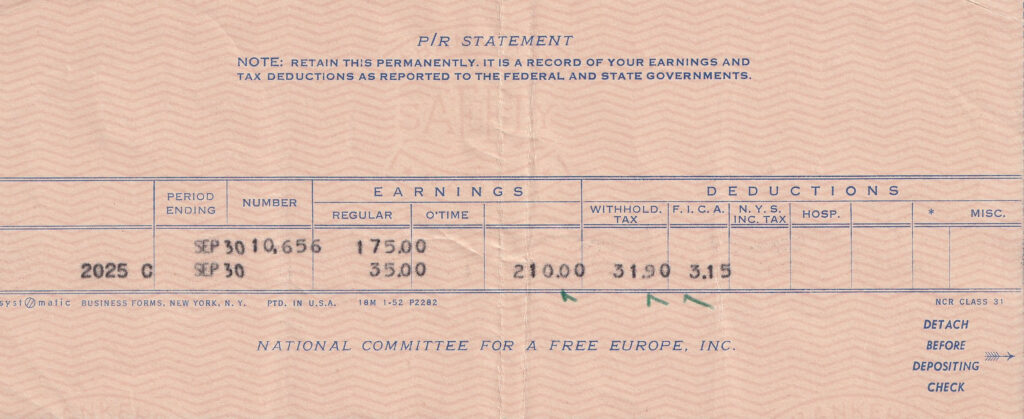
Artifact Description
Payroll Statement (P/R Statement)
Issuer: National Committee for a Free Europe, Inc.
Date: Period ending September 30, early 1950s
Place of issue: New York, N.Y.
Medium: Printed NCR payroll form on security-pattern paper
Collection: Cold War Radio Museum
This document is an original payroll statement issued by the National Committee for a Free Europe, Inc. (NCFE), the nominal civilian sponsor of Radio Free Europe (RFE) during the early Cold War. It itemizes regular and overtime earnings, along with deductions for federal withholding tax, FICA (Social Security), and New York State income tax—a routine bureaucratic artifact that masks an extraordinary political reality.
At the bottom of the form appears the full legal name of the organization. Nowhere does the document indicate that the wages it records were funded almost entirely through covert U.S. government appropriations routed via the Central Intelligence Agency. This absence is not accidental; it is the artifact’s historical significance.
Such documents illustrate how a covert strategic operation was embedded in ordinary civilian life. Journalists, editors, technicians, secretaries, and administrators were paid, taxed, and documented as employees of a private nonprofit—while participating in one of the most ambitious political communication projects of the Cold War.
The National Committee for a Free Europe: Origins and Purpose
Founding
Founded: June 1949
Location: New York City
Context: The collapse of postwar illusions about Soviet cooperation; communist takeovers in Eastern Europe; the Berlin Blockade
Architects: Senior U.S. national security officials working through private intermediaries (notably Frank Wisner’s Office of Policy Coordination)
The NCFE was created to provide a civilian façade for what was, in strategic terms, an extension of U.S. Cold War policy. Its central mission was to support Radio Free Europe, broadcasting to Poland, Czechoslovakia, Hungary, Romania, Bulgaria, and later other Soviet-dominated states.
Why the Committee Existed at All
The NCFE served three overlapping purposes:
- Legal and political insulation
It allowed RFE to operate outside formal diplomatic and treaty constraints governing official state broadcasting. - Credibility and plausibility
RFE was meant to sound like a surrogate national broadcaster, not an American government station like the Voice of America. - Operational secrecy
The Committee masked the role of Congress and the CIA during the most volatile phase of the Cold War.
The payroll statement you see here is a direct product of that structure.
The Funding Obfuscation: How It Worked
The Public Narrative
- NCFE claimed to be supported by private donations
- Fundraising campaigns such as the Crusade for Freedom
- Later: the Free Europe Fund
The Reality
- Nearly all funding came from secret congressional appropriations
- Funds were transferred to the CIA
- The CIA covertly financed NCFE and RFE operations
- Private donations covered only a symbolic fraction of expenses
This system persisted for over two decades.
Radio Liberty and Parallel Structures
- Radio Liberty (RL) began operations in 1951
- Targeted the Soviet Union
- Used similar cover organizations
- Eventually merged administratively with RFE
- Both stations were funded through the same covert mechanism
When Did the Secret Funding End?
CIA funding ended: 1971–1972. It was accelerated by press revelations, congressional scrutiny, and the broader crisis of confidence that followed Vietnam and major intelligence scandals.
Afterward, RFE/RL funding became open and congressional, and oversight moved to public boards. The stations later became part of today’s U.S. Agency for Global Media.
When Did the Truth Become Common Knowledge?
The CIA’s role was partially known by the mid-1960s and widely acknowledged by 1967, with official confirmation soon thereafter. Many émigré staff suspected or knew earlier, and Eastern European listeners often assumed American backing from the start.
Why the Obfuscation Was Used
There were strategic reasons: to protect listeners from accusations of collaborating with a foreign state, to preserve RFE’s identity as a national rather than foreign voice, and to allow sharper criticism of communist regimes than official diplomacy permitted. There was also a psychological logic: RFE’s authority rested on truthfulness, detail, and relevance more than on formal claims of independence.
Was It Necessary? Was It a Mistake?
In the early Cold War, secrecy was arguably necessary: Stalinist regimes criminalized listening, and overt state sponsorship could have endangered listeners and staff. Later, prolonged secrecy became harder to justify and ultimately counterproductive. The structure was effective but ethically compromised; the greater error was failing to transition earlier to transparency once RFE had established trust with its audiences.
Did Audiences Behind the Iron Curtain Care?
Evidence suggests: very little. Audiences judged RFE by accuracy, timeliness, and attention to local realities. For most listeners, who paid for it mattered less than whether it told the truth.
Why This Artifact Matters
This payroll statement embodies a Cold War paradox: a private paycheck issued by a nonprofit organization, funded by secret state appropriations, supporting journalists and staff who helped build one of the most influential information institutions of the twentieth century.
It is a quiet but powerful reminder that the Cold War was not only fought with speeches and spies, but with time cards, tax deductions, and ordinary working lives.
Cold War Radio Museum (CWRM) Collection.