

A reexamination of Walter Lippmann’s critique of the Voice of America (VOA) in light of wartime propaganda, Soviet influence operations, and the practical realities of Cold War broadcasting—revealing both the insight and the limits of his analysis.
Lippmann’s Prestige—and the Context He Carried With Him
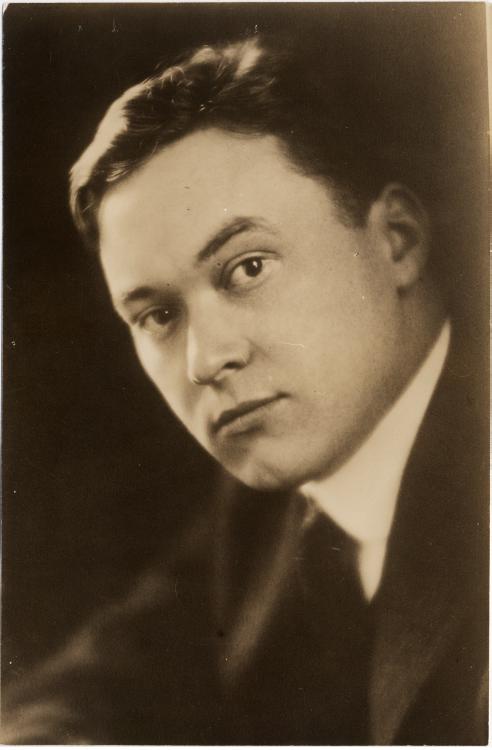
PL: Portret dziennikarza Waltera Lippmanna autorstwa fotografa Pirie MacDonalda, opublikowany w 1914 roku, wkrótce po powstaniu The New Republic. W późniejszych dekadach Lippmann stał się jednym z najważniejszych krytyków propagandy rządowej, w tym amerykańskiej radiofonii międzynarodowej. Ukształtowany doświadczeniem dwóch wojen światowych, odrzucał pogląd, że dziennikarze zatrudnieni przez rząd powinni kształtować opinię publiczną lub przemawiać w imieniu całego narodu. Domena publiczna: Przekazane do domeny publicznej.
A Celebrated Journalist in a Contested Information Environment
In August 1953, Reader’s Digest published a condensed version of Walter Lippmann’s article, originally printed in the New York Herald Tribune, under the title “Why the Voice of America Should Be Abolished.” Lippmann was one of the most influential American journalists and public intellectuals of the twentieth century. His authority gave unusual weight to his critique.
Yet Lippmann’s views were shaped by a broader wartime and early Cold War environment in which questions of propaganda, influence, and loyalty were deeply contested—and increasingly understood across party lines.
Espionage, Influence, and the Wartime Information System
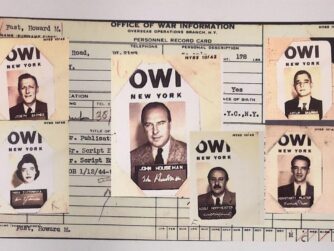
Less widely known is that Lippmann’s secretary, Mary Wolf Price, who concealed her Communist ties, was later identified in Soviet intelligence records and VENONA-related scholarship as a Soviet source under the codenames KID and DIR.1 In addition to providing information from Lippmann’s office, she served as a liaison to a high-value Soviet agent, Maurice Halperin (codename HARE), then working in the Office of the Coordinator of Information (COI), established by President Roosevelt on July 11, 1941, and headed by Colonel William J. “Wild Bill” Donovan.
The COI’s Foreign Information Service (FIS)—the precursor to what would later be known as the Voice of America—began radio broadcasts to Europe in February 1942 from studios at 270 Madison Avenue in New York. Thus, individuals later identified as Soviet agents were present within parts of the U.S. wartime information structure at its inception.
The Office of War Information (OWI), created by Executive Order 9182 on June 13, 1942, absorbed the FIS broadcasting operation. Another Soviet agent, Flora Wovschin (codename ZORA), worked in OWI’s Overseas Branch research section, preparing analytical material, including reports related to Poland’s eastern territories occupied by the Soviet Union in 1939 under the terms of the Hitler-Stalin Pact and reoccupied in 1944.2
Halperin later moved to the Office of Strategic Services (OSS), the United States’ wartime intelligence agency and a predecessor of the Central Intelligence Agency, also under Donovan. While not a member of the Communist Party USA, John Houseman—who helped organize early U.S. government broadcasting—employed individuals with Communist Party affiliations in broadcasting roles. Halperin transmitted hundreds of sensitive diplomatic documents to Soviet intelligence, including material concerning the position of the Polish government-in-exile in its dealings with Stalin. Both Halperin and Wovschin later worked for the State Department but defected to the Soviet bloc during the early Cold War to avoid prosecution.
Awareness and Concern—Across Party Lines
The existence of Soviet espionage and influence within wartime agencies, including the Office of War Information, was not confirmed until the early 1950s, but concerns about Communist influence emerged much earlier and were not confined to one political party. During World War II, Republicans were generally more vocal in raising alarms, but some Democrats also expressed concern and issued warnings, even if at first more cautiously.
By the early Cold War, such concerns had become more broadly shared. Congressional scrutiny of U.S. international broadcasting—particularly during the 1953 hearings—was not exclusively partisan. While Senator McCarthy turned investigations into a political spectacle, other members of Congress, including Democrats such as Senator Henry M. Jackson of Washington, raised serious questions about policy, management, and the effectiveness of Voice of America broadcasts.
Reform, Bipartisanship, and the VOA Mission
In the late 1940s and early 1950s, members of both parties were concerned that VOA had been slow to adapt its programming to counter Soviet propaganda effectively. At the same time, there was broad bipartisan agreement that the United States still needed a credible international broadcasting service.
This consensus was reflected in the 1948 Smith–Mundt Act, which defined the mission of U.S. international broadcasting as directed abroad and not as a substitute for the domestic press.3 Although the law did not explicitly prohibit all domestic access to VOA materials, it clearly established that its purpose was to inform foreign audiences and that its output should not compete with or duplicate the role of American private media. These restrictions were later reinforced and more explicitly defined by the Zorinsky Amendment introduced by Sen. Edward Zorinsky, Democrat of Nebraska.4
When Congress believed that VOA was effectively countering Soviet propaganda and providing moral support to audiences behind the Iron Curtain, support for the institution remained bipartisan throughout much of the Cold War. When things went wrong, however, the criticism was bipartisan as well. A later example was the controversy over VOA’s refusal in the 1970s to broadcast interviews with Aleksandr Solzhenitsyn.5 Republican members of Congress protested, but so did Democrats, including Senator Henry M. Jackson. Democratic senators also joined in publicly honoring Solzhenitsyn, including at a Capitol Hill reception held in his honor.6 The episode demonstrated that congressional concern about VOA was not simply ideological or partisan, but tied to whether the broadcaster was seen as fulfilling its mission.
Lippmann in This Context
There is no evidence that Lippmann was aware of Mary Price’s espionage activities or that he was influenced by them. Nor was he a Communist sympathizer. However, during and after World War II, he advocated recognizing a Soviet sphere of influence in Eastern Europe and was critical of the leaders of the Polish government-in-exile who opposed such arrangements.7
In this respect, his views reflected a broader current of wartime and early postwar thinking—shared by some liberal internationalists and conservative realists alike—that emphasized balance-of-power stability over ideological confrontation, but which was increasingly rejected by both Democrats and Republicans as the Cold War hardened in the early 1950s. Lippmann consistently argued that the Soviet Union required a belt of friendly states along its western borders for security and had a legitimate interest in maintaining it—a position that, in retrospect, resembles later arguments used to justify Russian dominance over neighboring countries.
At the same time, the earlier presence of Soviet agents and influence networks within U.S. wartime institutions ensured that Moscow’s narratives reached and had a longlasting impact on parts of the American policy and media environment. A 1941 Soviet intelligence report listed twenty-two journalists among those working for the NKVD/NKGB, a category outnumbered only by engineers.8
A Critic Outside the Emerging Consensus
During World War II and into the early Cold War, Walter Lippmann remained one of the most influential liberal voices in American journalism. Like many liberals of his time, he favored accommodation with the Soviet Union and viewed confrontational uses of U.S. government broadcasting with skepticism. He supported the American and British concessions to Stalin at the expense of Poland made at the Big Three conference in Tehran in 1943—decisions taken without the knowledge or approval of the Polish government-in-exile in London, a loyal ally in the anti-Nazi coalition.9 These territorial and political concessions were opposed by most American conservatives, most Republicans, and even some liberal Democrats in Congress.
Despite his overall liberal outlook, elements of his thinking also anticipated conservative Realpolitik approaches later associated with figures such as Henry Kissinger and, in more recent years, Donald Trump. Although widely regarded as a liberal and one of the founding editors of The New Republic, Lippmann endorsed Richard Nixon over Hubert Humphrey in the 1972 presidential election.10
Still, his position on the Voice of America in 1953 diverged from the emerging broader bipartisan consensus in Washington. Republicans and Democrats alike shared concerns about propaganda and government overreach, including the risk of domestic influence. At the same time, they generally supported VOA’s mission abroad, provided it was credible, fact-based, and responsive to the needs of foreign audiences.
Lippmann’s critique went further. By calling for the abolition of the Voice of America, he rejected not just its shortcomings but the underlying premise of U.S. international broadcasting itself. In doing so, he placed himself outside the consensus that such broadcasting, if properly conducted, was both necessary and morally justified.
Within this framework, the Voice of America—especially as it evolved into a more assertive instrument of ideological competition—could be seen by him, both in 1953 and later, as an obstacle to improved relations between Washington and Moscow. This helps explain the deliberately provocative title of his 1953 column: “Why the Voice of America Should Be Abolished.”

PL: Karta QSL Głosu Ameryki potwierdzająca odbiór audycji z dnia 16 czerwca 1952 roku. Karta QSL to pisemne potwierdzenie odbioru sygnału radiowego w określonym czasie i miejscu. Z kolekcji Muzeum Radia Zimnej Wojny.

PL: Odwrotna strona karty przedstawia harmonogramy programów VOA w wielu językach oraz kieruje zapytania do ambasad i konsulatów USA—ukazując ścisłe powiązania operacyjne między Głosem Ameryki a amerykańską służbą dyplomatyczną we wczesnym okresie zimnej wojny. Z kolekcji Muzeum Radia Zimnej Wojny.
“The Voice of America Is an Impertinence”
Lippmann began with a memorable sentence:
For any Government agency to call itself the Voice of America is an impertinence.11
On this point, he was largely correct. The name was ill-chosen. At the time of its emergence during World War II, state broadcasting had already acquired a distinctly authoritarian aura. Supporters of creating an American government-run overseas broadcasting service both admired and feared the reach of Nazi radio. Yet instead of choosing a more neutral institutional name—something closer to the British Broadcasting Corporation—the United States adopted a title suggesting that a government agency could somehow speak for the nation as a whole. Walter Lippmann viewed such a claim as incompatible with American-style democracy and the constitutionally guaranteed freedom of the press. The United States, unlike totalitarian regimes, does not possess a single, unified “voice,” and any official effort to present one risks appearing presumptuous or misleading.
Even authoritarian systems typically used more geographically descriptive labels, such as Radio Berlin or Radio Moscow—names that identified the source of the broadcast without claiming to embody the voice of the nation itself. In that sense, Lippmann’s objection was not merely rhetorical. It reflected a deeper concern about the relationship between government, journalism, and representation in a democratic society.
At the same time, Lippmann’s objections rested on a conception of journalism that did not fully account for the practical realities of international broadcasting. While calling for the abolition of the Voice of America, he proposed that government facilities be used to transmit abroad “a selection of the regular American domestic news broadcasts.” He appeared not to recognize that transmitting such broadcasts in English would have had little or no impact in countries under communist rule. If he assumed they would be translated into foreign languages, he did not make this explicit; yet even then, the result would likely have resembled the centrally produced English-language scripts that VOA translated and distributed.
Listeners in Poland in 1951 described such material as “mostly uninteresting, not sufficiently topical, too full of detailed news and comments about American internal affairs and events incomprehensible to Poles who cannot follow daily developments in the United States of America.” They added that these broadcasts gave “the impression that they are prepared and spoken by clerks who do their job perfunctorily, without any intelligent understanding of the human element or of Polish susceptibilities.”12
Even during World War II, some members of Congress questioned the allocation of a significant portion of the Office of War Information budget to English-language broadcasts, given that no English-speaking country was at war with the United States. In later decades, the spread of the internet made English-language American news widely accessible abroad. In the early 1950s, however, only the U.S. government had the resources to build or lease the expensive shortwave and medium-wave transmitters required for international broadcasting. For private American media companies, foreign-language programming for overseas audiences was neither commercially viable nor institutionally central.
Lippmann’s further suggestion that program selection “be entrusted to men chosen by our own broadcasting companies and the press services” was likewise at odds with conditions abroad and with the structure of for-profit domestic media organizations. Earlier attempts by VOA managers to commission programming about the United States from the National Broadcasting Company (NBC) for translation into Spanish had already produced disappointing results. Members of Congress from both parties who reviewed these programs described those dealing with their states as “Baloney,” “Lies,” “Insults,” “Drivel,” “Nonsense,” “Falsehoods,” and a “Downright Tragedy.”13
The question was not whether the United States could speak with one voice, but whether it could present a reliable and intelligible account of itself and its policies to audiences with no access to independent information. The real issue was not the existence of a “voice,” but how it was used—and whether it reflected the diversity and complexity of American life rather than presuming to embody it.
How the Name Took Hold

PL: Broszura Departamentu Stanu USA „Campaign of Truth”, ok. 1952 r., przedstawiająca mikrofon audycji w języku rosyjskim z napisem „Głos Stanów Zjednoczonych Ameryki” (Голос Соединенных Штатов Америки). Jednocześnie podpis drukowany odnosi się już do „Voice of America”, co pokazuje okres przejściowy, w którym nazwa nie była jeszcze w pełni ujednolicona. Przedstawiona spikerka to najprawdopodobniej Helen Zhemchuzhny Bates Yakobson (1913–2002), związana z wczesnymi powojennymi audycjami rosyjskimi VOA, choć w momencie publikacji broszury nie była już pracownikiem rozgłośni. Broszura znajduje się w zbiorach Muzeum Radia Zimnej Wojny.
This photograph, reproduced in a U.S. State Department “Campaign of Truth” publication, circa 1952, captures an important moment in the evolution of American international broadcasting identity. Although the term “Voice of America” had begun to gain official and public acceptance by the early 1950s, earlier formulations—such as “Voice of the United States of America”—remained in use.
The Russian inscription on the microphone reflects a more literal, state-centered formulation, contrasting with the more symbolic and aspirational “Voice of America.” The coexistence of both forms in the same publication illustrates the gradual and sometimes inconsistent process by which the VOA name became standardized.
The image also reflects the belated launch of Russian-language broadcasting after World War II. During the war, the United States avoided direct broadcasting to Soviet audiences so as not to antagonize Stalin. The postwar introduction of Russian-language programming in 1947 marked a significant shift in policy—one that would later become central to Cold War information strategy.
President Truman’s Assistant Secretary of State for Public Affairs, William Benton—who oversaw U.S. international broadcasting from August 31, 1945, to September 30, 1947—was a successful businessman with a background in advertising. He considered the phrase “Voice of America” “a very good one,” but acknowledged that it was not used initially and did not come into wide use for U.S. government broadcasts until several years after the war.14
The name “Voice of America,” however, may have appeared in print in the United States as early as 1943, in a pro-Soviet socialist pamphlet published by Polish and Czechoslovak broadcasters associated with the emerging VOA effort. Some of these individuals were later identified as being in contact with Soviet intelligence or influence networks, and a number subsequently worked for communist regimes in Eastern Europe.15
Although “Voice of America” did not become the official designation immediately, it quickly took hold, and Lippmann was right to sense the conceptual pretension embedded in the name. There is little documentary evidence indicating how much he knew about VOA’s wartime origins—specifically, that it employed individuals with pro-Soviet sympathies and others later identified as agents of influence, including Howard Fast, a novelist who became a Communist Party USA activist and Stalin Peace Prize laureate, and who served as the first chief writer and editor of English-language news.
Evidence from the later-declassified VENONA project—based on intercepted Soviet intelligence cables—also revealed that Soviet intelligence had sources within the Office of War Information and related U.S. government agencies. Some of these individuals were identified, while others remained unnamed. Among those identified was Flora Wovschin, who worked in wartime information services and later transferred to the State Department. VENONA materials indicate that such sources could be tasked not only with reporting on their colleagues but also, when possible, with seeking positions in other parts of the U.S. government where they might have greater access or influence.16
Nor is it clear whether Lippmann was aware that the Roosevelt administration refused to issue a U.S. passport to the OWI official, later called the first VOA director, John Houseman, effectively forcing his resignation.17 Propaganda strategy was coordinated—quietly but effectively—between Washington and Moscow by Robert E. Sherwood, a playwright, presidential speechwriter, and head of OWI’s Overseas Division, which supervised VOA broadcasts. While Houseman organized the staff and oversaw theatrical program production, from New York and later from London, Sherwood helped align American messaging with that of its wartime allies, including the Soviet Union.
It was Robert E. Sherwood who, in his confidential “Weekly Propaganda Directive” of May 1, 1943, warned that “some Poles” who questioned the Soviet explanation of the Katyn massacre of thousands of Polish military officers and intellectual leaders in NKVD captivity might be aiding Hitler by creating divisions among the Allies.18 The suggestion was extraordinary. Poland was a loyal ally whose government-in-exile, underground state, and armed forces were actively fighting Nazi Germany. Its request for an independent investigation by the International Red Cross was a natural response to the discovery of mass graves containing thousands of its officers. Yet within OWI and VOA, such appeals were framed as politically suspect and potentially harmful to Allied unity—an interpretation that closely mirrored Soviet propaganda. Sherwood’s deputy, fellow traveling journalist Joseph F. Barnes, served as John Houseman’s superior at VOA and functioned as the de facto director of programming, while Houseman’s formal role was that of chief radio producer.
What Lippmann Understood—and What He Missed
Regardless of how much Lippmann knew about VOA’s origins, his 1953 critique was uneven. In several respects, he correctly identified structural and journalistic problems in government broadcasting. In others, he revealed a serious misunderstanding of what audiences behind the Iron Curtain actually wanted and needed from American broadcasting.
The Wrong Model for Audiences Behind the Iron Curtain
Lippmann argued that:
The people overseas should have available to them substantially the same news that we have available to us.19
This was a central weakness of his analysis. People living under free media systems and those living under censorship and political terror did not have the same information needs. A French audience in a country with an active and pluralistic press might well prefer its own correspondents or a selection of American domestic news. But listeners in Poland, Czechoslovakia, Hungary, or the Soviet Union were in a fundamentally different position. They were not primarily looking for selected reports about life in the United States. They wanted reliable information about their own countries, about Communist rule, and about realities their own media could not report.
Lippmann did not fully grasp that distinction and showed limited engagement with the realities of life behind the Iron Curtain. In this respect, he stood far from the position of former U.S. Ambassador to Poland Arthur Bliss Lane, who understood that the problem was not whether the United States should speak abroad, but whether it understood the psychology and circumstances of those to whom it was speaking. Lane wrote:
As for radio broadcasts beamed to Poland as the ‘Voice of America,’ my opinion of their value differed radically from that of the authors of the program in the Department of State. … I felt that the Department’s policy to tell the people in Eastern Europe what a wonderful democratic life we in the United States enjoy showed its complete lack of appreciation of their psychology. And, especially in Poland, which had suffered through six years of Nazi domination, it was indeed tactless, to say the least, to remind the Poles that we had democracy, which they also might again be enjoying, had we not acquiesced in their being sold down the river at Teheran and Yalta.20
Arthur Bliss Lane Saw the Problem More Clearly

Lane’s point went far beyond questions of style. Drawing on his experience as the first U.S. ambassador to postwar Poland, Lane understood that audiences in Eastern Europe did not need America advertised to them. They needed hope, realism, and evidence that the United States recognized the tragedy of their political condition. He was also one of the co-founders of Radio Free Europe.
As he wrote, radio broadcasting to the Soviet bloc could serve a useful purpose only “if appropriate material is used that will bring hope and cheer, instead of intensifying despair,” and only if guided by “the wisdom of statesmanship, not that of salesmanship.”21
Salesmanship, Not Statesmanship
That last phrase is especially relevant because William Benton, who helped shape early postwar public diplomacy and VOA policy, came out of advertising. Benton believed in persuasion—presenting America in an attractive way and “selling” democratic values—rather than directly confronting Soviet propaganda. By 1946, he had become convinced that the United States needed Russian-language broadcasting, but he did not yet know what kind of programming it should contain. He relied heavily on Charles Thayer and other State Department specialists on the Soviet Union to develop an appropriate approach. Many anti-Communists, especially conservative Republicans, regarded Benton’s and Thayer’s strategy as misguided from the outset.
Listeners themselves offered a similar critique. In 1951, letters smuggled out of Poland described VOA broadcasts as “uninteresting, drab, bureaucratic in tone, [and] unconvincing.”22
How VOA Actually Worked
Lippmann misunderstood how the Voice of America actually functioned. He wrote that there was no effective way for the State Department to know what translated programs would mean in actual transmission. This was only partly true—and not in the way he meant it. The problem was not that translations escaped control. Before roughly 1951, most VOA output in foreign languages was, in fact, centrally originated in English and then translated. Management therefore generally knew what was being broadcast. The deeper problem was, in fact, the opposite of what Lippmann imagined: too much of the content was being dictated from the center in English, by individuals often unfamiliar with the realities and expectations of audiences behind the Iron Curtain.
Later, under pressure from congressional criticism and from President Truman’s “Campaign of Truth,” VOA allowed somewhat more original, locally informed reporting in the foreign-language services. But even then, central control remained substantial, and scripts were frequently translated back into English for review. These were, in fact, two distinct issues: origination and control. Lippmann opposed origination in the foreign-language services, in part because he was wary of refugee journalists and feared a loss of bureaucratic control. In practice, however, the over-centralized English-language system was itself one of VOA’s main weaknesses, as it often produced material that was unappealing, irrelevant, or tone-deaf to the needs of foreign audiences.
Here, too, Lane’s critique was more perceptive than Lippmann’s. Lane understood that content aimed at Eastern Europe had failed not because it was too independent of Washington, but because it was too superficial, too “salesmanlike,” and too detached from political reality.
Where Lippmann Was More Persuasive
Lippmann was more persuasive when he described the postwar absorption of the wartime propaganda apparatus into the State Department. He wrote that the organization was not absorbed because Secretary James F. Byrnes “wanted to do propaganda,” but because he was “a compassionate Democrat” who could provide “a refuge for the displaced persons of the wartime propaganda services.” On this point, Lippmann was largely correct, though the full context is more complex.
President Harry S. Truman did not wish to continue the Office of War Information in its wartime form, but neither did he wish to abandon international broadcasting altogether. Lippmann was familiar with the background of the transfer from the Office of War Information to the State Department because Secretary of State James F. Byrnes had asked him to direct the government’s information activities, including the Voice of America. Lippmann refused the offer, telling Byrnes that the position could not be separated from leadership and that “no qualified public official needs the intervention of a public relations expert between himself and the people.”23 Byrnes even sent an Air Force plane to bring Lippmann to Washington in an effort to change his mind. Lippmann went but could not be persuaded to take the position.24
This point about leadership was fundamental. The Voice of America could be effective only when the U.S. president, the agency head, and the VOA director shared a realistic understanding of its potential and its limits in specific countries, rather than expecting it to be equally effective worldwide—especially in English or in countries with free media.
Propaganda, Oversight, and the Limits of Government Journalism
Lippmann disapproved of having the Voice of America within the State Department “singing songs, cracking jokes, [and] entertaining the kiddies” around the world. In his view, if the Voice of America were to exist at all, it should limit itself to broadcasting news drawn from private American media. He also argued that, as a free nation, the United States does not possess “an official ideology, an official doctrine and an official set of opinions.”25
This last observation is particularly revealing. Journalists are often influenced—sometimes strongly—by ideological assumptions and by domestic and foreign political alignments. During World War II, Roosevelt administration officials recruited individuals they considered loyal to the administration and effective for wartime information work; some of them, however, were more sympathetic to Soviet positions than the president himself. Roosevelt’s trusted liberal adviser, Under Secretary of State Sumner Welles, warned the White House in 1943 that John Houseman was “said to be responsible for placing Communists in key positions in foreign radio sections of OWI.” About another key VOA figure and Houseman’s superior, Joseph F. Barnes, Welles wrote: “It has been reliably stated that there has been no crucial point in Russian development, since 1934, when Barnes has not followed the Party line and has been much more successful than the official spokesman in giving it a form congenial to the American way of expression.”26
Government employment gave such figures influence and institutional authority not available to private media journalists, whose work remained subject to domestic scrutiny and professional competition. By contrast, VOA broadcasts—especially in foreign languages—were largely beyond the reach of domestic media oversight. This lack of transparency appears to have concerned Lippmann.
At the same time, Lippmann did not fully appreciate how much American attitudes toward the Soviet Union had changed by 1953. As a proponent of balance-of-power politics and of spheres of influence as instruments of stability, he underestimated the willingness of President Truman and much of the American public to support nations under Soviet domination—many of them consigned there in part by Roosevelt’s concessions to Stalin—not through military intervention but by providing access to information and ideas denied by their regimes.
The postwar solution for the Voice of America—politically expedient but institutionally ambiguous—was to place it within the State Department, an agency that Congress still trusted in 1945. This stood in contrast to wartime attitudes, when Congress had come close to defunding the Office of War Information and its overseas broadcasting operations out of concern over domestic propaganda and potential communist influence.
What followed was not a carefully designed system but an improvised arrangement: a large, ideologically heterogeneous workforce—many of whom had been recruited during the Roosevelt administration and were identified, fairly or not, with its political outlook—was carried over into a peacetime structure without a clearly defined mission or doctrine. This early pattern helped establish a long-term imbalance in the staffing and outlook of the VOA central English newsroom that later administrations—particularly Republican ones—found difficult to correct by introducing a broader mix of experience and political perspectives. The foreign-language services, by contrast, developed somewhat greater diversity of views after the war than the central English-language operation.
After the war, both Congress and the Truman administration moved quickly to scale back the wartime apparatus. The administration used Executive Order 9835—the “Loyalty Order,” issued on March 21, 1947—to remove VOA employees suspected of communist ties, while the 1948 Smith–Mundt Act strengthened security and vetting procedures and gave preference to U.S. citizens in hiring. By 1947, major cuts in VOA programming and personnel—reflected in the official press release of July 29, 1947, announcing a 40 percent reduction in programs approved by Assistant Secretary of State William Benton—had already substantially reduced the scope of operations. Uncertainty persisted about the purpose and direction of what remained of the Voice of America. In this sense, Lippmann’s observation captured a genuine structural weakness: the State Department inherited an organization that was politically sensitive, only partially reformed, and still searching for a coherent peacetime role—a condition that contributed to continuing congressional distrust without producing a decisive institutional solution.
Where Lippmann’s Critique Was Strongest
Lippmann was right in observing that foreigners, like Americans, do not wish to feel manipulated. His point that no one likes being “made fools of by someone with something to sell” was entirely sound. This was one of VOA’s recurring institutional weaknesses.
Some newsroom editors and managers—especially in the central English-language services—underestimated the intelligence of their audience and treated foreign listeners as passive consumers rather than as politically alert individuals capable of detecting condescension, propaganda formulas, and bad faith. Crude productions such as The Eye of the Eagle, approved by Robert Bauer in the central English services, illustrate the kind of broadcasting that would have vindicated Lippmann’s skepticism.
Such programming was sharply criticized within VOA, including by the Latin American Division and its American-born Foreign Service officers. Yet Bauer later emerged publicly as both a victim of the McCarthy hearings and a defender of responsible journalism. Bauer’s critics within VOA—specialists on Latin America or Russia who advocated skillful and responsible countering of Soviet disinformation—later emerged, unlike him, as the villains of the story. In his interview with Claude “Cliff” Groce, VOA and USIA journalist and official Robert Bauer asserted that those who complained about VOA’s coverage of Communism during the McCarthy hearings were “either immigrants, like Gerald Dooher, or first-generation Americans.” Referring to the chief of the Latin American Division, Steven Baldanza—who had supported Virgil Fulling—Bauer added that Baldanza’s “parents came from Sicily, and so forth.” He concluded with a telling remark: “See what I mean? Find me a Mayflower American!”27
The McCarthy Hearings and the Problem of Crude Propaganda
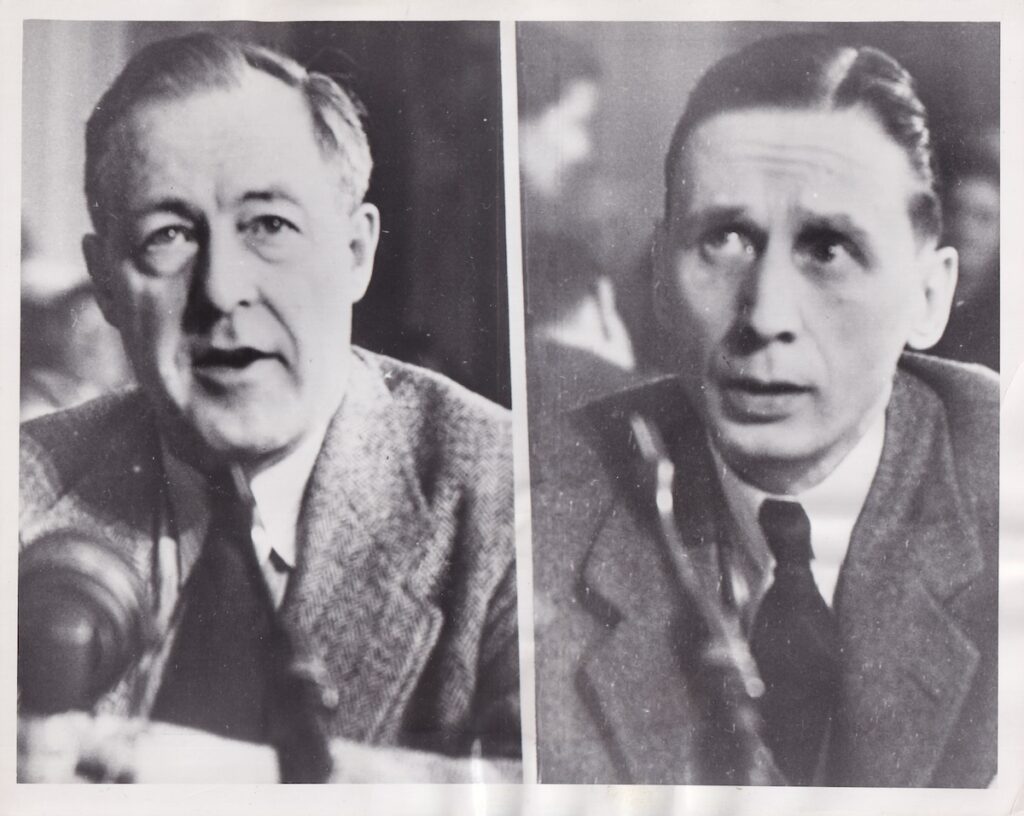
If Walter Lippmann followed even part of the 1953 McCarthy hearings on the Voice of America—and it is difficult to imagine that he did not absorb at least some of their public impact, given his well-known criticism of McCarthy’s methods—he would likely have encountered examples of what VOA managers and editors in the central English services, including former OWI broadcasters, Robert Bauer and Robert B. Goldmann, presented as “anti-Communist propaganda.” Some of the material cited in their defense of VOA programming did indeed amount to crude propaganda and may, at times, have been counterproductive. Had Lippmann examined such examples closely, they would have reinforced his skepticism about the credibility and effectiveness of government broadcasting.
Yet this was not the only model of journalism within VOA, nor was it the one advocated by many of the most thoughtful critics of its newsroom practices. Figures such as Virgil H. Fulling, Alexander Barmine, Bertram D. Wolfe, John Cocutz, and others—later criticized or marginalized after testifying before the McCarthy subcommittee—were not calling for bombast, nor were they making indiscriminate accusations of disloyalty. Rather, they argued for greater accuracy, sharper analysis, and a more serious engagement with the realities of Communist systems.
Several of these individuals brought substantial intellectual authority to the debate. Bertram Wolfe and Alexander Barmine, for example, were among the most knowledgeable American analysts of Marxism and Soviet politics. Yet critics within VOA and among its defenders—particularly some holdover journalists from the Office of War Information era—dismissed the critics in personal and often disparaging terms, labeling them “McCarthyites,” “former Communists,” “immigrants,” “thick-headed,” “dope,” “pathetic,” “pariah,” “disgruntled,” and “troublemaker.”28
Importantly, these critics had been warning about Soviet policies and methods well before such views became more widely accepted in the United States. In March 1945, Bertram Wolfe wrote in Common Sense about the consequences of the 1939 Hitler–Stalin Pact, Soviet deportations of Polish citizens to the Gulag, and the execution of Polish political and labor leaders—subjects that were largely absent from VOA broadcasts during World War II and remained sensitive in the immediate postwar years.29
Similarly, Alexander Barmine, a Soviet defector who later became chief of the VOA Russian Service, warned as early as 1944 about Communist influence operations within the United States. Writing in Reader’s Digest, he argued that even as the United States fought Nazi totalitarianism, it risked a “moral and psychological disarmament” in the face of another form of totalitarian threat.
The United States is waging a deadly struggle against Nazi totalitarianism. All its energies, labor, wealth, thousands of its lives, are being sacrificed to destroy this enemy of democracy. Yet, at the same time, in the press, on the radio, in the Government and among liberal circles supposed to represent the vigilant conscience of the nation, there is in process a moral and psychological disarmament before another totalitarian conspiracy — that of the Communists — which threatens our democracy even more seriously.30
In this context, the central issue raised during the hearings was not simply whether VOA opposed Communism, but how it did so. The contrast between crude, declarative propaganda and informed, evidence-based analysis reflected deeper disagreements about the nature of effective international broadcasting and bureaucratic control. Lippmann recognized the dangers of the former but did not fully engage with the possibilities of the latter.
Lippmann’s Silence About Soviet Influence and the Work of VOA’s Refugee Journalists
On the question of Soviet propaganda influence and refugee broadcasters who challenged it after the war, Lippmann was strangely silent. He does not address the issue directly, and it is difficult to know whether he considered it central or peripheral. What he did not seem to appreciate was that, by 1953, conditions within VOA had already begun to change. Thanks in part to the Truman Doctrine, which in 1947 pledged American support to nations threatened by the Soviet Union, as well as to the departure of pro-Soviet writers and editors and the hiring of anti-Communist refugee broadcasters—such as Polish Service writer and editor Zofia Korbońska—the Voice had become more effective in broadcasting to the Soviet bloc. She was recommended for her VOA position by Ambassador Arthur Bliss Lane, who had known her and her husband in Warsaw and met them again upon their arrival in the United States in 1947 after their escape from Poland.
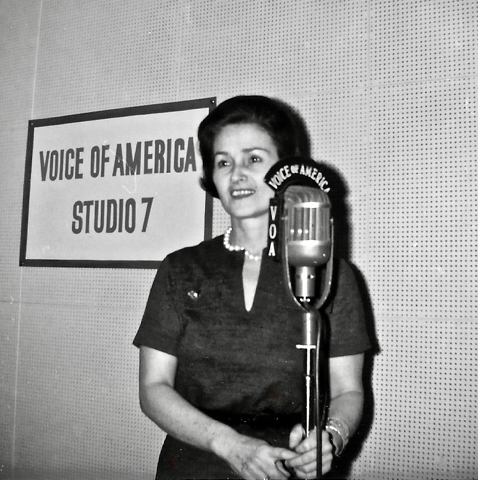
PL: Zofia Korbońska przy mikrofonie Voice of America w studiu 7, miejsce nieustalone, lecz najpewniej Nowy Jork lub Waszyngton, data niepewna, ale prawdopodobnie z końca lat 40. lub z lat 50. Jedna z czołowych postaci Polskiego Państwa Podziemnego w czasie II wojny światowej, później stała się jednym z najważniejszych głosów Polskiej Sekcji VOA. Zdjęcie z archiwum Marka Walickiego.
Lippmann, while supportive of the Truman Doctrine in its application to Greece and Turkey, was critical of its broader implications. He worried that it could be misinterpreted in ways that might induce “civil strife in countries where the national cooperation is delicate and precarious.” One such country was Poland, which Lippmann believed belonged to the Soviet sphere of influence, along with the rest of Eastern Europe.31
Truman’s Alternative: Sharpen the Voice, Do Not Abolish It
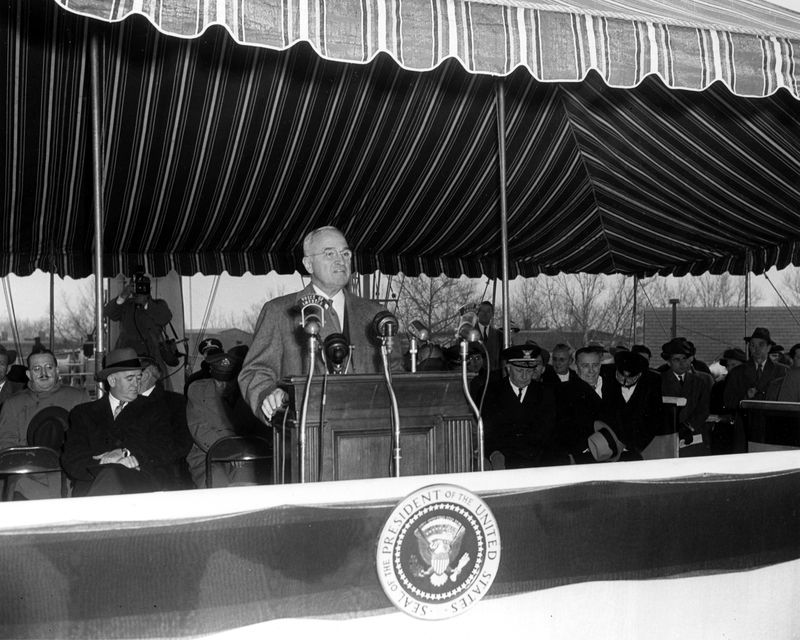
PL: Prezydent Harry S. Truman przemawia na pokładzie kutra Straży Przybrzeżnej USA Courier, pływającego nadajnika radiowego wykorzystywanego przez Głos Ameryki, 4 marca 1952 r. Zwodowany miesiąc później okręt był promowany jako „statek z ładunkiem prawdy”. Choć pomyślany jako mobilna platforma nadawcza, Courier okazał się konstrukcyjnie i operacyjnie ograniczony. Jego projekt oraz decyzje z nim związane—zatwierdzone przez inżynierów Głosu Ameryki—stały się przedmiotem szerszych dochodzeń Kongresu w 1953 r., dotyczących zarządzania i programów Głosu Ameryki.
President Truman viewed the competition with the Soviet Union differently and sought to sharpen Voice of America programming in its response to Communism. Secretary of State Dean Acheson’s report to Congress confirmed that the “Campaign of Truth,” announced by Truman in 1950, had resulted not in dramatic expansion but in “sharpened program content and specialized radio treatment.”32
He added that in broadcasts to Eastern Europe “greater program variety was introduced,” along with “more liberal use” of anti-Communist satire, exposés, documentary material, and dramatization.33 Progress was uneven and often slow, but it was nonetheless real.

PL: Broszura Departamentu Stanu USA The Campaign of Truth, ok. 1952 r., przedstawiająca założenia i zakres amerykańskiej dyplomacji publicznej we wczesnym okresie zimnej wojny. Tekst podkreśla rolę Voice of America w docieraniu do odbiorców na całym świecie oraz przeciwdziałaniu propagandzie sowieckiej poprzez wiadomości, komentarze i programy kulturalne. Ze zbiorów Muzeum Radia Zimnej Wojny.
Lippmann’s own view of Truman’s leadership suggests that he would have regarded the “Campaign of Truth” with considerable skepticism, if not outright disapproval. He was often sharply critical of Truman’s style of decision-making, which he saw as impulsive, and he opposed aspects of the administration’s early Cold War posture. His political preferences—supporting Thomas E. Dewey in 1948 and later Dwight D. Eisenhower—reflected a broader lack of confidence in Truman’s approach. In that context, Lippmann appears either to have discounted or to have ignored the administration’s effort to reform and strengthen international broadcasting rather than abolish it.
Radio Free Europe and the Broadcasting Model Lippmann Overlooked

The pamphlet uses dramatic newspaper-style headlines and imagery—including a photograph of the so-called “Freedom Tank,” a makeshift armored vehicle used by Czechoslovak refugees in a 1953 escape through the Iron Curtain—to illustrate the perceived impact of Western broadcasts. By linking such acts of defiance with Radio Free Europe, the campaign sought to persuade Americans that their financial and moral support was contributing to resistance against communist regimes.
PL: Obraz pochodzi z broszury kampanii Crusade for Freedom, promującej poparcie społeczne dla Radia Wolna Europa we wczesnym okresie zimnej wojny. Kampania, rozpoczęta w 1950 roku, była ogólnokrajową inicjatywą w Stanach Zjednoczonych, mającą na celu zbieranie funduszy i mobilizowanie opinii publicznej na rzecz nadawania do Europy Wschodniej i innych regionów znajdujących się pod rządami komunistycznymi. Broszura znajduje się w zbiorach Cold War Radio Museum.
Broszura wykorzystuje dramatyczne nagłówki stylizowane na prasowe oraz sugestywne obrazy—w tym fotografię tzw. „Freedom Tank,” improwizowanego pojazdu pancernego użytego przez czechosłowackich uchodźców podczas ucieczki przez Żelazną Kurtynę w 1953 roku—aby zilustrować wpływ zachodnich audycji. Łącząc takie akty sprzeciwu z działalnością Radia Wolna Europa, kampania miała przekonać Amerykanów, że ich wsparcie finansowe i moralne bezpośrednio przyczynia się do oporu wobec reżimów komunistycznych.
Overcoming censorship and focusing on human rights violations in the Communist bloc reflected a model of international broadcasting that differed sharply from the one Lippmann had in mind. The desperation of audiences behind the Iron Curtain can be illustrated by the episode of the so-called “Freedom Tank.” On July 25, 1953, eight Czechoslovak refugees crossed the Czechoslovak–West German border near Waldmünchen in a makeshift armored vehicle that broke through barbed wire and mine-protected frontier barriers. Radio Free Europe later acquired the vehicle and turned it into a publicity and fund-raising symbol in the Crusade for Freedom campaign.34 The event itself revealed something many Western observers still failed to grasp: people were prepared to risk prison, death, and the loss of their families merely to escape Communist rule. That reality was not fully understood by Walter Lippmann, by many liberals of his generation, or by some editors and reporters in VOA’s central English newsroom, including individuals who had earlier defended or minimized Stalinism and still shaped VOA output in the early Cold War.
By contrast, Radio Free Europe’s journalists and managers understood much better what such audiences wanted and needed. RFE’s mission was not burdened by the same conceptual ambiguity as the Voice of America’s. From the beginning, its broadcasts were directed to the “captive countries behind the Iron Curtain,” and its first Czechoslovak broadcast in July 1950 explicitly opened with the words, “The voice of free Czechoslovakia is speaking, the radio station Free Europe.” That language made clear that RFE claimed to speak not for the American government or for “America,” but for exiles, refugees, and the silenced opponents of Communist regimes. Listeners behind the Iron Curtain were interested in the United States, but they wanted news about America filtered through the realities of their own lives, fears, and political circumstances. RFE generally knew how to do this. So did some of VOA’s regional experts, including Bertram D. Wolfe and Edmund Demaitre, as well as some Foreign Service officers with direct knowledge of the countries to which VOA broadcast. Others, however—especially some holdovers from the OWI period and some officials who still approached Soviet Russia primarily as a partner for negotiation rather than as an enemy of democracy and a source of propaganda and disinformation—did not fully understand what effective broadcasting required at that stage of the Cold War.
Lippmann overlooked the creation of Radio Free Europe and, later, Radio Liberty. Conceived during the Truman administration and initially funded in secret by the U.S. government from the CIA budget, these services were designed to provide something closer to surrogate domestic broadcasting for audiences in the “captive nations.” Judging from his writings, it is unlikely that Lippmann would have approved of them. Yet their later success demonstrated the limits of his analytical framework. Listeners behind the Iron Curtain did not simply want American domestic news from the Voice of America; they wanted truthful broadcasts that addressed the realities of their own lives under dictatorship—something the surrogate broadcasting model was better equipped to provide—or, in VOA’s case, a more balanced mix of American and surrogate news.
Some lower-ranking State Department officials placed in charge of the Voice of America in 1945, along with certain VOA managers and editors carried over from the pro-Soviet Office of War Information period, failed to grasp the depth of repression and fear in Soviet-bloc societies. For many listeners, tuning in to Western radio carried real risks—criminal penalties, loss of employment, or denunciation by neighbors. They were unlikely to take such risks merely to hear about routine American domestic matters, such as a presidential budget proposal. As VOA’s Hungarian-born analyst Edmund Demaitre observed, such programming reflected “the absurdity” and revealed a broader pattern of “ineptitude.”35
Radio Free Europe and Radio Liberty, which did not broadcast in English but in the languages of their target audiences, largely avoided this problem. As Demaitre suggested, although one of VOA’s missions was to present a truthful picture of American life, those responsible for centrally produced English-language scripts—intended for translation—were not always clear about what aspects of the United States should be emphasized, for which audiences, and in what proportion.
The secrecy surrounding Radio Free Europe—particularly its early management links to the CIA—was widely regarded at the time as necessary to preserve journalistic credibility and maintain plausible deniability. This arrangement allowed RFE and later RL journalists to engage in sharper criticism of communist regimes. Some former officials later acknowledged that greater transparency about funding might have been preferable. Others argued that, in the early years, the alternative—direct State Department control or integration with the Voice of America—would likely have been more restrictive to its surrogate radio mission.36
Importantly, Radio Free Europe also demonstrated a greater willingness to examine its own failures. Its leadership later acknowledged mistakes made by the Hungarian Service in 1956, particularly in overstating the likelihood of Western support for the uprising—errors that the Polish Service largely avoided during unrest in Poland the same year. By contrast, many Voice of America officials and some former staff members tended to minimize or avoid public discussion of earlier programming and managerial shortcomings.
On balance, however, the Voice of America’s contributions to the eventual Western success in the Cold War outweighed its institutional weaknesses. This was due in part to sustained congressional oversight and external criticism—beginning during World War II and continuing in the postwar period, including from journalists such as Walter Lippmann. Even flawed initiatives could play a constructive role. The U.S. Coast Guard transmitter ship Courier, for example, did not perform as effectively against Soviet jamming as its designers had promised, yet it served an important symbolic and public-awareness function.
Over time, Courier’s operations helped deliver programming to audiences in parts of the communist world and in developing regions vulnerable to Soviet influence. At the same time, the controversy surrounding its limitations helped draw attention—within both the Truman administration and Congress—to deeper structural and managerial problems at the Voice of America. Addressing those problems became essential to strengthening U.S. international broadcasting at a critical moment in the Cold War.
A Better Contemporary Critic: Eugene Lyons
A useful contemporary counterpoint to Lippmann’s critique of the Voice of America is Eugene Lyons, whose understanding of Soviet propaganda and of VOA was far deeper. Lyons had been a pro-Communist fellow traveler in the 1920s and 1930s, had interviewed Stalin, and personally knew many Western reporters, including The New York Times’s Walter Duranty, who moved in pro-Kremlin circles, denied that the Katyn massacre and the deadly famine in Ukraine had been ordered by the Kremlin, and attacked other journalists—such as Gareth Jones—who dared to expose Stalin’s crimes.37
By the 1950s, Lyons had become one of the most perceptive American critics of Soviet Communism and was in close contact with figures such as Alexander Barmine at VOA. In a 1954 Reader’s Digest article, Lyons acknowledged the earlier problem with unusual clarity:
Without doubt, some ‘subversive’ individuals formerly found their way into VOA, as into other agencies in Government. Fortunately, the Voice has cleared house. Ardent anti-Communists on the inside are now convinced that no known Communists or Communist sympathizers remain.38
Lyons’s judgment was more historically grounded than Lippmann’s. He recognized both that VOA had once suffered from pro-Soviet influence and that, by 1954, those individuals were largely gone. He concluded not that the Voice should be abolished, but that it should be improved:
That the Voice has shortcomings is admitted. But the remedy is not to destroy this one official channel for reaching the freedom-loving peoples of the world. The remedy is to improve and strengthen the Voice.39
Conclusion: Insightful, Influential, and Fundamentally Limited
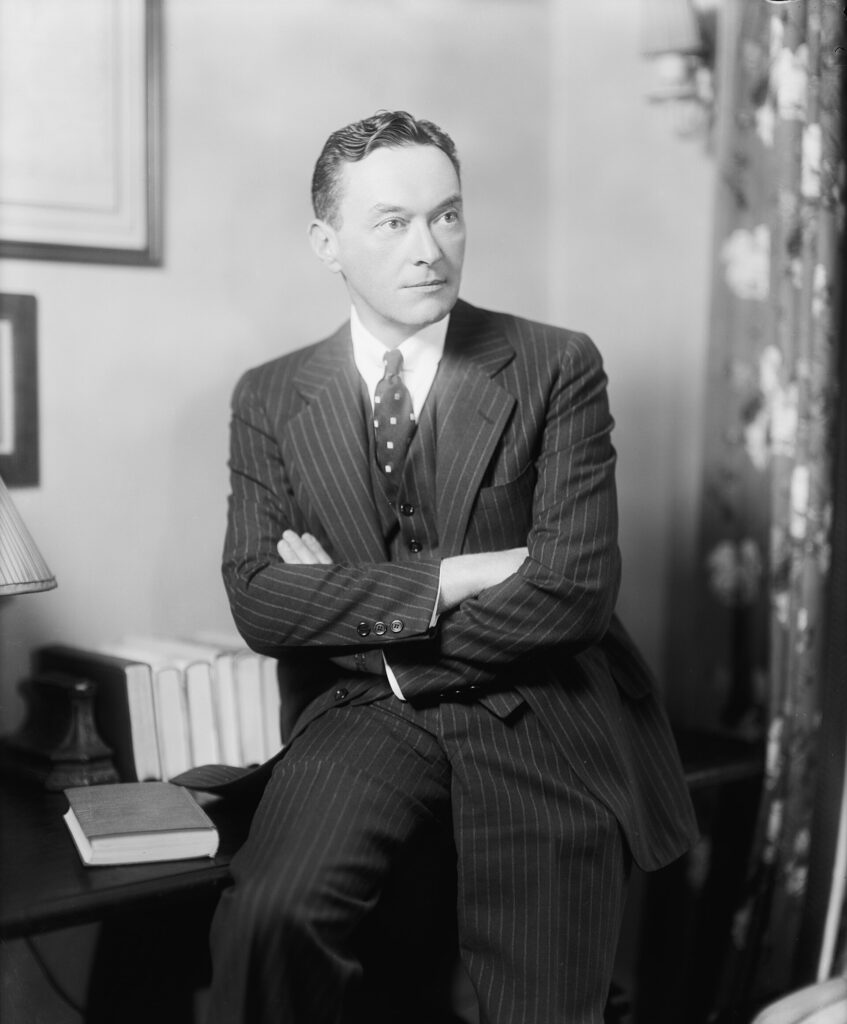
This portrait, produced by the Harris & Ewing studio between 1905 and 1945 and preserved in the Library of Congress, captures Lippmann at the height of his authority—an authority that would shape, but not fully define, the debate over the purpose and limits of the Voice of America.
PL: Walter Lippmann (1889–1974), jeden z najbardziej wpływowych amerykańskich dziennikarzy i intelektualistów XX wieku, którego krytyka Voice of America z 1953 roku—wzywająca do jej likwidacji—odzwierciedlała zarówno przenikliwe spostrzeżenia instytucjonalne, jak i istotne ograniczenia. Pisząc z perspektywy ukształtowanej przez doświadczenia okresu międzywojennego i II wojny światowej, Lippmann trafnie ostrzegał przed propagandą rządową i niebezpieczeństwami mówienia w imieniu „Ameryki”, nie w pełni rozumiał jednak potrzeby informacyjne odbiorców żyjących pod rządami komunistycznymi ani ewoluującą rolę nadawania międzynarodowego w okresie zimnej wojny.
Portret wykonany przez studio Harris & Ewing w latach 1905–1945 i przechowywany w Bibliotece Kongresu ukazuje Lippmanna u szczytu jego autorytetu—autorytetu, który kształtował, lecz nie definiował ostatecznie, debatę nad rolą i ograniczeniami Głosu Ameryki.
Lippmann’s Insight—and Its Limits
Eugene Lyons’s conclusion was much closer to the institutional realities of World War II and of 1953 than Lippmann’s sweeping call for the abolition of the Voice of America. Lippmann was right about the name, about certain bureaucratic absurdities, about the danger of manipulative propaganda by the government, its officials, or individual reporters and editors claiming to speak on behalf of America, and right that credibility was the central issue. But he did not fully understand the needs of listeners living under repression, did not grasp the internal structure and evolving reforms of VOA, and did not distinguish between crude propaganda and the more serious, evidence-based anti-Communist journalism advocated by some of VOA’s most thoughtful critics and later partially adopted by the U.S. government itself.
In that sense, his article is best read not as a definitive judgment on the Voice of America, but as a revealing document of postwar American uncertainty: sharp in some institutional insights, but limited by a partial understanding of Communist dictatorship, audiences in the “captive nations,” and the actual possibilities of international broadcasting. Lippmann’s belief in human decency—shared by many American liberals of his generation—limited his ability to fully recognize the nature of Communist dictatorships. He did not see Communism and fascism in the same light as Susan Sontag later did when, at a 1982 New York demonstration in support of the Polish trade union movement Solidarity, she declared that Communism was “a variant—the most successful variant—of Fascism” and observed that for decades readers of Reader’s Digest had often been better informed about communist realities than readers of journals of the liberal left.40
Katyn, Soviet Illusions, and What Lippmann Did Not See

PL: Fotografia ekshumowanych ciał z masowych grobów katyńskich, datowana na 1943 rok i zachowana w aktach katyńskich Komisji Maddena w National Archives w Waszyngtonie. Zdjęcie zostało najprawdopodobniej wykonane podczas ekshumacji prowadzonych po odkryciu grobów pod kontrolą niemiecką, choć autor fotografii nie został wskazany w zachowanych materiałach archiwalnych.
Eugene Lyons, who in his later years worked as an editor at Reader’s Digest, wrote in his book Our Secret Allies: The Peoples of Russia (1953) about “revivified Stalin worship in the war years when the Kremlin magically became a freedom-loving ally” and “the revised legend fashioned by the comrades of the OWI, the BBC, and other Allied agencies celebrated a regime not too different from our own—democratic and liberal in its own inscrutable way.”41 While not a Soviet sympathizer or agent of influence like Walter Duranty, Lippmann does not appear to have addressed the Katyn massacre directly in his published work. The Voice of America also gave limited attention to the secret execution by the Soviet NKVD of thousands of Polish military officers and intelligentsia leaders until about 1951, after promoting the Soviet propaganda lie about the murders during World War II under OWI Director Elmer Davis, President Roosevelt’s speechwriter Robert E. Sherwood, Walter Duranty’s friend Joseph Barnes, John Houseman, and Howard Fast.42 Some of the other “founding figures” of the Voice of America, including Wallace Carroll—later news editor of the Washington bureau of The New York Times—continued for several years after the war to defend the Soviet version of the Katyn massacre. 43
According to the English historian Tony Judt, until at least 1946, Walter Lippmann and other liberal Western journalists and intellectuals “simply refused to believe what they were told about Soviet actions in Eastern Europe and elsewhere.”44 Many believed the Soviet disinformation about Katyn for much longer, or pretended that there was no definite proof of Soviet complicity in this and other atrocities. Some individuals sympathetic to Soviet positions, such as Stefan Arski, who later served the communist regime in Warsaw, were still working for the Voice of America in 1947. VOA’s wartime China expert, Owen Lattimore, sought to reassure American readers that workers in the Soviet Gulag were provided with a vitamin-rich diet of fruits and vegetables.45
Censorship, Leadership, and Institutional Fragility
The whitewashing of Stalin and Communism within the Office of War Information and the Voice of America was largely confined to the World War II period under the Roosevelt administration. Censorship favorable to Moscow was most pronounced at that time, but continued to some degree—primarily for diplomatic reasons—under both Democratic and Republican administrations. It did not fully end until President Ronald Reagan changed the agency’s leadership.
Lippmann, while opposed to antagonizing Soviet Russia for geopolitical reasons, would likely have rejected both the whitewashing of Soviet realities and the censorship of news on principle. At the same time, he would almost certainly not have supported Reagan’s more confrontational policies toward Moscow. Pre-Reagan VOA management and much of the central English-language newsroom shared similar reservations and often viewed such policies with open skepticism.
It is abundantly evident from his 1953 column that Lippmann would also not have tolerated activist journalism or one-sided reporting at taxpayers’ expense, whether from the left or the right. He would have preferred to see the Voice of America abolished rather than allow the government or its journalists to engage in propaganda directed at both foreign and domestic audiences. Such activism—especially when practiced by both officials and journalists, as occurred within VOA during World War II—nearly led to the agency’s defunding following a bipartisan vote in Congress in 1943.
As observed by Edmund Demaitre, one of VOA’s most outstanding journalists during the Cold War, the agency’s institutional position was always precarious. This vulnerability was compounded by the relatively low standing of many of its directors—Edward R. Murrow being a notable exception—and, at times, by the questionable competence of some politically appointed VOA directors.46 Even limited failures of leadership in preventing partisanship or ideological bias within a taxpayer-funded institution could have far-reaching consequences for the organization as a whole, as both the wartime experience and later controversies demonstrate.
Demaitre’s observations are particularly valuable because, while critical of excesses during the McCarthy period, he also defended journalists such as Alexander Barmine and Bertram D. Wolfe, whose reputations were damaged by VOA officials and broadcasters shaped by the OWI environment created in part by John Houseman’s theatrical style and accommodation to Soviet wartime narratives. Barmine and Wolfe had opposed crude propaganda and called instead for more rigorous, fact-based journalism, yet they were often accused of precisely the practices they rejected.47
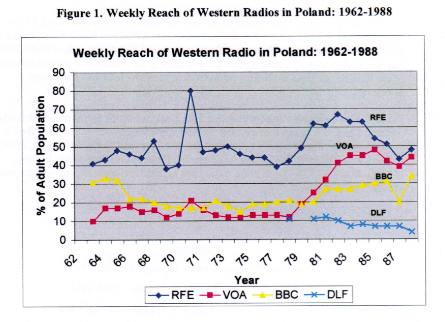
A similar pattern of tension reemerged during the early years of the Reagan administration. The reforms implemented in the 1980s contributed to a significant expansion in VOA’s audience reach and influence in Poland and other countries of Eastern and Central Europe after years of relative stagnation.48
This growth formed part of a broader set of developments that culminated in the peaceful collapse of Communist regimes in the region and, ultimately, the dissolution of the Soviet Union. A key factor in the success of the VOA Polish Service in the peaceful transformations of the 1980s was presidential leadership in foreign policy aimed at ending Russian imperialism in the region and funding focused on foreign-language services broadcasting to countries with the greatest informational need and opportunity for change. Without such leadership and targeted funding, U.S. international broadcasting cannot hope to achieve much success. Part of this success also depended on the strict avoidance of encouraging violence or offering unrealistic hope of American support. The Polish Service presented a broad segment of American opinion in the fashion that Lippmann envisioned, but it did so through experienced journalists who were born and educated in Poland rather than through the central English services.
The English-Service Problem and the Risks of Domestic Exposure
One of the less appreciated facts of U.S. government-funded international broadcasting is that programming in English has a limited audience abroad and limited opportunity for impact, but carries a large risk of being accused by members of Congress of both parties and by partisan media of propagandizing to Americans, since VOA English-language content is now widely available on the Internet, including on social media, in the United States. Only a strong example of partisan impartiality and effective management could reduce that risk, though not eliminate it altogether. Another fact to consider is that American society may have become too polarized to sustain a balanced and credible English-language news platform speaking on behalf of the whole country. Weak management can also increase the risk of hiring journalists who work for the intelligence services of other countries, as VOA did several years ago when it used such a Russian journalist as a freelancer for its English-language programs and defended him despite evidence of his questionable connections to the Russian government. Weak management can also allow VOA English and foreign-service journalists to express their partisan or other political biases. Such failures can take many forms, including running one-sided electoral campaign commercials, VOA reporters posting attacks on American politicians on private social media accounts or trying to justify extreme violence by groups such as Hamas while avoiding calling them terrorists in VOA English-language broadcasts.
A Precarious Institution
Several years ago, I met with the newly appointed agency head and the VOA director to discuss the lessons of VOA’s past. I tried to impress upon them that one mistake by a single journalist can do irreparable damage to VOA precisely because it is not like other private media: it claims to represent America, which Lippmann saw as an impertinence, and it has a Charter that, by law, requires accuracy, balance, and comprehensiveness. The response I got from the VOA director was that “journalists make mistakes all the time.” I knew then that VOA was at great risk of losing its bipartisan support in Congress and among American taxpayers, who can now agree on a rapidly decreasing number of issues. Perpetuating the myth of constant journalistic objectivity in VOA’s history without examining its weak points and mistakes led to diminished vigilance on the part of management and of individual editors and reporters in an organization that has always had a precarious existence, dependent entirely on the goodwill of the President, the American people, and members of Congress.
Poor risk management has led to incidents of journalistic misconduct and calls from both the left and the right for the abolition of the Voice of America, both in the past and more recently. The pendulum can swing from one direction to another, depending on which side is more susceptible to Soviet—and now Russian—propaganda or to disinformation from other sources. What can forgotten is that the Voice of America can be useful and successful, especially in times of international crisis, but not in every country or territory, as demonstrated in Vietnam, Cambodia, Afghanistan, and Gaza, and not in all languages. This does not mean that the Voice of America should refrain from broadcasting in local languages, but it must limit its expectations, focus on fundamental human rights, and present U.S. policies—and the debates surrounding them—accurately and with balance.
Final Assessment
When Walter Lippmann proposed offering a balanced selection of American media news in English, the delivery of American news abroad was still technically difficult and expensive. That is no longer the case, and VOA in English would largely duplicate content already widely available, while not serving the needs that still exist in some foreign-language services. Another overlooked fact is that the English services cannot attract the top talent that goes to the private media in the United States, while the foreign-language services can find such talent among exiles who cannot return to their countries but also cannot find suitable employment abroad. Yet another often overlooked fact is that the ability to change public opinion in countries that already have some form of free media is limited, but can be invaluable in times of crisis in countries that control the free flow of information.
In the end, Lippmann’s critique of the Voice of America illuminates both the strengths and the limits of postwar American liberal and conservative thought. He was an unusual liberal who held a conservative view of geopolitics. He understood the dangers of propaganda, the importance of credibility, and the risks of bureaucratic overreach. But he did not fully grasp the risks inherent in accommodating Communist dictators or the nature of the emerging Cold War conflict, in which information itself became a central instrument of power. He viewed international broadcasting through the lens of traditional diplomacy and balance-of-power politics, rather than as a means of reaching societies deprived of free information. As a result, his analysis, though often perceptive, failed to account for the needs of captive audiences, the internal evolution of the Voice of America, the creation of more effective Radio Free Europe, and the possibility that truthful, well-informed broadcasting could serve not as propaganda, but as a form of political and moral support for those living under dictatorship. In this respect, his argument for abolition reveals less about the limitations of the Voice of America than about the difficulty, even for the most astute observers of his time, in understanding the informational dimension of the Cold War.
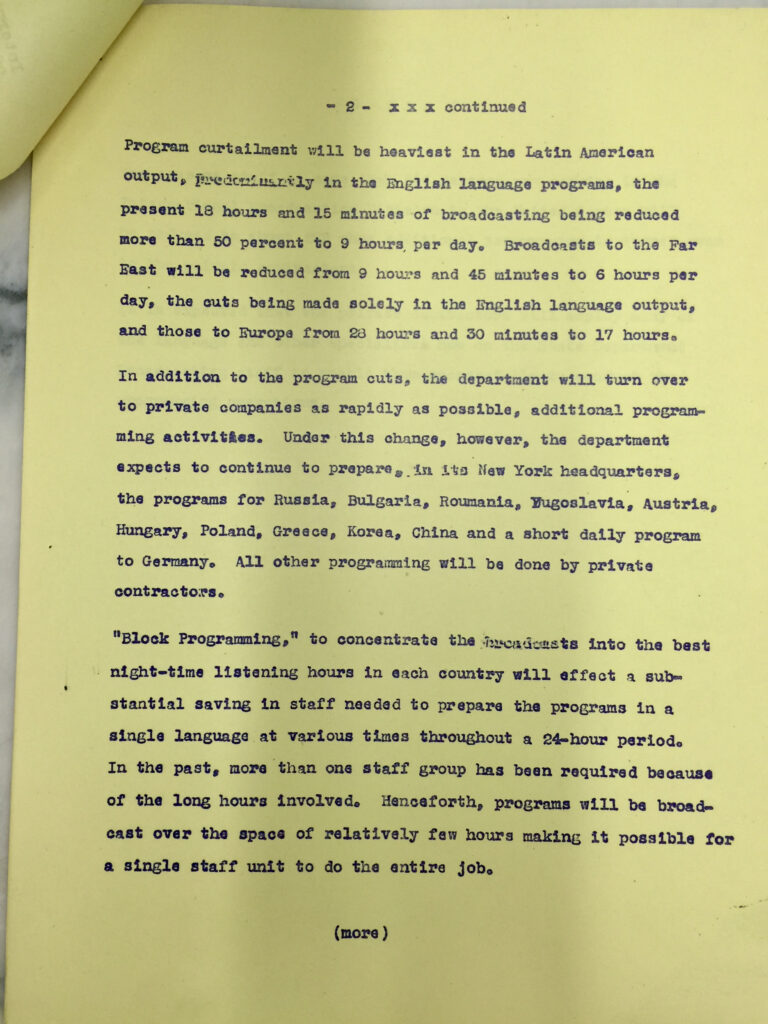
The following declassified State Department press release of July 29, 1947 documents a major reduction in Voice of America programming and the introduction of “block programming.” It provides rare contemporary evidence of early postwar restructuring of U.S. international broadcasting—decisions shaped not only by budgetary pressures but also by evolving strategic priorities and concerns over personnel, loyalty, and organizational control.


DEPARTMENT OF STATE (OIC)
International Broadcasting Division
224 W. 57th Street, New York 19
Phone: Circle 6-4400
FOR IMMEDIATE RELEASE
(Simultaneous Release in Washington)
WASHINGTON, July 29 — Reduction in the State Department’s Voice of America programs by 40 percent, together with a new “block programming” system to minimize the effects of the cut by concentrating programs in the best night-time listening hours in each country, was announced today by William Benton, Assistant Secretary of State for Public Affairs.
The changes in time will be made at 12 o’clock noon EDST on Tuesday, July 29, Mr. Benton said, and constitute one of a series of major steps underway to bring the Department’s International Information and Cultural Affairs program within the limits of the reduced appropriation provided by Congress for the 1947–48 operation. The new budget calls for an expenditure of six million, nine hundred thousand dollars, as against eight million, four hundred thousand dollars last year. Other changes will be announced within the next few days.
Broadcasting by the Voice of America will be cut from 55 hours to 35 hours a day under the new plan, and Danish and Swedish will be dropped from the list of 26 languages in which the programs are now broadcast. Dutch-language programs to the Netherlands will also be eliminated, though programs to the Netherlands East Indies in that language will be continued.
— 2 — (continued)
Program curtailment will be heaviest in the Latin American output, predominantly in the English-language programs, the present 18 hours and 15 minutes of broadcasting being reduced by more than 50 percent to 9 hours per day. Broadcasts to the Far East will be reduced from 9 hours and 45 minutes to 6 hours per day, the cuts being made solely in the English-language output, and those to Europe from 28 hours and 30 minutes to 17 hours.
In addition to the program cuts, the Department will turn over to private companies, as rapidly as possible, additional programming activities. Under this change, however, the Department expects to continue to prepare, in its New York headquarters, the programs for Russia, Bulgaria, Romania, Yugoslavia, Austria, Hungary, Poland, Greece, Korea, China, and a short daily program to Germany. All other programming will be done by private contractors.
“Block programming,” to concentrate broadcasts into the best night-time listening hours in each country, will effect a substantial saving in staff needed to prepare programs in a single language at various times throughout a 24-hour period. In the past, more than one staff group has been required because of the long hours involved. Henceforth, programs will be broadcast over the space of relatively few hours, making it possible for a single staff unit to do the entire job.
— 3 —
The present staff of more than 500 persons now working in the International Broadcasting Division in the United States will be reduced to about 225 when additional programming is turned over to private contractors.
It is expected that the private contractors will employ many of the language and other specialists now on the State Department broadcasting staff to enable them to successfully conduct the programming operations.
NOTES:
- Christopher Andrew and Vasili Mitrokhin, The Mitrokhin Archive: The KGB in Europe and the West (London: Penguin Books, 2000), 140.
- John Earl Haynes and Harvey Klehr, Venona: Decoding Soviet Espionage in America (New Haven: Yale University Press, 2000), 99–104.
- United States Information and Educational Exchange Act of 1948 (Smith–Mundt Act), Pub. L. 80–402, sec. 2, 62 Stat. 6 (1948), declaring that the Act’s objectives were “to enable the Government of the United States to promote a better understanding of the United States in other countries” and authorizing “an information service to disseminate abroad information about the United States, its people, and policies”; full text available at GovInfo, https://www.govinfo.gov/content/pkg/COMPS-1091/pdf/COMPS-1091.pdf.
- Sen. Edward Zorinsky (Democrat of Nebraska) introduced the domestic-distribution restriction later known as the Zorinsky Amendment during Senate consideration of the Foreign Relations Authorization Act, Fiscal Years 1986 and 1987. As offered on the Senate floor on June 7, 1985, the amendment stated: “No funds authorized to be appropriated to the United States Information Agency shall be used to influence public opinion in the United States. No program material prepared by the United States Information Agency shall be distributed within the United States.” See “1985 Amendment from Senator Edward Zorinsky (D-NE) to the Smith-Mundt Act of 1948,” reproducing the Congressional Record text of June 7, 1985, https://www.smithmundt.com/1985-amendment-from-senator-edward-zorinsky-d-ne-to-the-smith-mundt-act-of-1948/. The domestic-influence restriction remains in force today in codified form at 22 U.S.C. § 1461–1a, which provides that “no funds authorized to be appropriated to the Department of State or the Broadcasting Board of Governors shall be used to influence public opinion in the United States,” https://www.govinfo.gov/link/uscode/22/1461-1a.
- Victor Franzusoff, Talking to the Russians (Santa Barbara: Fithian Press, 1998), 180; Aleksandr Solzhenitsyn, “The Soft Voice of America,” National Review, April 30, 1982 (republished February 24, 2015), https://www.nationalreview.com/2015/02/soft-voice-america-aleksandr-solzhenitsyn/.
- “Memorandum From the President’s Deputy Assistant (Friedersdorf) to President Ford,” Washington, July 12, 1975, in Foreign Relations of the United States, 1969–1976, vol. XVI, doc. 163, noting that a Capitol Hill reception for Aleksandr Solzhenitsyn was being sponsored by Senators Henry M. Jackson (D–WA), Joseph R. Biden Jr. (D–DE), Dale Bumpers (D–AR), Frank Church (D–ID), John Glenn (D–OH), Hubert H. Humphrey (D–MN), Daniel K. Inouye (D–HI), Warren G. Magnuson (D–WA), John L. McClellan (D–AR), John O. Pastore (D–RI), Abraham A. Ribicoff (D–CT), Adlai E. Stevenson III (D–IL), Richard B. Stone (D–FL), Harrison A. Williams Jr. (D–NJ), Clifford P. Case (R–NJ), William E. Brock III (R–TN), James L. Buckley (Conservative–NY), Jesse A. Helms (R–NC), Jacob K. Javits (R–NY), Robert W. Packwood (R–OR), William V. Roth Jr. (R–DE), Richard S. Schweiker (R–PA), Ted Stevens (R–AK), Robert Taft Jr. (R–OH), and Lowell P. Weicker Jr. (R–CT), https://history.state.gov/historicaldocuments/frus1969-76v16/d163.
- Ronald Steel, Walter Lippmann and the American Century (New Brunswick: Transaction Publishers, 1999), 415–417.
- John Earl Haynes, Harvey Klehr, and Alexander Vassiliev, Spies: The Rise and Fall of the KGB in America (New Haven: Yale University Press, 2009), 145.
- Steel, Walter Lippmann and the American Century, 586–87.
- Steel, Walter Lippmann and the American Century, 586–87.
- Walter Lippmann, “Why The Voice of America Should Be Abolished,” Reader’s Digest, August 1953, 41; condensed from New York Herald Tribune, April 27, 1953.
- Congressional Record (Bound Edition), 82d Cong., 1st sess., vol. 97, pt. 7 (July 23, 1951–August 13, 1951), July 24, 1951, 8749–8750, https://www.govinfo.gov/content/pkg/GPO-CRECB-1951-pt7/pdf/GPO-CRECB-1951-pt7-2-2.pdf.
- Homer E. Capehart, “Voice of America?” speech delivered in the U.S. Senate, May 26, 1948 (Washington, DC: United States Government Printing Office, 1948), “Not printed at Government expense.”
- Sidney Hyman, The Lives of William Benton (Chicago: University of Chicago Press, 1969), 332.
- Poland Fights–Polish Labor Group, Unconquered Poland (New York, 1943), 7.
- Haynes and Klehr, VENONA, 197–201.
- Howard Fast, Being Red (Boston: Houghton Mifflin, 1990), 4–26; Howard Fast, “On Receiving the Stalin Peace Award,” http://www.trussel.com/hf/plots/t590.htm; Sumner Welles to Marvin H. McIntyre, memorandum, April 6, 1943, Franklin D. Roosevelt Library and Museum, Box 77, State – Welles, Sumner, 1943–1944, President’s Secretary’s File, National Archives Identifier: 16619284, https://catalog.archives.gov/id/16619284.
- Robert E. Sherwood, Director, Overseas Branch, Office of War Information; RG208, Director of Overseas Operations, Record Set of Policy Directives for Overseas Programs, 1942–1945 (Entry 363); Box 820; National Archives at College Park.
- Lippmann, “Why The Voice of America Should Be Abolished,” Reader’s Digest, August 1953, 41.
- Arthur Bliss Lane, I Saw Poland Betrayed (Indianapolis: Bobbs-Merrill, 1948), 219.
- Arthur Bliss Lane, I Saw Poland Betrayed, 219.
- Congressional Record (Bound Edition), 82d Cong., 1st sess., vol. 97, pt. 7 (July 23, 1951–August 13, 1951), July 24, 1951, 8749–8750, https://www.govinfo.gov/content/pkg/GPO-CRECB-1951-pt7/pdf/GPO-CRECB-1951-pt7-2-2.pdf.
- Ronald Steel, Walter Lippmann and the American Century (New Brunswick: Transaction Publishers, 1999), 422–423.
- Steel, Walter Lippmann and the American Century, 423.
- Steel, Walter Lippmann and the American Century, 424.
- Sumner Welles to Marvin H. McIntyre, memorandum, April 6, 1943, with enclosures, Departmental Correspondence, 1933–1945, President’s Secretary’s File, Franklin D. Roosevelt Library, National Archives Identifier 16619284, https://catalog.archives.gov/id/16619284.
- Robert Bauer Oral History Interview, interviewed by Claude “Cliff” Groce, October 4, 1989, Foreign Affairs Oral History Collection, Association for Diplomatic Studies and Training (ADST), https://www.adst.org/OH%20TOCs/Bauer%2C%20Robert.toc.pdf.
- Robert Bauer interview by Claude “Cliff” Groce, October 4, 1989, Association for Diplomatic Studies and Training Foreign Affairs Oral History Project, PDF (Library of Congress), https://www.adst.org/OH%20TOCs/Bauer%2C%20Robert.toc.pdf; Barry Zorthian, interview by Claude “Cliff” Groce, October 20, 1988, Association for Diplomatic Studies and Training Foreign Affairs Oral History Project, PDF (Library of Congress), remarks describing Virgil Fulling as “thick-headed,” “pathetic,” and asserting suicide, https://tile.loc.gov/storage-services/service/mss/mfdip/2004/2004zor01/2004zor01.pdf; Robert William Pirsein, The Voice of America: An History of the International Broadcasting Activities of the United States Government, 1940–1962 (New York: Arno Press, 1979), excerpt from the author’s interview with Harold Berman, 283.
- Bertram D. Wolfe, “Poland: Acid Test for a People’s Peace,” Common Sense, March 1945.
- Alexander Barmine, “The New Communist Conspiracy,” Reader’s Digest, October 1944, http://www.oldmagazinearticles.com/alexander-barmine-soviet-defector-pdf.
- Steel, Walter Lippmann and the American Century, 437–439.
- Dean Acheson, U.S. Secretary of State, “Launching the Campaign of Truth–First Phase: Sixth Semiannual Report of the Secretary of State to Congress on the International Information and Educational Exchange Program, July 1 to December 31, 1950,” Department of State Publication 3479, December 1951, 3, https://hdl.handle.net/2027/umn.31951d03562370p?urlappend=%3Bseq=8.
- Dean Acheson, “Launching the Campaign of Truth–First Phase,” 4, https://hdl.handle.net/2027/umn.31951d03562370p?urlappend=%3Bseq=11.
- Richard H. Cummings, Radio Free Europe’s “Crusade for Freedom” (Jefferson: McFarland & Company, 2010), 100–102).
- Edmund Demaitre, Eyewitness: A Journalist Covers the 20th Century (New York: Frederick Ungar Publishing, 1981), 321–22.
- Arch Puddington, Broadcasting Freedom: The Cold War Triumph of Radio Free Europe and Radio Liberty (Lexington: University Press of Kentucky, 2000), 20–32.
- Eugene Lyons, Assignment in Utopia (New York: Harcourt, Brace & Company, 1937), 575.
- Eugene Lyons, “How Good Is the Voice of America,” Reader’s Digest, June 1954, 91.
- Lyons, “How Good Is the Voice of America,” 92.
- Susan Sontag, remarks delivered at Town Hall, New York, February 6, 1982; contemporary coverage includes “Seeing Red,” Time, March 15, 1982, and The Washington Post, March 16, 1982.
- Eugene Lyons, Our Secret Allies: The Peoples of Russia (New York: Duell, Sloan & Pearce, 1953), 339.
- S. J. Taylor, Stalin’s Apologist: Walter Duranty, The New York Times’s Man in Moscow (New York: Oxford University Press, 1990), p. 280. Walter Duranty to John Gunther, 2 March 1939, Personal Files of John Gunther.
- Wallace Carroll, Persuade or Perish (Boston: Houghton Mifflin, 1948), 152.
- Tony Judt, Postwar: A History of Europe Since 1945 (New York: The Penguin Press, 2005), 108.
- Owen Lattimore, “New Road to Asia,” National Geographic Magazine 86, no. 6 (December 1944): 641–676.
- Demaitre, Eyewitness, 322–23.
- Robert Bauer Oral History Interview, interviewed by Claude “Cliff” Groce, October 4, 1989, Foreign Affairs Oral History Collection, Association for Diplomatic Studies and Training (ADST), https://www.adst.org/OH%20TOCs/Bauer%2C%20Robert.toc.pdf.
- R. Eugene Parta, (Former) Director of Audience Research and Program Evaluation, Radio Free Europe/Radio Liberty, Inc., “Listening to Western Radio Stations in Poland, Hungary, Czechoslovakia, Romania, and Bulgaria: 1962-1988 – Longitudinal Listening Trend Charts.” Prepared for the Conference on Cold War Broadcasting Impact co-organized by the Cold War International History Project, Woodrow Wilson International Center for Scholars, Washington, DC, and the Hoover Institution of Stanford University, Stanford, California, October 13-15, 2004.