
by Ted Lipien for Cold War Radio Museum
April 22 is not a date usually remembered in the history of the Voice of America (VOA). Yet it deserves to be. On this day in 1954, at the Hotel McAlpin in New York, Howard Fast — a former chief news writer and editor for Voice of America during World War II — publicly accepted the Stalin Peace Prize at a ceremony reportedly attended by about 1,000 guests. The event brought together prominent figures from left-wing and pro-Soviet political and cultural circles in the United States and marked, in a sense both historical and ironic, a public reward for one of VOA’s earliest and most important wartime writers.
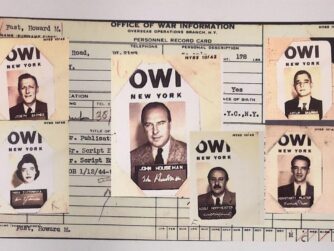
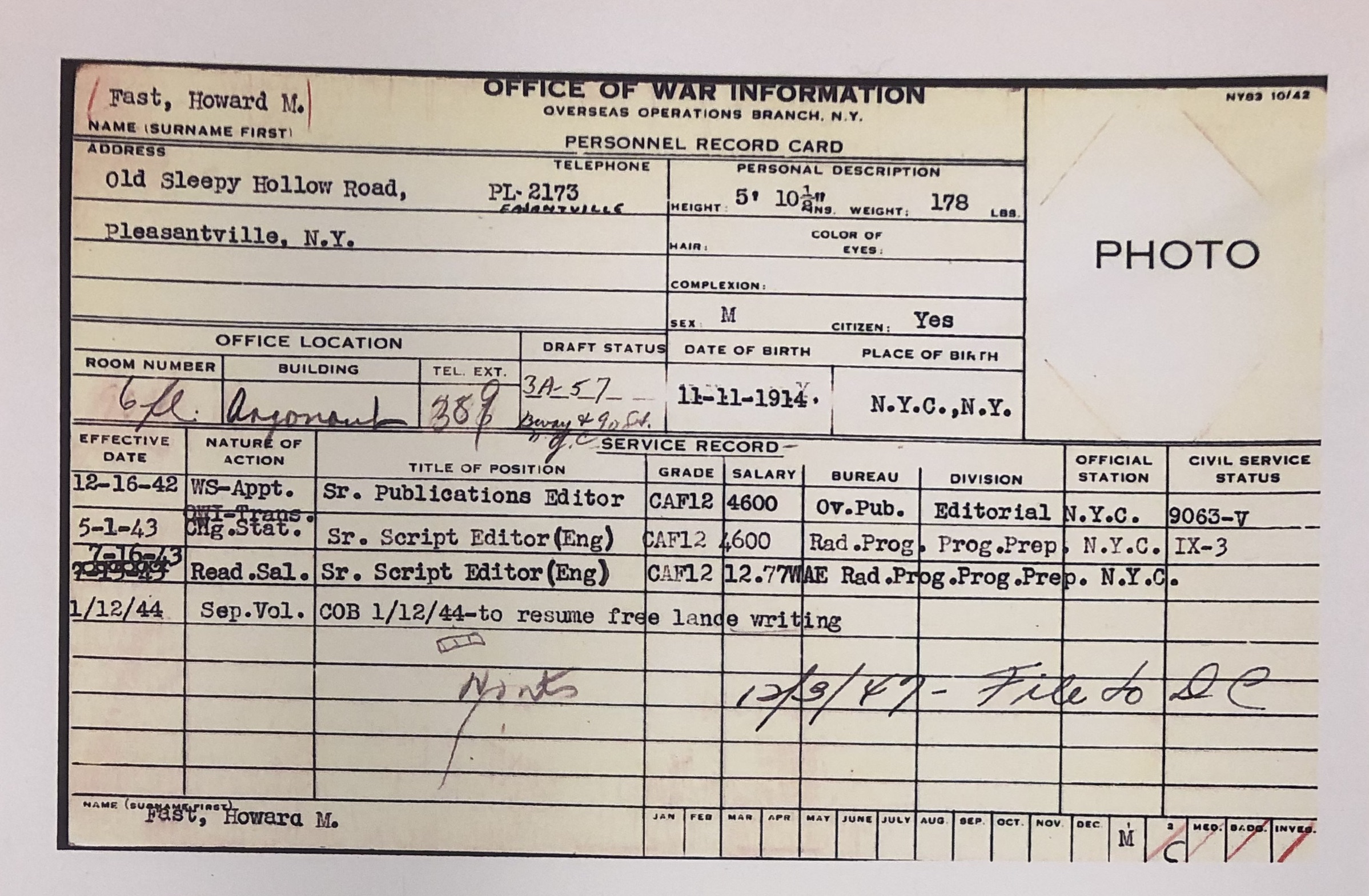
Fast was not a minor employee. During World War II, in the Overseas Division of the U.S. Office of War Information (OWI), he served as chief English-language news writer for broadcasts later identified as the Voice of America. He worked under men such as John Houseman, Joseph Barnes, and Elmer Davis at a time when the wartime U.S.-Soviet alliance shaped American information policy and when Soviet interests were frequently protected in OWI and VOA output. Fast later wrote openly that, while at VOA, he refused to engage in what he called “anti-Soviet or anti-Communist propaganda” — that is, in practice, truthful reporting that might have exposed Stalin’s crimes or complicated the wartime image of the Soviet Union as a democratic ally.1
By 1954, Fast had long since left the U.S. government and become one of the most visible Communist Party-linked writers in the United States. His support for the Soviet cause had already led to his prison sentence for contempt of Congress, his active backing of Henry Wallace’s 1948 presidential campaign, and his public defense of Communist front organizations and Soviet “peace” campaigns. The Stalin Peace Prize, created by decree of the Presidium of the Supreme Soviet in 1949, was meant to honor foreign intellectuals and activists who helped advance Soviet foreign-policy messaging under the banner of peace.2
The Cold War Radio Museum preserves rare primary documents from the New York ceremony itself. They are more revealing than later recollections. They show not merely that Fast received the award, but how the event was presented, who spoke, and how the language of peace was used in a political setting deeply shaped by Soviet influence.
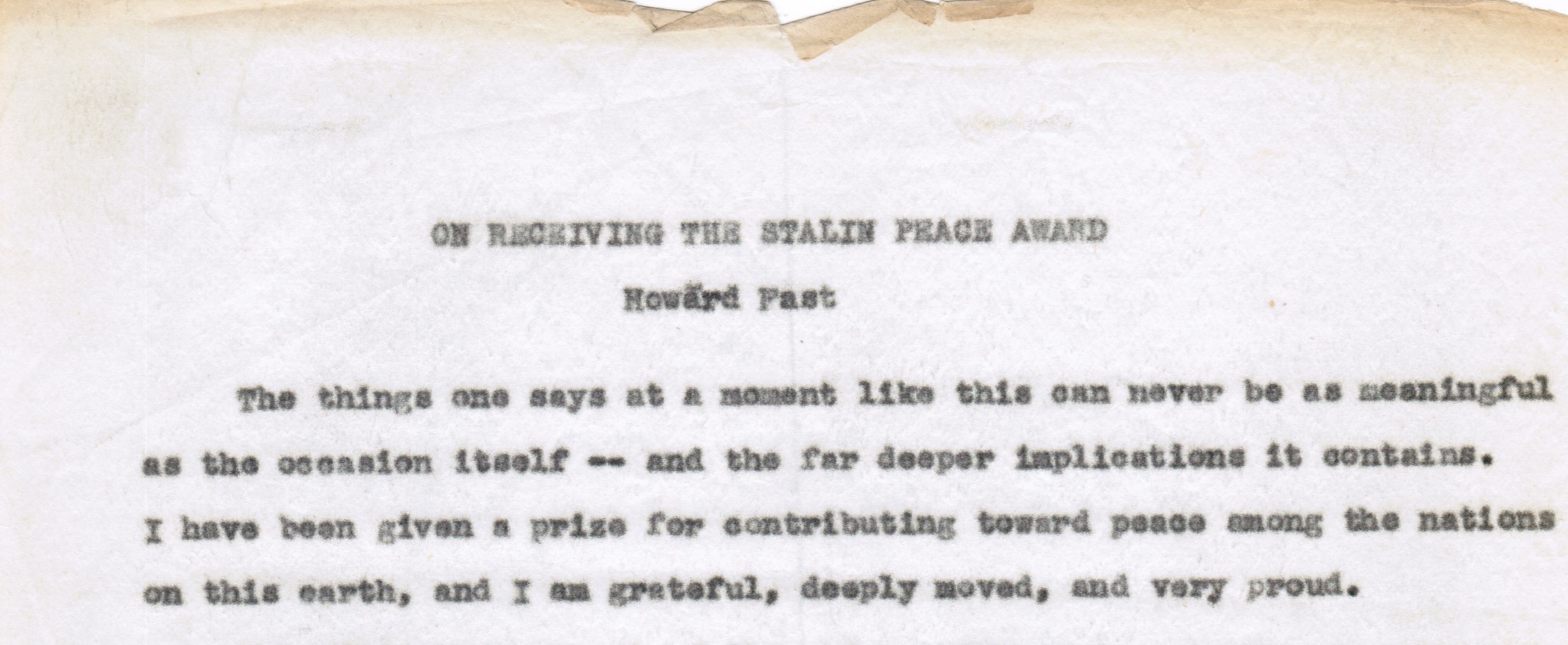
The opening is sober, ceremonial, and carefully constructed:
“The things one says at a moment like this can never be as meaningful as the occasion itself — and the far deeper implications it contains. I have been given a prize for contributing toward peace among the nations on this earth, and I am grateful, deeply moved, and very proud.”3
It was a language designed to elevate the occasion beyond politics. But the politics were unmistakable. This was not a neutral literary tribute. It was a Soviet-sponsored peace award named after Stalin and bestowed on an American writer who, during the war, had helped shape U.S. government broadcasts in a period when Soviet propaganda claims — including the lie about Katyn — were often protected rather than challenged. Fast was not being honored despite this record. He was being honored, in substantial part, because of the political loyalties and public usefulness it represented.
In his acceptance speech, Fast made the larger meaning explicit. He praised the Soviet Union as a force for peace and suggested that hostile misunderstanding, rather than the nature of the Soviet regime itself, stood between Americans and the truth.
It is a peace prize; nothing can ever change that, and nothing will — and when, even for a moment, the tissue of lies and slander erected between this land of ours and the Soviet Union is parted, is brushed aside, we see beyond this prize a monumental force for the peace of mankind.4
That sentence alone helps explain why this date belongs in VOA history. A decade after helping to write wartime American broadcasts, Fast stood in New York and publicly described the Soviet Union — still shaped by Stalin’s legacy and by the mechanisms of repression he created — as a “monumental force” for peace. The irony does not need exaggeration. It speaks for itself.
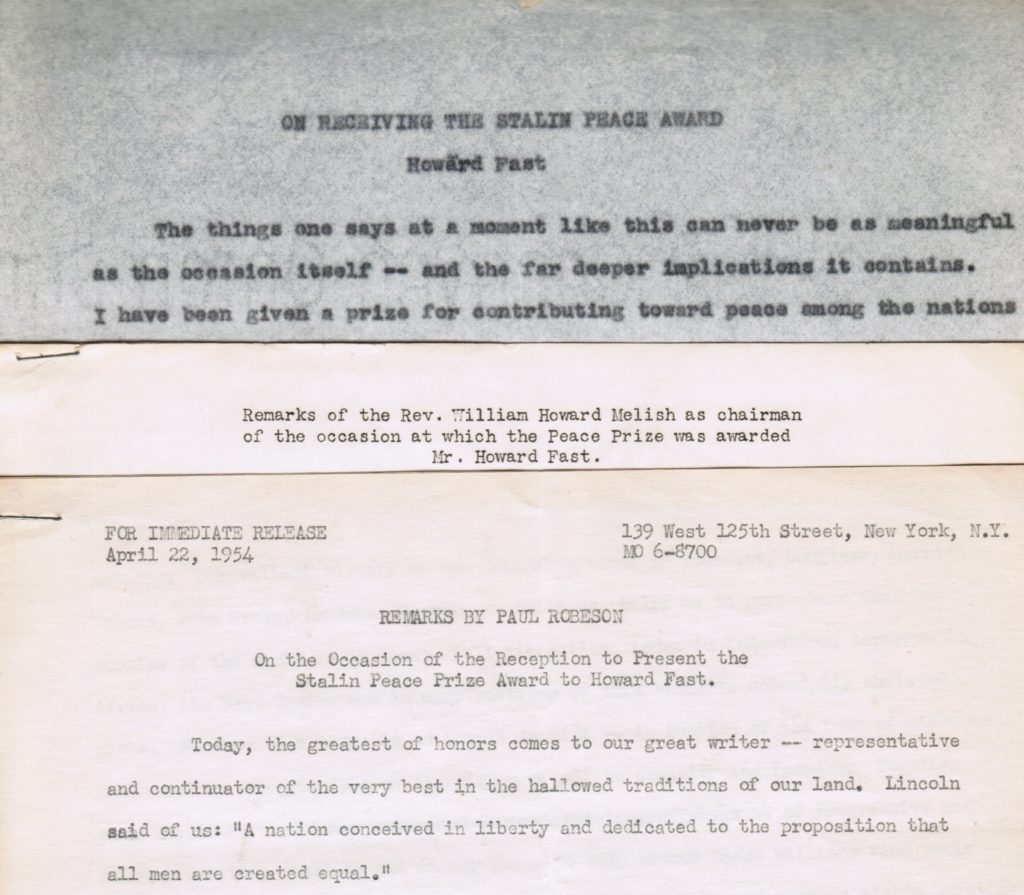
The Museum also preserves typed texts of other speeches delivered that evening. One identifies the remarks of the Rev. William Howard Melish as chairman of the occasion at which the Peace Prize was awarded to Howard Fast. Another records remarks by Paul Robeson delivered at the reception. These documents matter because they show that the evening was not a private exchange or an isolated literary ceremony. It was a structured public event, with a chairman, featured speakers, prepared texts, and a press-style format for circulation.
Melish and Robeson were not incidental figures. Their presence placed the ceremony within a broader world of American activism that combined civil-libertarian, progressive, and explicitly pro-Soviet currents in the early Cold War. The event thus stands not only as a personal honor bestowed on Fast, but also as a revealing moment in the political culture of the American left at a time when Soviet “peace” campaigns sought influence through intellectual prestige and moral rhetoric and could be studied and compared with “peace” campaigns of today.
Fast’s own biography makes the occasion even more significant. He had entered OWI in late 1942 and soon became chief English-language news writer for wartime U.S. government radio broadcasts to Europe. According to his biographer Gerald Sorin, Fast was radicalized by his colleagues at OWI and joined the Communist Party in 1943 while still working there.5 In his memoir Being Red, Fast later admitted that he sought information from the Soviet Embassy in Washington for his wartime broadcasting work and proudly recalled refusing to include material critical of the Soviet Union.6
There is no evidence that Fast was a Soviet spy. But there is ample evidence that he functioned as an effective Soviet agent of influence — a journalist and writer who, whether from conviction, naiveté, or ideological blindness, helped present Stalin’s wartime state in terms favorable to Soviet interests. In that sense, the Stalin Peace Prize was not merely a symbolic decoration. It was recognition, from the Soviet side, of a relationship already proven in practice.
The New York ceremony came after other turning points in Fast’s public life. In 1950, he served a three-month prison sentence after his conviction for contempt of Congress for refusing to provide records of the Joint Anti-Fascist Refugee Committee, which U.S. authorities regarded as a Communist front organization.7 In 1948, he had campaigned for Henry Wallace and denounced anti-communist critics in language his own biographer later described as morally reckless.8 The Stalin Peace Prize ceremony therefore crowned not an isolated gesture, but a decade of public alignment.
The documents preserved by the Museum also help recover something that later memoirs and official institutional histories often blur: the social texture of such events. They remind us that Soviet prestige in the West was not maintained only by agents, party officials, or covert networks. It also depended on ceremonies, speeches, audiences, applause, and a moral vocabulary in which “peace” could be separated from truth. That is what makes these pages valuable as historical evidence. They show not only what was said, but the kind of public world in which it could be said with confidence.
Fast later left the Communist Party after Khrushchev’s revelations about Stalin’s crimes, but he never truly repudiated his wartime role at VOA or his enthusiastic defense of the Soviet cause. He did not return the prize. He did not apologize to the victims of the regimes he had helped excuse. In his 1990 memoir, he remained proud of his refusal to include “anti-Soviet or anti-Communist propaganda” in wartime U.S. broadcasts.9
For that reason, April 22, 1954, deserves to be remembered as more than a footnote in literary or Communist Party history. It is also part of the history of the Voice of America. The former chief writer of one of America’s most important wartime broadcasting services stood in New York and accepted a prize named after Stalin. The Museum’s surviving documents allow that moment to be seen clearly, without euphemism and without forgetting how much was at stake in the words “peace” and “truth” during the Cold War.
NOTES:
- Howard Fast, Being Red (Boston: Houghton Mifflin Company, 1990), 23.
- On the International Stalin Prize for Strengthening Peace Among Peoples, see the general reference at Wikipedia, “Lenin Peace Prize”. For Fast’s own later account, see Howard Fast, Being Red, 318.
- Howard Fast, “On Receiving the Stalin Peace Award,” typed text in the collection of the Cold War Radio Museum / Muzeum Radia Zimnej Wojny im. Stefana i Zofii Korbońskich. A later text version is also reproduced at http://www.trussel.com/hf/plots/t590.htm.
- Howard Fast, “On Receiving the Stalin Peace Award,” http://www.trussel.com/hf/plots/t590.htm.
- Gerald Sorin, Howard Fast: Life and Literature in the Left Lane (Bloomington: Indiana University Press, 2012), 55.
- Howard Fast, Being Red, 18–19, 23.
- The New York Times, “11 ‘Anti-Fascists’ Are Sent to Jail,” June 8, 1950, 1, 11; Gerald Sorin, Howard Fast, 136–142.
- Sorin, Howard Fast, 140, 160; Benn Steil, The World That Wasn’t: Henry Wallace and the Fate of the American Century (New York: Avid Reader Press, 2024), 433–469.
- Howard Fast, Being Red, 23, 318.