
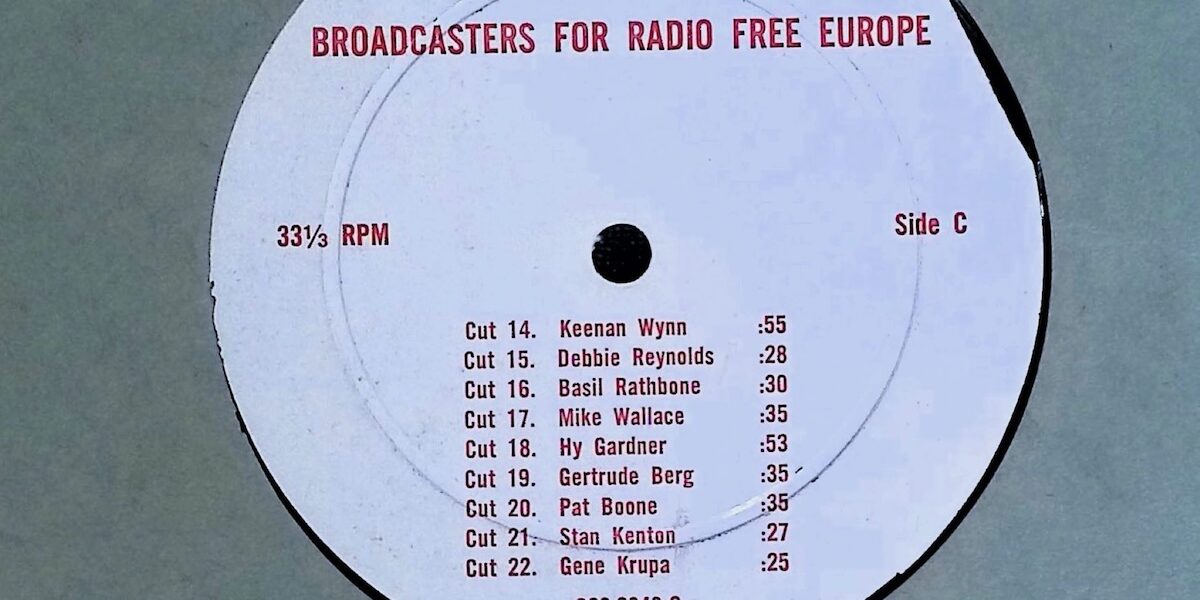
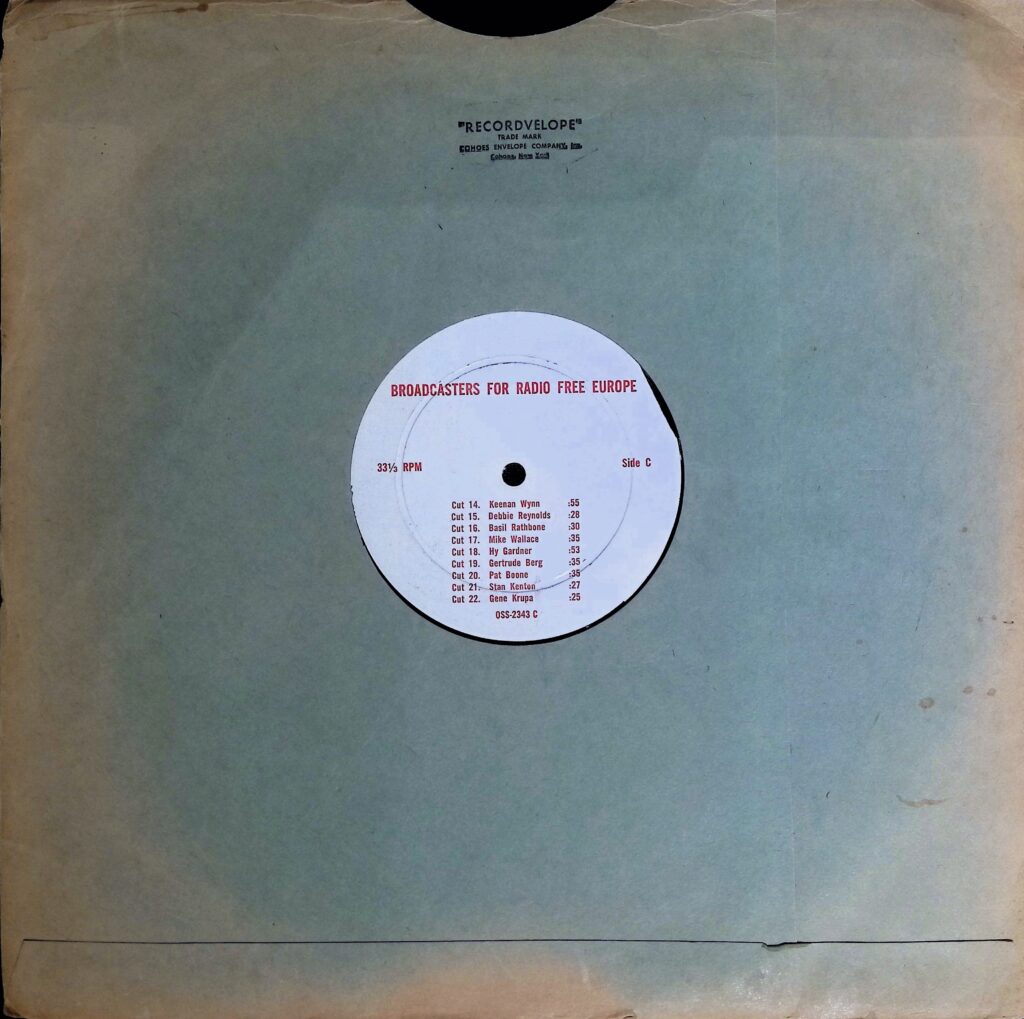
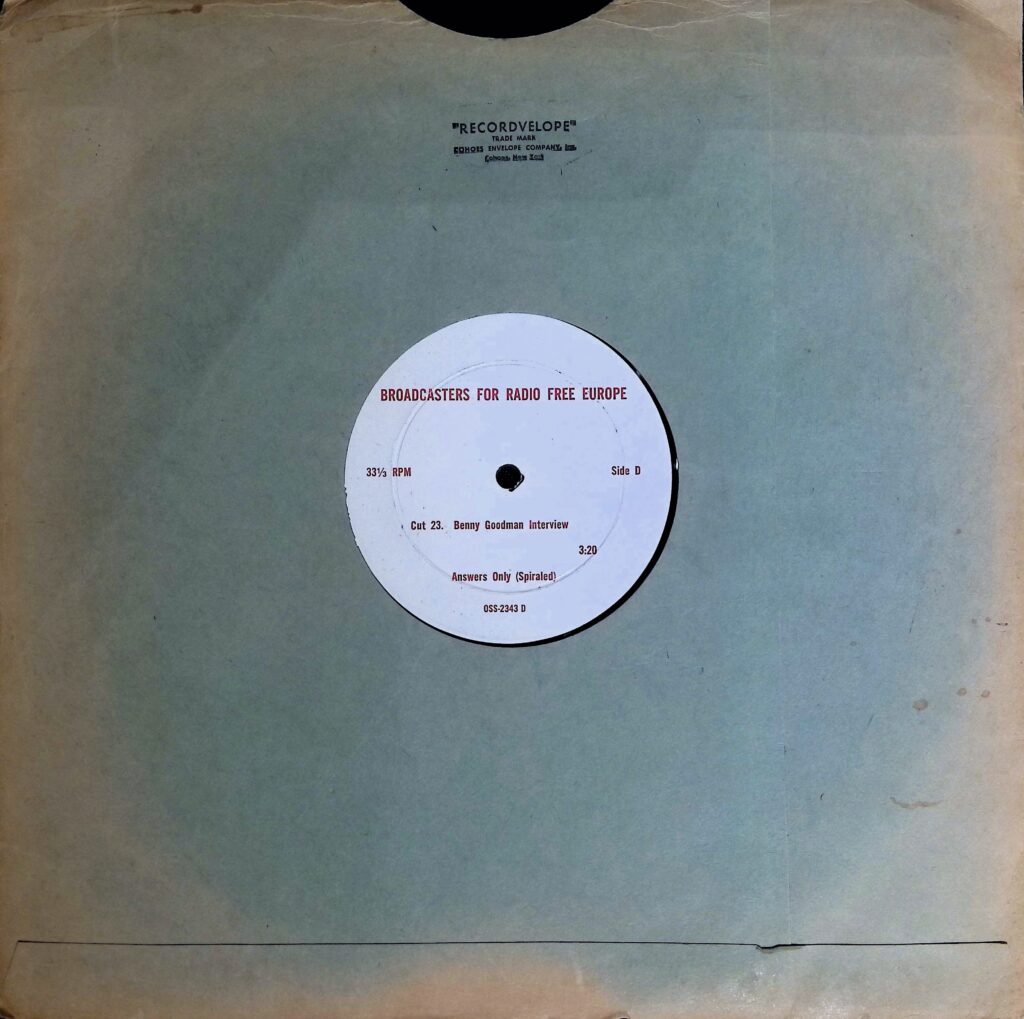
These two images document a 33⅓ RPM transcription disc titled “Broadcasters for Radio Free Europe.” The names listed and the format place it in the late 1950s to early 1960s, during the period when Radio Free Europe (RFE) operated publicly through the Free Europe Fund and the Crusade for Freedom campaign.
The disc contains a sequence of short recorded statements by American actors, journalists, and musicians, followed by a longer segment featuring Benny Goodman. The structure is consistent: each speaker introduces themselves, frames conditions behind the Iron Curtain, and ends with a direct appeal for support.
The Crusade for Freedom Context
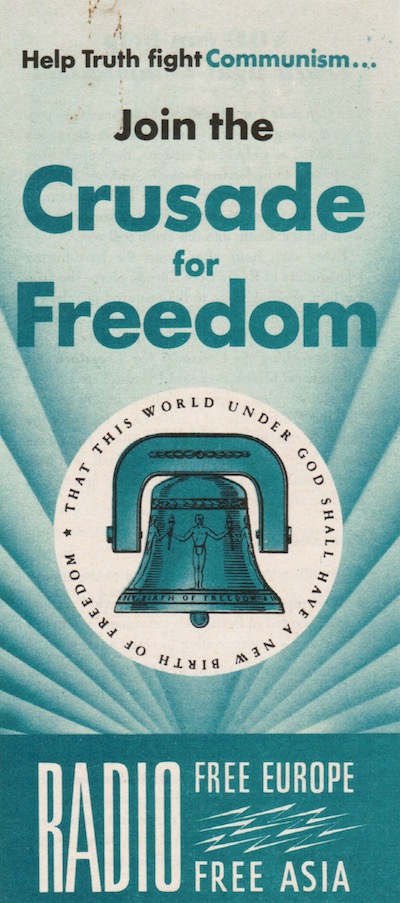
The repeated appeals on this disc refer to the Crusade for Freedom, a major public relations and fundraising campaign launched in the 1950s to build American public support for Radio Free Europe. The campaign presented RFE as a privately supported broadcasting effort, with Americans encouraged to send small donations—often called “truth dollars”—through the Crusade for Freedom.
The public message, however, did not reflect the full funding structure. Private donations helped create visibility, public legitimacy, and political support, but they did not finance RFE operations at scale. For approximately the first two decades of RFE’s existence, the bulk of its funding came secretly from U.S. government appropriations channeled through the CIA. The CIA connection continued until 1971.
In his book, Radio Free Europe’s “Crusade for Freedom”: Rallying Americans Behind Cold War Broadcasting, 1950-1960, Richard H. Cummings—who served as Director of Security for Radio Free Europe/Radio Liberty (RFE/RL) for 15 years beginning in 1980—describes in detail the origins and development of the Crusade for Freedom and its extensive public relations activities. The campaign functioned as a long-running advertising and fundraising effort on behalf of Radio Free Europe, conducted primarily in the United States by the organization known as Crusade for Freedom, Inc. In 1960, the organization was renamed the Radio Free Europe Fund, a name it formally adopted in December 1962.
Cummings wrote:
In the late 1940s, a diverse group of prominent Americans publicly put forth an enterprising agenda to change the American political landscape. Their visions and dedicated efforts resulted in the Crusade for Freedom, which, for more than ten years, was an intense domestic public relations and media campaign. It evolved not only to arouse the “average” American against the Communist threat, real and perceived, but also to morally, politically, and financially support the radio station Radio Free Europe (RFE) in Cold War Germany and, for a few years in the early 1950s, Radio Free Asia (RFA) in San Francisco, California.1
The establishment of Radio Free Europe was presented to the public as a private initiative launched in 1949 by a group of prominent Americans associated with the National Committee for a Free Europe. In fact, RFE was created as a covert U.S. government project, funded through the Central Intelligence Agency. The purpose of the Crusade for Freedom campaign, organized by the National Committee for a Free Europe, was to build public support among Americans for RFE’s mission of broadcasting uncensored news and commentary—via shortwave and medium-wave radio—to countries under communist rule behind the Iron Curtain. As Cummings notes, the campaign was designed not only to raise funds, but also to rally public opinion and increase awareness of the Communist system and Soviet propaganda. In that sense, this disc is best understood as part of the public-facing promotional framework surrounding RFE, rather than as evidence that private donations sustained its operations. Campaigns such as the Crusade for Freedom helped build public awareness and political legitimacy.
The recordings on this disc reflect that purpose closely. They use familiar American voices—actors, journalists, and musicians—to repeat a consistent message: that audiences behind the Iron Curtain lacked access to uncensored information, that Radio Free Europe provided it, and that Americans could support this effort through contributions to the Crusade for Freedom.
The excerpts below illustrate how this message was constructed and repeated across different voices.
The opening segment by Keenan Wynn establishes the central theme: freedom of expression contrasted with censorship.
All of us, as Americans, take this freedom for granted… Radio Free Europe cracks the Iron Curtain every day of the year.
Keenan Wynn (1916–1986)
American character actor in film, radio, and television, known for roles in MGM productions and later Disney films such as Mary Poppins. He was a reliable supporting performer in both dramatic and comedic roles and the son of vaudeville comedian Ed Wynn.
Debbie Reynolds shifts the emphasis slightly, presenting support for Radio Free Europe as an individual civic action:
If you’ve been wondering what you can do to fight Communism from your own home, there is something you can do… support Radio Free Europe.
Audio excerpt – Debbie Reynolds
Debbie Reynolds (1932–2016)
American actress, singer, and dancer best known for her role in Singin’ in the Rain (1952). She maintained a long career in film, television, and live performance and later became active in film preservation and Hollywood history.
The same structure appears in more formal language in the segment by Mike Wallace, who invokes the U.S. Constitution:
The Constitution of the United States says that Congress shall make no law prohibiting the freedom of the press… there is no such provision protecting the people of the satellite countries… for uncensored news, they can turn to Radio Free Europe.
Mike Wallace (1918–2012)
American journalist and broadcaster, widely recognized as a longtime correspondent for CBS’s 60 Minutes. Before that, he worked in radio, advertising, and early television, developing a direct and confrontational interview style.
Other contributors—Hy Gardner and Gertrude Berg—restate the same argument in terms of journalism and broadcasting practice.
Hy Gardner
Sorting out fact from fiction and getting truthful news to the public has been my job for many years… Twenty-eight powerful Radio Free Europe transmitters keep truthful programs and news… flowing.
Hy Gardner (1914–1989)
American journalist, columnist, and radio/television commentator known for his syndicated newspaper column and media appearances. He covered entertainment and public affairs, often combining reporting with commentary.
Gertrude Berg
I’ve played on radio, as you know, for many years, so I know how potent the medium is… Radio Free Europe counters Red propaganda with truth.
Gertrude Berg (1899–1966)
American actress, writer, and producer, best known as the creator and star of The Goldbergs, one of the earliest successful radio and television sitcoms. She played a central role in shaping early American broadcast entertainment.
A different dimension appears in the segments by Stan Kenton and Gene Krupa, where music—especially jazz—is presented as a cultural expression of freedom.
Stan Kenton
The band and I have made many tours of Europe, and we’ve learned that people everywhere like good American jazz… You can help support Radio Free Europe by sending your contribution to the Crusade for Freedom.
Stan Kenton (1911–1979)
American jazz pianist, composer, and bandleader known for leading innovative big bands that experimented with orchestral jazz. His work pushed beyond traditional swing toward more complex arrangements and modern styles.
Gene Krupa
I’ve been beating the drums for quite a few years now and it has taught me two things: one is that a solid beat is a must for a good rhythm section, the other is that good jazz is one of America’s best ambassadors in foreign countries.
Gene Krupa (1909–1973)
American jazz drummer and bandleader, one of the most influential percussionists of the swing era. He helped bring the drum kit to prominence as a solo instrument, notably through performances with Benny Goodman.
The final and longest segment, featuring Benny Goodman, moves beyond a standard appeal. His recorded answers describe experiences touring Europe and the strong demand for American jazz, even where it was restricted. Unlike the shorter scripted segments, Goodman’s remarks are more observational. They connect music, audience interest, and political context, while still reinforcing the role of Radio Free Europe as a channel through which both information and culture reached listeners across the Iron Curtain.
When it comes to music, people everywhere are about the same… Over the years, I’ve learned that you can bring people together with music… even though they can’t understand a word of each other’s language.
Benny Goodman (1909–1986)
American clarinetist and bandleader known as the “King of Swing,” central to the popularization of jazz in the 1930s and 1940s. He also played a role in racial integration in music by leading one of the first prominent integrated jazz ensembles.
Across these segments, the repetition is deliberate. Different voices deliver nearly identical arguments, reinforcing a unified message designed for wide reuse. Taken together, these recordings show a highly standardized production format:
- multiple recognizable voices
- short, reusable segments
- consistent messaging and call to action
- integration of political and cultural themes
This disc does not document broadcasting into Eastern Europe directly. Instead, it captures how Radio Free Europe presented itself to American audiences—as a privately supported effort to transmit truth and maintain connections across closed borders.
Its value lies precisely in that function. It is a small but clear example of how Cold War broadcasting combined fundraising language, cultural figures, and political messaging within a single production designed for repeated use.
TRANSCRIPT NOTE
Transcript (Selected Excerpts)
The full transcript is not reproduced here. Short excerpts above illustrate the recurring structure and messaging of the recordings. The record also includes statements by additional well-known figures whose segments follow the same general structure but are not reproduced here in audio form. Their messages reinforce the central themes of the compilation—restricted access to information behind the Iron Curtain, the role of Radio Free Europe, and the call for public support through the Crusade for Freedom.
Basil Rathbone (1892–1967), a classically trained stage actor best known to film audiences as Sherlock Holmes, delivers a message that closely follows the standard Crusade for Freedom message structure. He emphasizes the isolation of audiences behind the Iron Curtain, describing them as “trapped and disheartened” and exposed only to official propaganda. His appeal rests on a simple premise: that truthful information, even when restricted, can prevail. He concludes by urging support for Radio Free Europe as a means of ensuring that alternative sources of information continue to reach those audiences.
Pat Boone (b. 1934), one of the most popular American singers of the 1950s, frames his message in more direct and accessible terms. He stresses that “freedom is not free” and points to the demand for outside news among listeners in Eastern Europe who hear only Soviet-controlled broadcasts. His segment highlights the practical cost of maintaining Radio Free Europe transmissions and repeats the campaign’s central claim that these broadcasts depend on contributions from ordinary Americans, reinforcing the idea of shared responsibility.
Conclusion
Radio Free Europe began broadcasting on July 4, 1950, with a program directed to Czechoslovakia. Transmissions to other Soviet Bloc countries were added soon afterward and quickly attracted large audiences across East Central Europe.
In the early 1950s, the Crusade for Freedom also organized balloon campaigns that carried millions of anti-communist leaflets across the Iron Curtain. When communist governments in Czechoslovakia and Hungary protested, the U.S. State Department responded that both the radio broadcasts and the leaflet operations were conducted by a private organization and that neither the U.S. government nor U.S. authorities in West Germany were involved.2
This public explanation did not reflect the underlying reality of U.S. government involvement, but it needs to be understood in the context of the time. Media conditions in the Soviet Bloc were defined by pervasive censorship, limited access to outside information, and strict state control over communication. There were no alternative channels comparable to today’s digital networks. Transnational broadcasting required substantial resources and was not commercially viable for private actors. In that environment, government-funded “surrogate” broadcasting—standing in for independent domestic media—was seen in Washington as both necessary and effective. A 1951 Crusade for Freedom fact sheet explicitly noted that Radio Free Europe was “not restricted by the ethics of diplomacy which effect (sic) Voice of America.”3
Under CIA oversight, Radio Free Europe and later Radio Liberty journalists generally operated with a degree of editorial flexibility that often exceeded that of the Voice of America (VOA), the official U.S. international broadcaster. During World War II, VOA had reflected aspects of Allied wartime messaging, including Soviet narratives, and in the immediate postwar period, when it was under the State Department, it exercised caution in reporting on issues likely to complicate diplomatic relations, including the Katyn massacre. VOA promoted during the war the Soviet propaganda lie that the Germans were responsible for murdering in Katyn thousands of Polish military officers and intellectual leaders.4
A large majority of journalists working on Polish desks at the Office of War Information and the Voice of America who had any prior visibility in the political or cultural life of prewar Poland were individuals with strongly left-leaning views, many of whom later supported—and in numerous cases joined—the Soviet-backed, communist-dominated government established in Poland after the war.5 By the early 1950s, however, pro-Soviet VOA broadcasters had been forced out or left and restrictions on truthful reporting about communism and Soviet Russia were reduced following congressional criticism and internal reforms.
Tensions between policy guidance and editorial independence did not disappear entirely. At various points in later decades, VOA management limited the treatment of certain topics, including restrictions in the 1970s on reading extended excerpts from works by Soviet dissident Aleksandr Solzhenitsyn. By contrast, Radio Free Europe and Radio Liberty, based in Munich, were generally less constrained by diplomatic considerations and maintained consistent coverage of subjects such as Katyn and Soviet repression. At the same time, their journalists operated within the broader framework of U.S. Cold War objectives.
Before the public disclosure of CIA funding in the early 1970s, many Americans were led by Crusade for Freedom and Free Europe Fund campaigns to believe that the stations were financed primarily through private contributions. Policymakers viewed this presentation as useful: it reinforced the credibility of the broadcasts, allowed the stations to reject criticism from communist governments, and supported a more direct tone in their programming. In the longer term, however, the gap between public messaging and actual funding proved difficult to sustain and was eventually addressed through a transition to openly acknowledged U.S. government support.
NOTES:
- Richard H. Cummings, Radio Free Europe’s “Crusade for Freedom”: Rallying Americans Behind Cold War Broadcasting , 1950-1960 (Jefferson, NC and London: McFarland & Company, 2010), 1.
- Robert T. Holt, Radio Free Europe (Minneapolis: University of Minnesota Press, 1958), 7.
- Crusade for Freedom, Regional Office in Chicago, “Fact Sheet” in the Cold War Radio Museum collection.
- Cold War Radio Museum, “Voice of America and Soviet “Democracy”: How VOA Journalists Helped Establish Communist Regimes,” April 21, 2026, https://www.coldwarradiomuseum.com/voice-of-america-and-soviet-democracy-how-voa-journalists-helped-establish-communist-regimes/.
- The Cold War Radio Museum has not found a complete list of Polish-speaking journalists employed by the Coordinator of Information (COI), the Office of War Information, and the Voice of America unit within OWI. However, among the best-known figures whose biographies and employment histories have been documented, nearly all supported the postwar communist regime in Poland. Polish-American journalist Alina Żerańska, a VOA freelance writer during the Cold War, described the first Polish Service team as “poorly-qualified” producers of “mediocre” programs who, shortly after the war, returned to Poland to serve the communist regime. “Pierwsze audycje sekcji polskiej były marne. Dostały się tam wtedy jakieś mało wykwalifikowane osoby, które wnet po wojnie wróciły do kraju.” Alina Żerańska, “50 Lat Głosu Ameryki,” Nowy Dziennik: Przegląd Polski, April 30, 1992, Section 2.