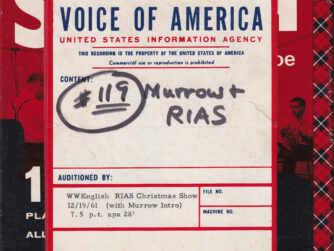

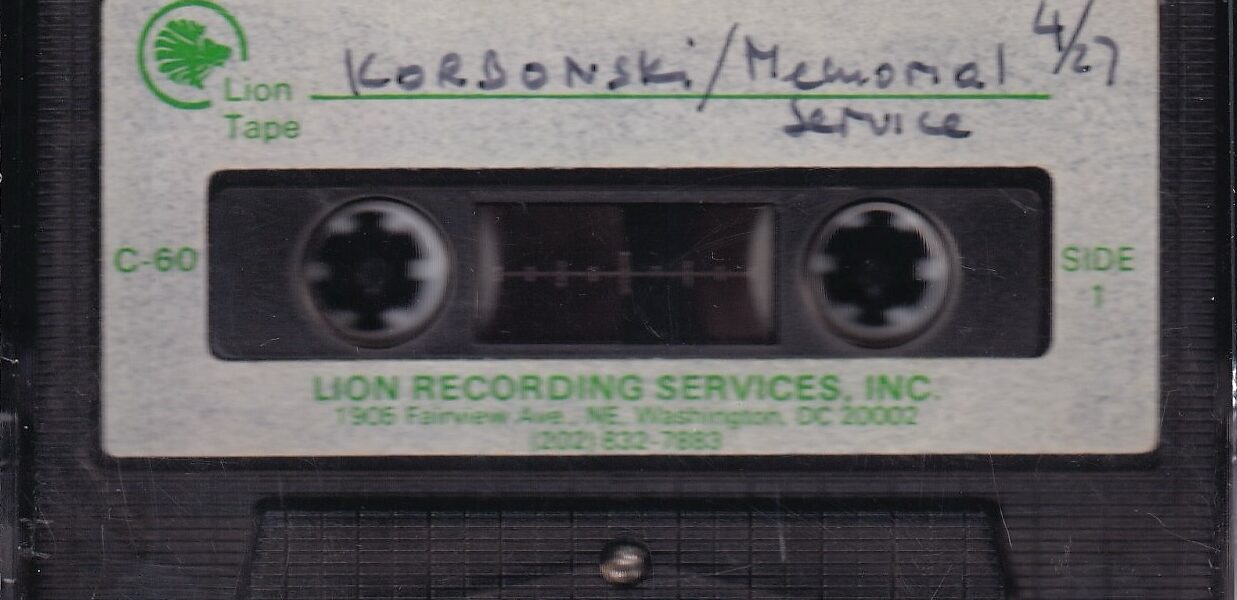
An archival audio cassette preserving a fragment of the funeral service for Stefan Korboński in Washington, D.C., in 1989, forms part of the documentary record of the Polish émigré community and its media institutions in the West.
The recording presented here is one of the few surviving audio traces of the memorial Mass held on April 27, 1989, for Stefan Korboński. During World War II, he served as head of the Directorate of Civil Resistance of the Polish Underground State, coordinating non-military resistance to German occupation. After 1945, he opposed the establishment of Soviet-backed communist rule in Poland and was forced into exile.
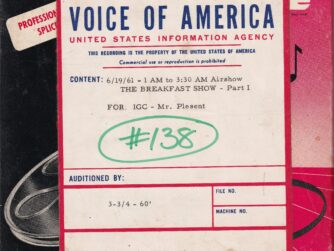
The cassette contains a brief excerpt of remarks and the voices of those gathered singing “Boże, coś Polskę” (“God, Thou Who Through So Many Ages”) followed by the Polish national anthem. The preserved fragment, lasting 6 minutes and 47 seconds, appears to be part of a longer recording used by the Voice of America Polish Service to produce a radio report.
Audio fragment from the funeral service for Stefan Korboński, Washington, D.C. (April 27, 1989)
From the collection of the Cold War Radio Museum / Muzeum Radia Zimnej Wojny im. Stefana i Zofii Korbońskich
Artist: Unknown (likely a reporter of the Voice of America Polish Service)
Direct audio link (alternative): Play recording (if the player does not work)
The author of the recording remains unidentified, but it was most likely made by a Voice of America Polish Service reporter. The speaker delivering the farewell remarks has also not been identified. The preserved words reflect both military and intellectual traditions of the Polish resistance:
Knight of the Order of Polonia Restituta.
Knight of the Virtuti Militari, I bid you farewell in the name of soldiers.
Laureate of the Jurzykowski Award,I bid you farewell in the name of writers.
I bid you farewell as one of the few remaining officers of the Home Army High Command, to which you also belonged.
Farewell, Stefan.
The service was attended by Zofia Korbońska, his wife and a distinguished figure in her own right, as well as by friends, colleagues, and members of the Polish émigré community. Among them were journalists from the Voice of America and Radio Free Europe, institutions through which the Korbońskis continued their lifelong commitment to truth and independent information after being forced into exile.
The Voice of America hired Zofia Korbońska for its Polish Service in 1948 on the recommendation of former U.S. Ambassador to Poland Arthur Bliss Lane. Lane, who that same year published his memoir I Saw Poland Betrayed, was among prominent Americans who supported the Truman administration’s efforts to reform U.S. international broadcasting by replacing personnel associated with pro-Soviet and pro-communist viewpoints—many of whom had been recruited during World War II under the Roosevelt administration.
Korbońska worked first in New York and later in Washington, D.C., using the pen names “Zofia Zielińska” and later “Zofia Orłowska” to protect her family and friends in Poland. Before she joined VOA, a significant proportion of the better-known Polish-speaking broadcasters employed during the war—and in some cases for several years afterward—held strongly left-leaning views. Many later supported—and in numerous cases joined—the Soviet-backed, communist-dominated government established by Stalin in Poland after the war.1
Korbońska continued to serve the Voice of America for more than three decades, writing and recording occasional programs into the 1980s, even after her formal retirement.
During the Cold War, Stefan Korboński served twice as chairman of the Assembly of Captive European Nations (ACEN). Through his books, articles, letters to Western editors, and appearances on Radio Free Europe and Voice of America programs, he sought to correct distortions of history and contemporary affairs. Zofia Korbońska performed a similar function at the Voice of America—as a writer, editor, and program host for the Polish Service, to the extent possible within a U.S. government broadcasting organization. She also assisted in proofreading her husband’s publications.
Stefan Korboński received the Alfred Jurzykowski Prize in 1973 from the New York-based foundation and, in 1980, was honored by the Yad Vashem Institute with the title Righteous Among the Nations medal.
Historical Context for American Readers
To American audiences, the Korbońskis may be less widely known, yet their story is deeply intertwined with the history of World War II and the Cold War.
- Stefan Korboński (1901–1989) was a key leader of the Polish Underground State—the largest and most sophisticated resistance structure in Nazi-occupied Europe.
- Zofia Korbońska (1912–2010) risked her life transmitting coded radio messages from occupied Poland to the Polish government-in-exile in London. Her reports brought some of the earliest news of Nazi atrocities to the outside world.
- After the war, both were arrested by the Soviet NKVD and later escaped communist-controlled Poland, eventually settling in the United States.
- In exile, Zofia Korbońska worked for the Voice of America, continuing to provide uncensored news to audiences behind the Iron Curtain.
Their lives illustrate a continuity of mission—from underground resistance, to exile, to Cold War broadcasting—linking wartime clandestine communication with later efforts to counter censorship and propaganda through radio.
Portrait of Stefan and Zofia Korboński (1981)
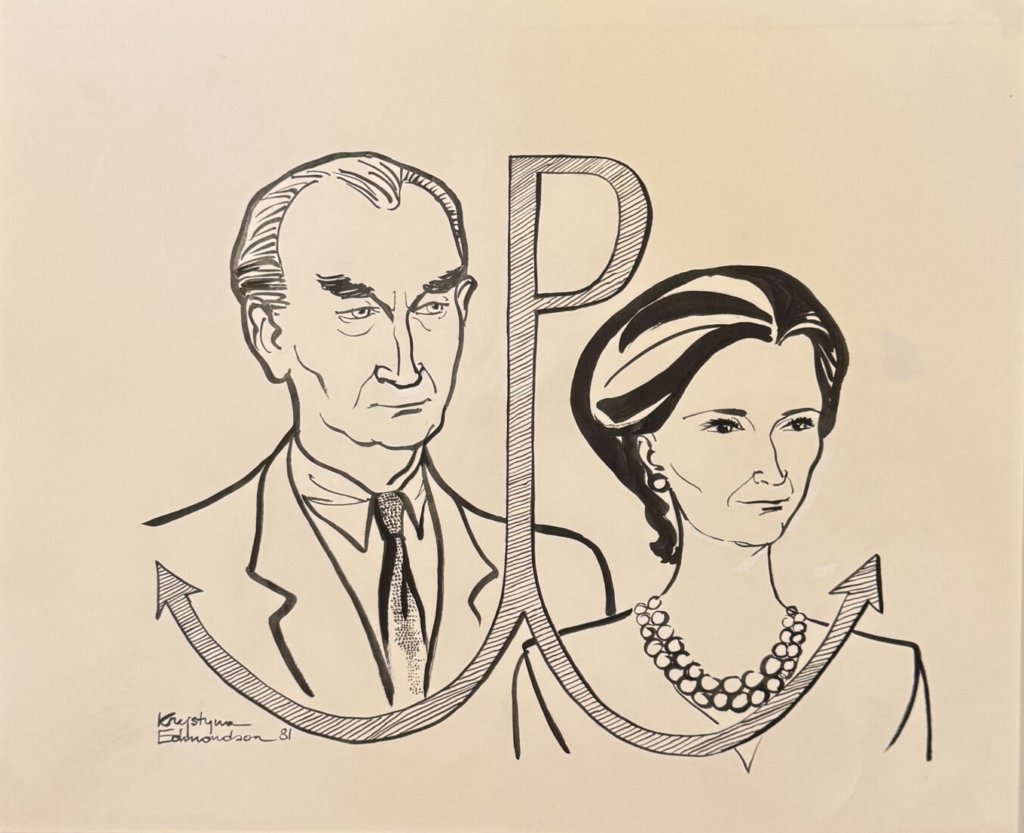
This portrait depicts one of the most recognizable couples of the Polish independence émigré community. The symbol of “Polska Walcząca” (the “Fighting Poland” anchor), incorporated between the figures, evokes their service in the wartime underground and their enduring commitment to Poland’s independence.
Source: Marek Walicki Collection, Cold War Radio Museum / Muzeum Radia Zimnej Wojny im. Stefana i Zofii Korbońskich.
Personal Note
For the author of this post, the recording carries a deeply personal meaning. Stefan and Zofia Korbońscy were not only colleagues and friends, but also the godparents of his daughter. What connected them was a shared commitment—to truth, to free media, and to an independent Poland.
Conclusion
The recording presented here is brief and fragmentary. Yet it remains a valuable historical artifact—a rare auditory witness to a moment of remembrance for a man who belonged to a generation for whom words carried weight, responsibility, and consequence.
In its simplicity, the recording preserves not only a farewell, but also a continuity of memory: from wartime resistance, through exile, to the final years of the Cold War.
NOTES:
- The Cold War Radio Museum has not found a complete list of Polish-speaking journalists employed by the Coordinator of Information (COI), the Office of War Information (OWI), and the Voice of America unit within OWI. However, among the best-documented figures whose biographies and employment histories are known, the majority supported the postwar communist regime in Poland. Polish-American journalist Alina Żerańska, a VOA freelance writer during the Cold War, described the first Polish Service team as “poorly qualified” producers of “mediocre” programs who, shortly after the war, returned to Poland to serve the communist regime. (“Pierwsze audycje sekcji polskiej były marne. Dostały się tam wtedy jakieś mało wykwalifikowane osoby, które wnet po wojnie wróciły do kraju.”) Alina Żerańska, “50 Lat Głosu Ameryki,” Nowy Dziennik: Przegląd Polski, April 30, 1992, Section 2.